Transcription of AN INTRODUCTION TO MECHANICS
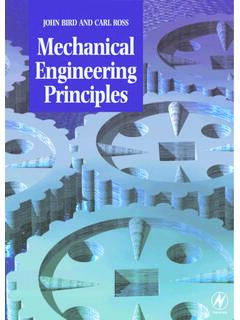
1 An INTRODUCTION to MechanicsFor 40 years, Kleppner and Kolenkow s classic text has introduced stu-dents to the principles of MECHANICS . Now brought up-to-date, this re-vised and improved Second Edition is ideal for classical mechanicscourses for first- and second-year undergraduates with foundation skillsin book retains all the features of the first edition, including numer-ous worked examples, challenging problems, and extensive illustrations,and has been restructured to improve the flow of ideas. It now features New examples taken from recent developments, such as laser slowingof atoms, exoplanets, and black holes A Hints, Clues, and Answers section for the end-of- chapter prob-lems to support student learning A solutions manual for instructors at kleppneris Lester Wolfe Professor of Physics, Emeritus, atMassachusetts Institute of Technology.
2 For his contributions to teachinghe has been awarded the Oersted Medal by the American Associationof Physics Teachers and the Lilienfeld Prize of the American PhysicalSociety. He has also received the Wolf Prize in Physics and the NationalMedal of kolenkowwas Associate Professor of Physics at Mas-sachusetts Institute of Technology. Renowned for his skills as a teacher,Kolenkow was awarded the Everett Moore Baker Award for KleppnerRobert KolenkowSECOND EDITIONU niversity Printing House, Cambridge CB2 8BS, United KingdomCambridge University Press is a part of the University of furthers the University s mission by disseminating knowledge in the pursuit ofeducation, learning and research at the highest international levels of on this D. Kleppner and R. Kolenkow 2014 This edition is not for sale in publication is in copyright. Subject to statutory exceptionand to the provisions of relevant collective licensing agreements,no reproduction of any part may take place without the writtenpermission of Cambridge University edition previously published by McGraw-Hill Education 1973 First published by Cambridge University Press 2010 Reprinted 2012 Second edition published by Cambridge University Press 2014 Printed in the United States by Sheridan catalogue record for this publication is available from the British LibraryISBN 978-0-521-19811-0 HardbackAdditional resources for this publication at University Press has no responsibility for the persistence or accuracy ofURLs for external or third-party internet websites referred to in this publication,and does not guarantee that any content on such websites is, or will remain.
3 Accurate or THE TEACHERxvLIST OF EXAMPLES xvii1 VECTORS AND The Algebra of Multiplying Components of a Base The Position Vectorrand Velocity and Formal Solution of Kinematical More about the Time Derivative of a Motion in Plane Polar Coordinates26 Note Approximation Methods36 Note The Taylor Series37 Note Series Expansions of Some CommonFunctions38 Note Differentials39 Note Significant Figures and ExperimentalUncertainty40 Problems41viCONTENTS2 NEWTON Newtonian MECHANICS and Modern Newton s Newton s First Law and Inertial Newton s Second Newton s Third Base Units and Physical The Algebra of Applying Newton s Dynamics Using Polar Coordinates72 Problems773 FORCES AND EQUATIONS OF The Fundamental Forces of Some Phenomenological A Digression on Differential Hooke s Law and Simple Harmonic Motion102 Note The Gravitational Force of a Spherical Dynamics of a System of Center of Center of Mass Conservation of impulse and a Restatement of the momentum and the Flow of Rocket momentum Flow and momentum Flux145 Note Center of Mass of Two- andThree-dimensional Integrating Equations of Motion in One Work and The Conservation of Mechanical Potential What Potential Energy Tells Us about Energy Non-conservative Energy Conservation and the Ideal Gas Conservation World Energy Usage194 Note Correction to the Period of a Pendulum199 Note Force, Potential Energy.
4 And the VectorOperator 200 Problems2056 TOPICS IN Small Oscillations in a Bound Normal Collisions and Conservation Laws225 Problems2337 ANGULAR momentum AND FIXED AXIS Angular momentum of a Fixed Axis Torque and Angular Dynamics of Fixed Axis Pendulum Motion and Fixed Axis Motion Involving Translation and The Work Energy Theorem and The Bohr Atom277 Note Chasles Theorem280 Note A Summary of the Dynamics of Fixed AxisRotation282 Problems2828 RIGID BODY The Vector Nature of Angular Velocity andAngular The Examples of Rigid Body Conservation of Angular Rigid Body Rotation and the Tensor of Advanced Topics in Rigid Body Dynamics320 Note Finite and Infinitesimal Rotations329 Note More about Gyroscopes331 Problems337viiiCONTENTS9 NON-INERTIAL SYSTEMS AND FICTITIOUS Galilean Uniformly Accelerating The Principle of Physics in a Rotating Coordinate System356 Note The Equivalence Principle and theGravitational Red Shift368 Problems37010 CENTRAL FORCE Central Force Motion as a One-body Universal Features of Central Force The Energy Equation and Energy Planetary Some Concluding Comments on PlanetaryMotion402 Note Integrating the Orbit Integral403 Note Properties of the Ellipse405 Problems40711 THE HARMONIC Simple Harmonic Motion.
5 The Damped Harmonic The Driven Harmonic Transient Response in Time and Response in Frequency427 Note Complex Numbers430 Note Solving the Equation of Motion for theDamped Oscillator431 Note Solving the Equation of Motion for theDriven Harmonic Oscillator434 Problems43512 THE SPECIAL THEORY OF The Possibility of Flaws in Newtonian The Michelson Morley The Special Theory of Simultaneity and the Order of The Lorentz Relativistic The Relativistic Addition of The Doppler The Twin Paradox470 Problems47213 RELATIVISTIC Relativistic Relativistic How Relativistic Energy and Momentumare The Photon: A Massless How Einstein DerivedE=mc2498 Problems49914 SPACETIME Vector World Lines in An Invariant in The Energy momentum Epilogue: General Relativity513 Problems515 HINTS, CLUES, AND ANSWERS TO SELECTEDPROBLEMS519 APPENDIX A MISCELLANEOUS PHYSICAL ANDASTRONOMICAL DATA527 APPENDIX B GREEK ALPHABET529 APPENDIX C SI PREFIXES531 INDEX533 PREFACEAn INTRODUCTION to Mechanicsgrew out of a one-semester course at theMassachusetts Institute of Technology Physics intended forstudents who seek to understand physics more deeply than the usualfreshman level.
6 In the four decades since this text was written physicshas moved forward on many fronts but MECHANICS continues to be abedrock for concepts such as inertia, momentum , and energy; fluencyin the physicist s approach to problem-solving an underlying theme ofthis book remains priceless. The positive comments we have receivedover the years from students, some of whom are now well advanced intheir careers, as well as from faculty at and elsewhere, reassuresus that the approach of the text is fundamentally sound. We have receivedmany suggestions from colleagues and we have taken this opportunity toincorporate their ideas and to update some of the assume that our readers know enough elementary calculus to dif-ferentiate and integrate simple polynomials and trigonometric do not assume any familiarity with differential equations. Our expe-rience is that the principal challenge for most students is not with un-derstanding mathematical concepts but in learning how to apply them tophysical problems.
7 This comes with practice and there is no substitutefor solving challenging problems. Consequently problem-solving takeshigh priority. We have provided numerous worked examples to help pro-vide guidance. Where possible we try to tie the examples to interestingphysical phenomena but we are unapologetic about totally pedagogicalproblems. A block sliding down a plane is sometimes mocked as thequintessentially dull physics problem but if one allows the plane to ac-celerate, the system takes on a new problems in the first edition have challenged, instructed, and occa-sionally frustrated generations of physicists. Some former students havevolunteered that working these problems gave them the confidence topursue careers in science. Consequently, most of the problems in thefirst edition have been retained and a number of new problems have beenadded. We continue to respect the wisdom of Piet Hein s aphoristic ditty1 Problems worthy of attack,Prove their worth by hitting addition to this inspirational thought, we offer students a few prac-tical suggestions: The problems are meant to be worked with pencil andpaper.
8 They generally require symbolic solutions: numerical values, ifneeded, come last. Only by looking at a symbolic solution can one de-cide if an answer is reasonable. Diagrams are helpful. Hints and answersare given for some of the problems. We have not included solutions inthe book because checking one s approach before making the maximumeffort is often irresistible. Working in groups can be instructional for allparties. A separate solutions manual with restricted distribution is how-ever available from Cambridge University revolutionary advances in physics that postdate the first editiondeserve mention. The first is the discovery, more accurately the rediscov-ery, of chaos in the 1970 s and the subsequent emergence of chaos the-ory as a vital branch of dynamics. Because we could not discuss chaosmeaningfully within a manageable length, we have not attempted to dealwith it.
9 On the other hand, it would have been intellectually dishonest topresent evidence for the astounding accuracy of Kepler s laws withoutmentioning that the solar system is chaotic, though with a time-scale toolong to be observable, and so we have duly noted the existence of second revolutionary advance is the electronic computer. Compu-tational physics is now a well-established discipline and some level ofcomputational fluency is among the physicist s standard tools. Never-theless, we have elected not to include computational problems becausethey are not essential for understanding the concepts of the book, andbecause they have a seductive way of consuming is a summary of the second edition: The first chapter is a math-ematical INTRODUCTION to vectors and kinematics. Vector notation is stan-dard not only in the text but throughout physics and so we take somecare to explain it.
10 Translational motion is naturally described using fa-miliar Cartesian coordinates. Rotational motion is equally important butits natural coordinates are not nearly as familiar. Consequently, we putspecial emphasis on kinematics using polar coordinates. chapter 2 in-troduces Newton s laws starting with the decidedly non-trivial conceptof inertial systems. This chapter has been converted into two, the first( chapter 2) discussing principles and the second ( chapter 3) devotedto applying these to various physical systems. chapter 4 introducesthe concepts of momentum , momentum flux, and the conservation of1 FromGrooks 1by Piet Hein, copyrighted 1966, The chapter 5 introduces the concepts of kinetic energy, po-tential energy, and the conservation of energy, including heat and otherforms. chapter 6 applies the preceding ideas to phenomena of general in-terest in MECHANICS : small oscillations, stability, coupled oscillators andnormal modes, and collisions.