Transcription of ANCHOR BOLTS A. Bolt and Nut Standards …
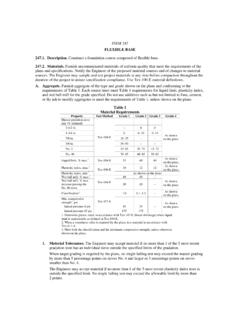
1 ITEM 449 ANCHOR BOLTS Description. Fabricate and install ANCHOR BOLTS to be embedded in or attached to concrete. Materials. A. BOLTS and Nuts. Provide BOLTS and nuts that meet the Standards given in Table 1. Table 1 bolt and Nut Standards Specified ANCHOR bolt Category bolt Standards Nut Standards Mild steel ASTM A 307 Gr. A or A 36 ASTM A 563 Medium-strength, mild steel ASTM F 1554 Gr. 55 with supplementary requirement S1 ASTM A 194 Gr. 2H or A 563 Gr. D or better High-strength steel ASTM A 325 or A 321 ASTM A 194 or A 563, heavy hex Alloy steel ASTM A 193 Gr.
2 B7 ASTM A 194 Gr. 2H or A 563 Gr. DH, heavy hex Provide a mill test report or manufacturer s certification indicating that the material conforms to these requirements. For alloy steel ANCHOR BOLTS , provide a test report or certification attesting to the heat treating process. If no specific bolt category is indicated on the plans, provide mild steel ANCHOR BOLTS with nuts that meet ASTM A 563. B. Washers. Use washers that meet ASTM F 436. C. Threads. Provide ANCHOR BOLTS with rolled or cut threads of UNC or 8UN series in accordance with ASME ANCHOR BOLTS larger than 2 in.
3 In diameter must have UNC series threads. If BOLTS have rolled threads, ensure that the diameter of the unthreaded portion is neither less than the minimum pitch diameter nor more than the maximum major diameter of the threads. If BOLTS have cut threads, ensure that the diameter of the unthreaded portion is not less than the minimum major diameter of the threads. Ensure that all threads for BOLTS and nuts have Class 2 fit tolerances in accordance with ASME Construction. A. Fabrication. Welded splicing of ANCHOR BOLTS is not permitted.
4 Provide an anchorage device with each ANCHOR bolt consisting of a standard bolt head, a threaded bolt with nut, or, if shown on the plans, a 90 bend. Make the inside-bend diameter approximately 2 times the ANCHOR bolt diameter, but at no point along the bend greater than 3 times the bolt diameter. Hot bending is permissible provided the temperature does not exceed 1,100 F. If the ANCHOR BOLTS will be installed in a template embedded in concrete, tack-weld the anchorage nuts to the template in the shop. Perform this welding with appropriate jigs to ensure that the ANCHOR bolt is perpendicular to the template.
5 When embedded templates are not specified and nuts are welded to the end of ANCHOR BOLTS for anchorage, weld only on the nut face at the unstressed end of the bolt . Ensure that no welding, arc, or other potential notch-producing effects occur in the stressed portion of the bolt . Shipping of the ANCHOR bolt cage in its assembled condition is not required. B. Finish. Galvanize in accordance with Item 445, Galvanizing. 1. ANCHOR BOLTS Embedded in Concrete. Galvanize the exposed end plus a minimum of 6 in., unless otherwise shown on the plans.
6 2. ANCHOR BOLTS Extending Through Concrete. Galvanize the complete length of the bolt . 3. Nuts. Galvanize exposed nuts. Galvanize the untapped blanks before cutting the threads. 4. Washers. Galvanize exposed washers. C. Installation. Hold the ANCHOR bolt and template assembly rigidly in position during concrete placement. Use wood templates or other positive means to ensure correct positioning of ANCHOR BOLTS not requiring steel templates. Positioning devices may be tack-welded to the steel templates but not to any portion of the ANCHOR BOLTS .
7 1. ANCHOR bolt Thread Lubricant Coating. For traffic signal poles, roadway illumination poles, high mast illumination poles, and overhead sign support structures, coat ANCHOR bolt threads before installing nuts with an electrically conducting lubricant compound described in Section , Definitions. Coat ANCHOR bolt threads for other structures with pipe joint compound or beeswax. After installing nuts, repair galvanizing damage on BOLTS , nuts, and washers in accordance with Section , Repairs. 2. ANCHOR bolt Tightening Procedure.
8 Tighten ANCHOR BOLTS for traffic signal poles, roadway illumination poles with shoe bases, high mast illumination poles, and overhead sign support structures in accordance with this Section. This procedure covers the tightening of nuts on a double-nut ANCHOR bolt system using ANCHOR BOLTS with 55-ksi or 105-ksi minimum yield strength and UNC or 8UN thread series to secure structures to drilled shaft foundations. a. Definitions. The following definitions apply to the ANCHOR bolt tightening procedure: Double-nut ANCHOR bolt system.
9 An ANCHOR bolt with 2 nuts that sandwich the structure s base plate. The bottom nut is positioned under the base plate to level, support, and provide the reaction for the force applied by tightening the top nut positioned above the base plate. Electrically conducting lubricant. A compound commonly used in the electrical industry to coat threads of field-cut rigid metal conduit and suitable for exposure to weather. Impact tightening. The tightening of nuts with a box end slug or knocker wrench and a sledgehammer.
10 The wrench, matching the size of the nut to be tightened, is driven with the sledgehammer to rotate the nut. Static tightening. The tightening of nuts with a spud wrench and a pipe or extension handle. The wrench, matching the size of the nut to be tightened, may be turned with more than one worker to rotate the nut. Snug-tight. The condition when the nut is in full contact with the base plate. It may be assumed that the full effort of a worker on a 12-in. wrench results in a snug-tight condition. Turn-of-the-nut method.