Example: confidence
and 6th Class - Stay Safe
The Stay Safe programme is a personal safety skills programme for primary schools. The aim of the programme is to reduce vulnerability to child abuse and bullying through the provision of personal safety education for children and training for teachers, school management boards and parents. It is developmentally structured to enable primary school
Tags:
Information
Domain:
Source:
Link to this page:
Documents from same domain
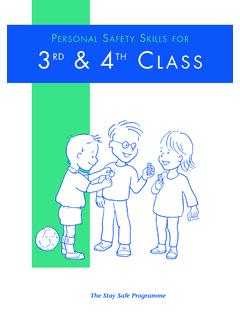
P SKILLS FOR 3RD & 4TH CLASS - Stay Safe
www.staysafe.ie1 INTRODUCTION The Stay Safe lessons for 3rd and 4th classes set out to develop children’s personal safety skills further. As children become more independent, their
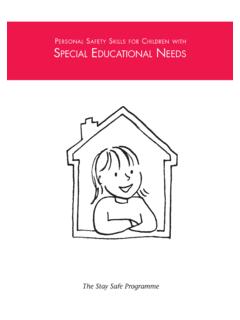
PERSONAL SAFETY SKILLS FOR C SPECIAL …
www.staysafe.ieThis handbook is designed to assist teachers in introducing personal safety skills to children with special educational needs. Depending on the nature
4th Class - Stay Safe
www.staysafe.ieTEACHER’S IDE 1 The Stay Safe programme is a personal safety skills programme for primary schools. The aim of the programme is to reduce vulnerability to child abuse
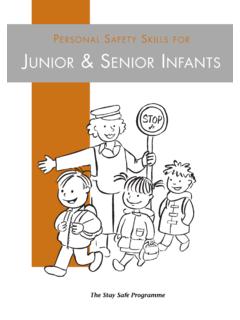
P S JUNIOR & S ENIOR INFANTS - Stay Safe
www.staysafe.ieThe Stay Safe Programme PERSONAL SAFETY SKILLS FOR JUNIOR & S ENIOR INFANTS
Stay Safe
www.staysafe.ie“TEACHERS ARE PARTICULARLY WELL PLACED to observe and monitor children for signs of abuse. They are the main care givers to children outside the family context and have regular contact with children in the school setting.
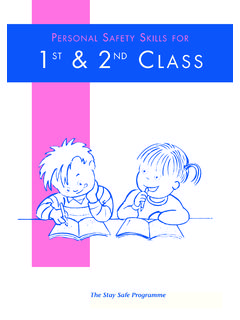
P S 1ST & 2ND CLASS - Stay Safe
www.staysafe.ieCONTENTS Introduction Page 1 Preparatory Work Page 2 Teaching the Stay Safe Programme Page 5 Feeling Safe and Unsafe Page 7 Bullying Page 11 Touches Page 16
Junior and Senior Infants - Stay Safe
www.staysafe.ieJunior and Senior Infants THE STAY SAFE PROGRAMME By Deirdre MacIntyre and Maria Lawlor The content and development of this edition was co-ordinated
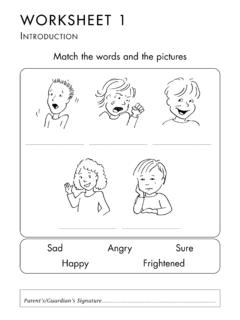
WORKSHEET 1 - Stay Safe
www.staysafe.ieParentÕs/GuardianÕs Signature..... WORKSHEET 1 INTRODUCTION Match the words and the pictures Sad Angry Sure
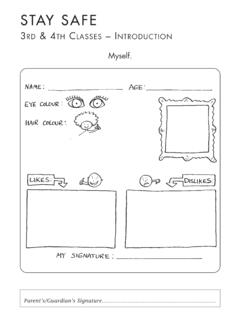
STAY SAFE
www.staysafe.ieSTAY SAFE 3RD & 4TH CLASSES — TOPIC 2 Find the words that describe how you feel when you help your friends. ParentÕs/GuardianÕs Signature.....
and 2nd Class - Stay Safe
www.staysafe.ie1st and 2nd Class THE STAY SAFE PROGRAMME By Deirdre MacIntyre and Maria Lawlor The content and development of this edition was …
Related documents

PERSONAL SAFETY FOR CHILDREN - ed
www2.ed.govStranger 45% 17% Identity of Perpetrator in Non-Family Abductions 21% 5% 4% Caretaker or Babysitter 6% ... should begin teaching children about personal safety. A child’s ability to comprehend and practice safety skills is affected by age, educational, and developmental levels. ... Rehearse safety skills so that they become second nature. 5.
4th Class - Stay Safe
www.staysafe.ieThe Stay Safe programme is a personal safety skills programme for primary schools. The aim of the programme is to reduce vulnerability to child abuse and bullying through the provision of personal safety education for children and training for teachers, school management boards and parents. It is developmentally structured to enable primary school
The role of childcare professionals in supporting mental ...
www.pacey.org.ukSome research indicates that children from disadvantaged backgrounds can begin nursery or reception with weaker self-regulation skills than their peers. As a result, embedding self-regulation strategies into early years teaching is likely to be particularly beneficial for children from disadvantaged backgrounds (Houghton et al, 2011). More

Teaching about consent and healthy boundaries – a guide ...
www.ifpa.ieTeaching about consent and healthy boundaries – a guide for educators ... opportunity for information to be repeated and for skills such as refusal skills to be ... best friend, aunty, teacher, stranger, police officer, religious leader etc] and ask them to say which circle they think they should go in. When you’ve written the people into ...

Teaching Strategies GOLD Objectives 24-36
www.hitinc.orgFollowing are indicators that children meeting WRHS’s program expectations would demonstrate. Refer to these expectations when ... Uses Scientific Inquiry Skills Objective 25: Demonstrates knowledge of characteristics of living things ... Begins to …
Resource Guide: Child Development Resources for Parents ...
childcareta.acf.hhs.govSmall, or fine, motor development—when children learn to use small muscles in their hands to eat, draw, dress, play, and write. Sensory development is the process by which children hear, see, taste, touch, smell, and feel. Social and emotional development is the process by which children learn to relate to others, such as

A Brief Cognitive-Behavioral Treatment for Social Anxiety ...
www.therapyresources.org1) Psycho-education involves teaching clients about the relationship between thoughts, emotions and physiological reactions 2) Cognitive restructuring involves correcting negative or inaccurate cognitions. It is based on the premises that socially anxious …