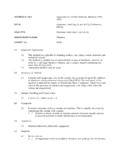
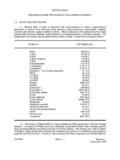
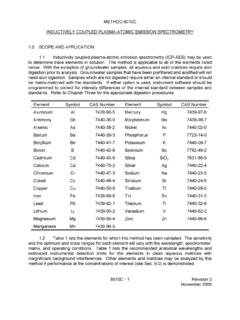
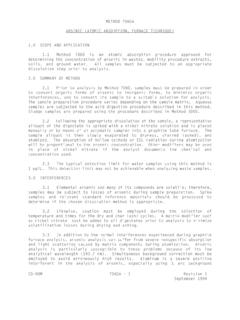
Transcription of APPENDIX A TO PART 136 METHODS FOR …
1 APPENDIX A TO PART 136 METHODS FOR ORGANIC CHEMICAL ANALYSIS OF MUNICIPAL ANDINDUSTRIAL WASTEWATERMETHOD 608 organochlorine pesticides AND and method covers the determination of certain organochlorine pesticides and following parameters can be determined by this method:ParameterSTORET " $ * ( ,4' ,4' ,4' is a gas chromatographic (GC) method applicable to the determination of thecompounds listed above in municipal and industrial discharges as provided under40 CFR Part When this method is used to analyze unfamiliar samples for any orall of the compounds above, compound identifications should be supported by at leastone additional qualitative technique. This method describes analytical conditions for asecond gas chromatographic column that can be used to confirm measurements madewith the primary column. Method 625 provides gas chromatograph/mass spectrometer(GC/MS) conditions appropriate for the qualitative and quantitative confirmation ofresults for all of the parameters listed above, using the extract produced by this method detection limit (MDL, defined in Section ) for each parameter is listed1in Table 1.)
2 The MDL for a specific wastewater may differ from those listed, dependingupon the nature of interferences in the sample sample extraction and concentration steps in this method are essentially the same asin METHODS 606, 609, 611, and 612. Thus, a single sample may be extracted to measurethe parameters included in the scope of each of these METHODS . When cleanup isrequired, the concentration levels must be high enough to permit selecting aliquots, asnecessary, to apply appropriate cleanup procedures. The analyst is allowed the latitude,under Section 12, to select chromatographic conditions appropriate for the simultaneousmeasurement of combinations of these modification of this method, beyond those expressly permitted, shall be consideredas a major modification subject to application and approval of alternate test proceduresunder 40 CFR Parts and method is restricted to use by or under the supervision of analysts experienced inthe use of a gas chromatograph and in the interpretation of gas chromatograms.
3 Eachanalyst must demonstrate the ability to generate acceptable results with this methodusing the procedure described in Section of measured volume of sample, approximately 1 L, is extracted with methylene chlorideusing a separatory funnel. The methylene chloride extract is dried and exchanged tohexane during concentration to a volume of 10 mL or less. The extract is separated bygas chromatography and the parameters are then measured with an electron method provides a Florisil column cleanup procedure and an elemental sulfurremoval procedure to aid in the elimination of interferences that may be interferences may be caused by contaminants in solvents, reagents, glassware,and other sample processing hardware that lead to discrete artifacts and/or elevatedbaselines in gas chromatograms. All of these materials must be routinely demonstratedto be free from interferences under the conditions of the analysis by running laboratoryreagent blanks as described in Section must be scrupulously cleaned.
4 Clean all glassware as soon as possible3after use by rinsing with the last solvent used in it. Solvent rinsing should befollowed by detergent washing with hot water, and rinses with tap water anddistilled water. The glassware should then be drained dry, and heated in amuffle furnace at 400 C for 15-30 minutes. Some thermally stable materials, suchas PCBs, may not be eliminated by this treatment. Solvent rinses with acetoneand pesticide quality hexane may be substituted for the muffle furnace rinsing with such solvents usually eliminates PCB ware should not be heated in a muffle furnace. After drying andcooling, glassware should be sealed and stored in a clean environment to preventany accumulation of dust or other contaminants. Store inverted or capped withaluminum use of high purity reagents and solvents helps to minimize interferenceproblems.
5 Purification of solvents by distillation in all-glass systems may by phthalate esters can pose a major problem in pesticide analysis whenusing the electron capture detector. These compounds generally appear in thechromatogram as large late eluting peaks, especially in the 15 and 50% fractions fromFlorisil. Common flexible plastics contain varying amounts of phthalates. Thesephthalates are easily extracted or leached from such materials during laboratoryoperations. Cross contamination of clean glassware routinely occurs when plastics arehandled during extraction steps, especially when solvent-wetted surfaces are from phthalates can best be minimized by avoiding the use of plastics inthe laboratory. Exhaustive cleanup of reagents and glassware may be required toeliminate background phthalate contamination. T interferences from phthalate esters4,5can be avoided by using a microcoulometric or electrolytic conductivity interferences may be caused by contaminants that are co-extracted from thesample.
6 The extent of matrix interferences will vary considerably from source to source,depending upon the nature and diversity of the industrial complex or municipality beingsampled. The cleanup procedures in Section 11 can be used to overcome many of theseinterferences, but unique samples may require additional cleanup approaches to achievethe MDL listed in Table toxicity or carcinogenicity of each reagent used in this method has not been preciselydefined; however, each chemical compound should be treated as a potential healthhazard. From this viewpoint, exposure to these chemicals must be reduced to the lowestpossible level by whatever means available. The laboratory is responsible for maintaininga current awareness file of OSHA regulations regarding the safe handling of thechemicals specified in this method. A reference file of material data handling sheetsshould also be made available to all personnel involved in the chemical references to laboratory safety are available and have been identified for the6-8information of the following parameters covered by this method have been tentatively classified asknown or suspected, human or mammalian carcinogens: 4,4 -DDT, 4,4 -DDD, the BHCs,and the PCBs.
7 Primary standards of these toxic compounds should be prepared in ahood. A NIOSH/MESA approved toxic gas respirator should be worn when the analysthandles high concentrations of these toxic and equipment, for discrete or composite sample bottle 1-L or 1-qt, amber glass, fitted with a screw cap lined withTeflon. Foil may be substituted for Teflon if the sample is not corrosive. If amberbottles are not available, protect samples from light. The bottle and cap linermust be washed, rinsed with acetone or methylene chloride, and dried before useto minimize sampler (optional) The sampler must incorporate glass samplecontainers for the collection of a minimum of 250 mL of sample. Samplecontainers must be kept refrigerated at 4 C and protected from light duringcompositing. If the sampler uses a peristaltic pump, a minimum length ofcompressible silicone rubber tubing may be used.
8 Before use, however, thecompressible tubing should be thoroughly rinsed with methanol, followed byrepeated rinsings with distilled water to minimize the potential for contaminationof the sample. An integrating flow meter is required to collect flow (All specifications are suggested. Catalog numbers are included for illustrationonly.) funnel 2-L, with Teflon column Chromatographic column, approximately 400 mm long x 19 mmID, with coarse frit filter column 400 mm long x 22 mm ID, with Teflon stopcock andcoarse frit filter disc (Kontes K-42054 or equivalent). tube, Kuderna-Danish 10-mL, graduated (Kontes K-570050-1025or equivalent). Calibration must be checked at the volumes employed in the glass stopper is used to prevent evaporation of flask, Kuderna-Danish 500- mL (Kontes K-570001-0500 orequivalent). Attach to concentrator tube with column, Kuderna/Danish Three-ball macro (Kontes K-503000-0121 orequivalent).
9 10 to 15-mL, amber glass, with Teflon-lined screw chips-Approximately 10/40 mesh. Heat to 400 C for 30 minutes or Soxhletextract with methylene bath Heated, with concentric ring cover, capable of temperature control ( 2 C).The bath should be used in a Analytical, capable of accurately weighing chromatograph An analytical system complete with gas chromatograph suitable foron-column injection and all required accessories including syringes, analytical columns,gases, detector, and strip-chart recorder. A data system is recommended for measuringpeak 1 m long x 4 mm ID glass, packed with SP-2250 on Supelcoport (100/120 mesh) or equivalent. This column was used todevelop the method performance statements in Section 14. Guidelines for the useof alternate column packings are provided in Section 2 m long x 4 mm ID glass, packed with 3% OV-1 on Supelcoport(100/120 mesh) or Electron capture detector.
10 This detector has proven effective in theanalysis of wastewaters for the parameters listed in the scope (Section ), andwas used to develop the method performance statements in Section for the use of alternate detectors are provided in Section water Reagent water is defined as a water in which an interferent is notobserved at the MDL of the parameters of hydroxide solution (10 N) Dissolve 40 g of NaOH (ACS) in reagent water anddilute to 100 thiosulfate (ACS) acid (1+1) Slowly, add 50 mL to H SO (ACS, sp. gr. ) to 50 mL of , hexane, isooctane, methylene chloride Pesticide quality or ether Nanograde, redistilled in glass if ether must be shown to be free of peroxides before it is used as indicatedby EM Laboratories Quant test strips. (Available from Scientific Products Co.,Cat. No. P1126-8, and other suppliers.)