Transcription of Applying Webb’s Depth-of-Knowledge (DOK) …
1 1 updated 2010 Karin K. Hess, National Center for Assessment, Dover, NH. Permission to reproduce is given when authorship is fully cited. Applying webb s Depth-of-Knowledge (DOK) Levels in Science Karin K. Hess According to Norman L. webb ( Depth-of-Knowledge Levels for Four Content Areas, March 28, 2002), interpreting and assigning Depth-of-Knowledge levels to both objectives within standards and assessment items is an essential requirement of alignment analysis. Four levels of depth of knowledge are used for this analysis. A general definition for each of the four ( webb ) Depth-of-Knowledge levels is followed by Table 1, which provides further specification and examples for each of the DOK levels in science.
2 Generally speaking, large-scale, on-demand assessments should only assess Depth-of-Knowledge Levels 1, 2, and 3. Depth-of-Knowledge at Level 4 should be reserved for local assessment and is included here primarily for illustrative purposes. Descriptors of DOK Levels for Science (based on webb , March 2002 and TIMSS Science Assessment framework, 2003) Level 1 Recall and Reproduction requires recall of information, such as a fact, definition, term, or a simple procedure, as well as performing a simple science process or procedure. Level 1 only requires students to demonstrate a rote response, use a well-known formula, follow a set procedure (like a recipe), or perform a clearly defined series of steps.
3 A simple procedure is well-defined and typically involves only one-step. Verbs such as identify, recall, recognize, use, calculate, and measure generally represent cognitive work at the recall and reproduction level. Simple word problems that can be directly translated into and solved by a formula are considered Level 1. Verbs such as describe and explain could be classified at different DOK levels, depending on the complexity of what is to be described and explained. A student answering a Level 1 item either knows the answer or does not: that is, the answer does not need to be figured out or solved. In other words, if the knowledge necessary to answer an item automatically provides the answer to the item, then the item is at Level 1.
4 If the knowledge necessary to answer the item does not automatically provide the answer, the item is at least at Level 2. Level 2 Skills and Concepts includes the engagement of some mental processing beyond recalling or reproducing a response. The content knowledge or process involved is more complex than in level 1. Items require students to make some decisions as to how to approach the question or problem. Keywords that generally distinguish a Level 2 item include classify, organize, estimate, make observations, collect and display data, and compare data. These actions imply more than one step. For example, to compare data requires first identifying characteristics of the objects or phenomenon and then grouping or ordering the objects.
5 Level 2 activities include making observations and collecting data; classifying, organizing, and comparing data; and organizing and displaying data in tables, graphs, and charts. 2 updated 2010 Karin K. Hess, National Center for Assessment, Dover, NH. Permission to reproduce is given when authorship is fully cited. Some action verbs, such as explain, describe, or interpret, could be classified at different DOK levels, depending on the complexity of the action. For example, interpreting information from a simple graph, requiring reading information from the graph, is a Level 2. An item that requires interpretation from a complex graph, such as making decisions regarding features of the graph that need to be considered and how information from the graph can be aggregated, is at Level 3.
6 Level 3 Strategic Thinking requires deep knowledge using reasoning, planning, using evidence, and a higher level of thinking than the previous two levels. The cognitive demands at Level 3 are complex and abstract. The complexity does not result only from the fact that there could be multiple answers, a possibility for both Levels 1 and 2, but because the multi-step task requires more demanding reasoning. In most instances, requiring students to explain their thinking is at Level 3; requiring a very simple explanation or a word or two should be at Level 2. An activity that has more than one possible answer and requires students to justify the response they give would most likely be a Level 3.
7 Experimental designs in Level 3 typically involve more than one dependent variable. Other Level 3 activities include drawing conclusions from observations; citing evidence and developing a logical argument for concepts; explaining phenomena in terms of concepts; and using concepts to solve non-routine problems. Level 4 Extended Thinking requires high cognitive demand and is very complex. Students are required to make several connections relate ideas within the content area or among content areas and have to select or devise one approach among many alternatives on how the situation can be solved. Many on-demand assessment instruments will not include any assessment activities that could be classified as Level 4.
8 However, standards, goals, and objectives can be stated in such a way as to expect students to perform extended thinking. Develop generalizations of the results obtained and the strategies used and apply them to new problem situations, is an example of a Grade 8 objective that is a Level 4. Many, but not all, performance assessments and open-ended assessment activities requiring significant thought will be Level 4. Level 4 requires complex reasoning, experimental design and planning, and probably will require an extended period of time either for the science investigation required by an objective, or for carrying out the multiple steps of an assessment item.
9 However, the extended time period is not a distinguishing factor if the required work is only repetitive and does not require Applying significant conceptual understanding and higher-order thinking. For example, if a student has to take the water temperature from a river each day for a month and then construct a graph, this would be classified as a Level 2 activity. However, if the student conducts a river study that requires taking into consideration a number of variables, this would be a Level 4. 3 updated 2010 Karin K. Hess, National Center for Assessment, Dover, NH. Permission to reproduce is given when authorship is fully cited.
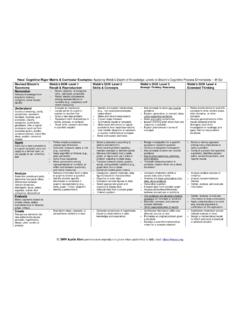
10 Table 1: Examples for each of the DOK Levels in Science, based on webb (Karin Hess, 2007) Level 1 Recall & Reproduction Level 2 Skills & Concepts Level 3 Strategic Thinking Level 4 Extended Thinking a. Recall or recognize a fact, term, definition, simple procedure (such as one step), or property b. Demonstrate a rote response c. Use a routine formula or rule d. Represent in words or diagrams a scientific concept or relationship e. Provide or recognize a standard scientific representation for simple phenomenon f. Perform a routine procedure, such as measuring length g. Perform a simple science process or a set procedure (like a recipe) h.