Transcription of Approach, Avoidance, and Coping With Stress
1 Approach, avoidance , and Coping With Stress Susan Roth and Lawrence J. Cohen Duke University ABSTRACT: The study of Stress and Coping points to two concepts central to an understanding of the response to trauma: approach and avoidance . This pair of concepts refers to two basic modes of Coping with Stress . Approach and avoidance are simply metaphors for cognitive and emotional activity that is oriented either toward or away from threat. An approach- avoidance model of Coping is presented in the context of contemporary theoretical ap- proaches to Coping . The research literature on Coping ef- fectiveness, including evidence from our laboratory, is dis- cussed, and speculations are made about the implications for future research.
2 The study of Stress and Coping has become quite popular in recent years, particularly in regard to traumatic life events. Although the area is broad and the Coping process is complex, there is a striking coherence in much of the literature. This coherence is based on two concepts central to an understanding of Coping with trauma: approach and avoidance . In its simplest form, this pair of concepts refers to two basic orientations toward stressful infor- mation, or two basic modes of Coping with Stress . Ap- proach and avoidance are shorthand terms for the cog- nitive and emotional activity that is oriented either toward or away from threat.
3 In this article we will present the case for utilizing the concepts of approach and avoidance to provide a co- herent theoretical structure to our understanding of cop- ing with Stress . Several different formulations of the ap- proach- avoidance dimension will be reviewed, followed by a brief review of the Coping effectiveness literature. Several studies from our laboratory will be used to illus- trate the relationship between Coping and outcome. Fi- nally, a general approach- avoidance model of Coping will be presented, with suggestions for further research to cor- roborate or extend the theory. The study of Coping with Stress has been split into two areas: anticipation of future stressful events and re- covery from trauma.
4 These areas have been kept re- markably distinct in both theory and research on Coping . Although there are clearly important differences between the two cases, we have chosen not to emphasize this dis- tinction. For any given Stress , anticipation and recovery are not always clearly separable; dealing with a trauma involves coming to terms with the event itself and with the threat of recurrence in the future. More important, Correspondence concerning this article should be sent to Susan Roth, Department of Psychology, Duke University, Durham, NC 27706. we have identified the same processes as central to Coping in both anticipation and recovery periods.
5 Approach- avoidance Formulations The approach- avoidance distinction is not new, having historical roots in psychoanalytic theories of defense and working through ( , Freud, 1915/1957), and in views of conflict from the behavioral ( , Hovland & Sears, 1938; Miller, 1944) and phenomenological ( , Lewin, 1951) traditions. In the more recent literature on Coping with Stress , approach- avoidance distinction is a core idea. One is struck by the extent to which the concepts of ap- proach and avoidance underlie the personality or indi- vidual difference variables studied in the anticipatory threat literature, and also the dimensions of Coping studied in traumatic Stress reaction research.
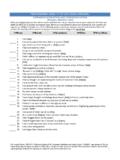
6 Table l briefly de- scribes 14 of these Coping formulations. In the anticipatory threat literature, the repression- sensitization distinction is paradigmatic of the approach- avoidance dimension of individual difference: Repression involves an avoidance of anxiety-arousing stimuli and their consequences and is a general orientation away from threat. Sensitization, on the other hand, is the approach toward anxiety-arousing stimuli and their consequences and is an orientation toward threat. Although, as we shall see, there is no clear-cut evidence regarding the effects of individual differences along the approach and avoidance dimensions, the issues for Coping and adaptation seem to be the following: Avoidant strategies seem useful in that they may reduce Stress and prevent anxiety from becom- ing crippling.
7 Approach strategies, on the other hand, allow for appropriate action and/or the possibility for no- ticing and taking advantage of changes in a situation that might make it more controllable. Approach strategies also allow for ventilation of affect. Individual differences along the approach- avoidance dimension have also been a focus of study in the traumatic Stress reaction research. For example, Shontz (1975) dis- cussed fragmentation versus containment in response to illness, whereas McGlashan, Levy, and Carpenter (1975) referred to integration and sealing over as two distinct styles of recovery from schizophrenia.
8 To illustrate, frag- mentation is a form of denial in which people split them- selves off from their illness, resulting in an unstable self- system. Containment is the incorporation of threat into an integrated self-structure, without overwhelming the self. Horowitz's (1976, 1979) formulation of the ap- proach- avoidance dimension in response to Stress is the most fully developed and will be discussed in more detail. July 1986 9 American Psychologist Copyright 1986 by the American Psychological Association, inc. 0003-066X/86/$ 813 Table 1 Summary of Approach- avoidance Coping Formulations Coping formulation avoidance Approach Measurement Perceptual defense- perceptual vigilance (Bruner & Postman, 1947) avoidance -vigilance (Cohen & Lazarus, 1973; Janis, 1958, 1977, 1982) Repression-sensitization (Bell & Byrne, 1978; Byrne, 1964) Repression-sensitization (Gudjonsson, 1981.)
9 Houston & Hodges, 1970) Nonvigilant-vigilant (Averill & Rosenn, 1972) Selective inattention- selective attention (Kahnemann, 1973) Inaccurate-accurate expectations (Johnson & Leventhal, 1974) Reducers-augmenters (Petrie, 1978) Blunting-monitoring (Miller, 1980; Miller & Mangan, 1983) Rejection-attention (Mullen & Suls, 1982) Sealing over-integration (McGlashan, Levy, & Carpenter, 1975) Relative deficit in perceiving threatening stimuli Procrastination, giving up of personal responsibility, inadequate search of environmental cues, restricting thought about the stressor, and failure to appraise the situation and make contingency plans avoidance of anxiety- arousing stimuli and their consequents, selective inattention and forgetting, and low anxiety Low subjective distress plus high electrodermal indicators of distress Preferences for unsignaled shock, even when avoidance possible Inattention to selected (eg, threatening)
10 Elements of the perceptual field Not having accurate information about what to expect regarding a threatening situation Ignoring warning signals and information about hazards; tolerance for pain Seeking distraction, relaxing, denying threat, practicing detachment and intellectualization Orientation away from stressor and one's reactions to it In regard to recovery from a schizophrenic episode, a lack of curiosity about the experience, a shifting of responsibility onto others, a negative view of the episode, an isolation of the episode from the rest of the person's life, and a failure to grow from the experience Relative readiness to perceive threatening stimuli Alertness; self-responsibility; thorough, active searching; seeking knowledge.