Example: quiz answers
AQA Chemistry A-level - PMT
Initial rate method: ‘Iodine Clock’ experiment ... Colorimeter: If any of the reagents or products are coloured (normally iodine), the reaction can be followed by measuring time vs absorbance. The absorbance is proportional to the concentration of iodine (a calibration graph is required to calculate the exact ...
Tags:
Information
Domain:
Source:
Link to this page:
Documents from same domain
Paper Reference(s) 6666/01 Edexcel GCE
pmt.physicsandmathstutor.comA container is made in the shape of a hollow inverted right circular cone. The height of the container is 24 cm and the radius is 16 cm, as shown in Figure 2.
Centre Number Candidate Number Edexcel GCE …
pmt.physicsandmathstutor.comCentre Number Candidate Number Write your name here Surname Other names Total Marks Paper Reference You must have: Mathematical …
Paper Reference(s) Edexcel GCE - Physics & Maths …
pmt.physicsandmathstutor.comThis publication may be reproduced only in accordance with Edexcel Limited copyright policy. ©2005 Edexcel Limited. Printer’s Log. No.N20232 B W850/R6666/57570 7/3/3/3/3
UNIVERSITY OF CAMBRIDGE INTERNATIONAL …
pmt.physicsandmathstutor.comThis document consists of 5 printed pages and 3 blank pages. DC (RCL (JDA)) 49875/4 © UCLES 2012 [Turn over UNIVERSITY OF CAMBRIDGE INTERNATIONAL EXAMINATIONS International General Certificate of Secondary Education
UNIVERSITY OF CAMBRIDGE INTERNATIONAL …
pmt.physicsandmathstutor.comUniversity of Cambridge International Examinations is part of the Cambridge Assessment Group. Cambridge Assessment is the brand name of University of
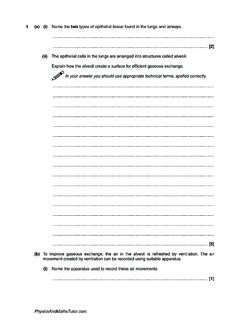
(a) (i) Name the types of epithelial tissue found in …
pmt.physicsandmathstutor.com(a) (i) Name the two types of epithelial tissue found in the lungs and airways.
F321: Atoms, Bonds and Groups Acids
pmt.physicsandmathstutor.comPlymstock School 1 F321: Atoms, Bonds and Groups Acids 49 Marks 1. A student carries out experiments using acids, bases and salts. Calcium nitrate, Ca(NO 3)2, is an example of a salt.
Edexcel GCE Physics - Physics & Maths Tutor
pmt.physicsandmathstutor.comEdexcel GCE N34431RA ©2009 Edexcel Limited. 1/1/1/1/1/2 *N34431RA0120* PMT. 2 *N34431RA0220* SECTION A Answer ALL questions. For questions 1–10, in Section A ...
Mark Scheme (Standardisation) January 2010
pmt.physicsandmathstutor.comMark Scheme (Standardisation) January 2010 . GCE . GCE Physics (6PH07/1) Edexcel Limited. Registered in England and Wales No. 4496 50 . 7. Registered Office: One90 High Holborn, London WC1V 7BH
Mark Scheme (Results) Summer 2016 - Physics & …
pmt.physicsandmathstutor.comMark Scheme (Results) Summer 2016 Pearson Edexcel GCE in Mechanics 1 (6677_01) PhysicsAndMathsTutor.com
Related documents
A Sample Lab Report The Iodine Clock Reaction Introduction
msmcgregor.weebly.comThe Iodine Clock Reaction Introduction: The factors that affect the rate of a chemical reaction are important to understand due to the importance of many such reactions to our health, well-being and comfort. It would be advantageous to slow down some of these reactions such as food spoilage and rust formations,
The Kinetics of the Iodine Clock Reaction
www.chemistrylabmanual.comThe iodine clock reaction is a well-known and memorable chemical reaction where two colorless solutions are mixed and, after a period of time ranging from seconds to minutes, the solution suddenly turns from colorless to colored (yellow or bluish–black. It is represented by the following

EXPERIMENT 13: THE IODINE CLOCK REACTION
intro.chem.okstate.edu13 - 1 Spring 1998 EXPERIMENT 13: THE IODINE CLOCK REACTION Background In this experiment you will study the rate of the reaction between iodide ion, I–, and persulfate (peroxydisulfate), S2O82–.The products of the reaction are I2 and sulfate ion. Write the balanced chemical equation for this reaction in the space provided.
IGCSE Biology 0610/63 Paper 6 Alternative to Practical Oct ...
pastpapers.papacambridge.com4 UCLES 2020 0610/63/O/N/20 Step 5 A stop-clock was started. Step 6 After one minute one drop of the mixture from beaker A was added to the first drop of iodine solution labelled A1 on the white tile. This was repeated for beakers B, C, D and U using drops B1, C1, D1 and U1. Step 7 Step 6 was repeated at one minute intervals until drops of the mixtures in the beakers

THE VERTICAL DIET & PEAK PERFORMANCE 2
road2beastmode.yolasite.comWake up at the same time every day, 7 days a week, this helps set the clock making it easier to get to sleep at night. Sleep in a pitch black room with blackout blinds. Turn off ALL appliances, ... IODINE - (RDA 150mcg) Stimulates Thyroid, boosts metabolism, boosts the …

Iodine Clock Reaction - NVCC
blogs.nvcc.eduIodine Clock Reaction Part 1: PostLab Name _____ 1. What is the overall order of the reaction in this lab? 2. Use your Rate Law and average k to calculate the reaction rate when [I-] = 0.025 M and [H 2 O 2 ] = 0.032 M. 3. onsider the reaction A + → Products. This reaction was experimentally determined to be first order in A and second order ...
Wound Assessment
www.woundcareresource.comwound with 12 o’clock being at the head. Therefore, in the picture on the right you would describe the undermining as being Xcm extending from 6 O’clock to 9 O’clock. Wound Location The location of the wound will also impact on determining a diagnosis and contribute to the plan(3). Below is a table showing