Transcription of ARCHIMEDES’ PRINCIPLE EXPERIMENT
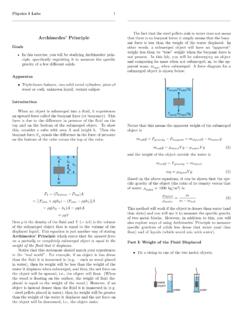
1 Course and Section_____ Names _____ Date_____ _____ archimedes PRINCIPLE EXPERIMENT Short Description: archimedes ' PRINCIPLE states that an object submerged in a fluid is buoyed by a force that is equal to the weight of the displaced fluid. In this lab, you are to do two experiments involving archimedes PRINCIPLE involving 1) a metal block submerged in water and 2) a helium-filled balloon. Equipment: Vertical long rod, clamp, force sensor, metal block+string, plastic beaker, balance plastic cup, balloon, small weight, He tank (machine shop), water. PART 1: Density of Aluminum (or copper) Preliminary questions 1. A the metal object is suspended by a string from a spring scale (the force sensor) which measures its weight. What is the weight of the object Wa in case (a) ?
2 What is the weight of the object Wb in case (b) ? What the difference of the two weights is equal to? 2. A beaker partly filled with water sits on a balance. Now a piece of aluminum is lowered into the water and held by a string (with your hand for example) so that it does not touch the bottom of the beaker. No water overflows. Does the weight measured by the balance go up, go down, or stay the same? Procedure A (for preliminary question 1) Set up DataStudio with the force sensor and display a graph of force vs. time. Zero the force reading by pressing the tare button on the side. Next, hang the metal (either aluminum or copper) from the force sensor and record the weight of the metal for a few seconds. Then place the metal into the cup of water until it s submerged. ( Place the cup on the table and adjust the height of the force sensor so the block doesn t touch the bottom of the beaker).
3 Stop the measurement, and find the average reading in air and in the water : Weightair_____ Weightwater_____ What is the physical meaning of the difference of these two readings? Numerical value of the difference: _____ Now find the density of the metal from the knowledge of its weight (in air), the buoyant force and the density of water water = 1,000 kg/m3 metal = _____ How does your measured density compare with the accepted value? Procedure B (for preliminary question 2) Use the beaker with water, the balance and the metal block, no force sensor. Measure the weight of the baker (with the water in it) using the balance. Next, holding with your hand the string, suspend the metal block i nto the beaker sitting on a balance. Does the weight of the beaker change when the metal is submerged?
4 WBeaker _____ WBeaker+Block _____ (with the metal inside) By how much? Express the difference in Newton. WBeaker+Block - WBeaker _____ Which force does this difference represent? How does this number compare with the results from Procedure A? Question: Would your result be different if you lowered a piece of copper, of the same volume, instead of aluminum into the water? Explain. PART II: Lifting capacity of a helium-filled balloon The lifting capacity of a helium-filled balloon is given by the difference of the buoyant force acting on it and the weight of the helium in the balloon. If an object is suspended by a string from the balloon floating in air at a constant height, then the lifting capacity is: ) (..gmgmgmWFosbHeB + + = wheregVFbairB = and gVWbHeHe = , where mb denotes the balloon mass, mo stands for the mass of the hanging object and ms is the mass of the string (you can neglect it).
5 Vb denotes the volume of the balloon, air is the density of air and He that of He gas. Hang a small mass mo from the balloon such that it floats in air without rising or falling. You can use paperclips or whatever object you prefer. After equilibrium is reached, remove the hanging mass mo and measure it with the scale. Record mo and mb as well by weighing a similar uninflated balloon (or ask to the TA for the weight of the balloon) mo_____ mb _____ Calculate the net weight in Newtons, the right hand side of equation (1): _____ Estimate the volume of the balloon using a ruler and assuming the balloon is a sphere. Vb = _____ The density of helium is kg/m3 and the density of air is kg/m3. Now calculate the lifting capacity (in Newtons), the left hand side of equation (1): _____ How does the calculated lifting capacity compare with the net weight of the load?
6 Question: How many helium filled balloons like the one you used in this lab would be required to lift you into the air?