Transcription of Assessing Cognition using the Cognitive Linguistic Quick ...
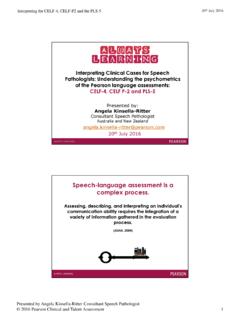
1 23/08/2017 1 Assessing Cognition using the Cognitive Linguistic Quick Test Plus (CLQT+) Presented by: Amy Schulenburg Pearson Clinical Assessment 2 Cognitive Linguistic Quick Test Plus (CLQT+) Approx 15 -30 mins to administer Ages 18-89 The CLQT was designed to quickly assess strengths and weaknesses in five Cognitive domains: attention, memory, executive functions, language and visuo-spatial skills Option of administering plus version for people with aphasia 10 subtest in traditional administration, 11 subtests in + (aphasia) administration Original published in 2001, Plus version in 2017 Cost.
2 Complete Kit = $490 Record Forms (25 pack) = $175 CLQT+ Stimulus book (if adding to original kit) = $219 CLQT(+) Subtests Personal facts Symbol cancellation* Confrontation naming Clock drawing Story retelling Symbol trails* Generative naming Design memory Mazes* Design generation Semantic comprehension** *Additional points scored for following auditory directions within this task for the Aphasia Administration **This subtest is only administered when using the Aphasia Administration 3 CLQT Tasks & Cognitive Domains Traditional Administration criterion -referenced Severity ratings for two
3 Age categories (ages 18-69 and 70-89) Severity ratings are mild, moderate, severe and WNL for each of the 5 Cognitive domains A total Composite Severity Rating and a Clock Drawing Severity Rating serve as a neurocognitive screener criterion -referenced Severity ratings for two age categories (ages 18-69 and 70-89) Severity ratings are mild, moderate, severe and WNL for Non- Linguistic Cognition index Linguistic /aphasia index Separate clock drawing severity rating Aphasia Administration Picking a tool to help (referral questions) 1.
4 I need a screening tool for rehab in acute care prior to Psych evals. (SLP / OT / PT) 2. I need a tool that helps detect early Cognitive decline which may present as other conditions. 3. I need a tool that I can use for progress monitoring. 4. I need something that informs intervention planning. 5. I need a tool that can assess Cognition in clients with aphasia. 23/08/2017 2 Traditional vs. Aphasia Administration When administering the CLQT+ to someone who has diminished language capability: Administer the original ten tasks Take note of any modifications indicated in the instruction banner at the beginning of each subtest on the Record Form.
5 Complete the examiner-rated items in the Symbol Cancellation, Symbol Trails and Mazes subtests Administer the Semantic Comprehension task Calculate the Auditory Comprehension score 7 1. This task helps to assess memory and language abilities. 2. Examinees with aphasia may respond poorly to these items due to language problems. In such cases, the memory severity rating may not accurately represent memory skills. 3. Note whether examinees demonstrate better recall of lifelong facts (date and place of birth) vs.
6 Newer facts (current age and address), a pattern seen especially in individuals with dementia and closed head injury. 4. Delayed and/or self corrected responses may indicate milder memory problems. Personal Facts 9 Symbol cancellation: 1. Symbol Cancellation is a non- Linguistic task of visual attention and perception. It also offers information regarding the integrity of the upper and lower quadrants of left and right visual fields. 2. Observe examinees' scanning strategies. Are they searching laterally from left to right, down and up, or scanning unsystematically?
7 Notice if examinees failed to cancel symbols in one or more of the four quadrants. 3. Errors of omission (correct symbols not cancelled) and commission (incorrect symbols cancelled) may be secondary to: generalized inattention visual discrimination problems partial or full hemianopsia visual neglect inattention to one side or quadrant of space 4. Observe whether there are similar visual field deficits on Clock Drawing, Symbol Trails, and Mazes tasks. 10 Confrontation Naming: in confrontation naming are a key symptom of aphasia that can result from various forms of brain damage ( , stroke, head injury, dementia, tumors, infections).
8 Responses suggest mild word-retrieval problems. Note immediate or delayed perseverations, repeated responses for all or part of a previous word. no points are deducted, an elaborated response may be symptomatic of verbosity or inability to limit information. the examinee to give a single word response. Use of seldom-used words may be a symptom of word-finding problems. Request a "common name. The types of errors examinees make can guide treatment of word-retrieval problems. 11 Clock Drawing: 1.
9 Clock Drawing serves as a mini-screening tool for all Cognitive domains. 2. This task can be re-administered to sample and monitor examinees progress, deterioration, or stability across several Cognitive domains. 3. Watch carefully as examinees draw the dock and note the strategies used. 4. 11 elements get scored to get a total score Story retelling: Retelling helps to assess auditory memory and comprehension, working memory, and language output skills. responses may indicate loss of topic or memory problems.
10 Partially correct information is provided, note whether recall is better for initial, medial, or final parts of the story as indications of arousal, attention, and storage capacity. Retelling is an easy way to assess narrative skills. no points are deducted for retelling the story out of sequence, you can analyze for recall of consecutive events building to the story conclusion by numbering each item recalled 23/08/2017 3 13 Symbol Trails: Trails is a nonlinguistic task used to help assess planning, self monitoring, working memory, and visual attention even in examinees with compromised language skills.