Transcription of Assessing Communication, Critical Thinking, Clinical ...
1 2012 -2013 Assessment Project Final Report Submitted by Marie Gilbert Department of nursing May, 2013 Assessing communication , Critical thinking , Clinical Judgment and Collaboration throughout the Baccalaureate nursing Program Abstract The Simulated Clinical Experience (SCE) provides a unique opportunity to assess student outcomes at specific stages throughout the nursing program. This project included two phases. Phase 1, fall 2012, the development of a standardized scoring rubric to measure communication , collaboration, Critical thinking , and Clinical judgment (4Cs) in a simulated Clinical environment.
2 A process of theory-driven descriptive statements, observations, review, and refinement was used to create the rubric. A total of 75 descriptors were identified, leveled and categorized. Phase 2, spring 2012, a pilot study, collected and analyzed data to investigate the relationship between student performance (as quantified by the scoring rubric) and time of day, simulation order, and semester level. Phase 2 (the pilot study) identified some of the challenges associated with objective, quantitative assessment of communication , collaboration, Critical thinking , and Clinical judgment.
3 The leveled rubric showed potential as a standardized approach to assess student progress, the integration of the 4Cs throughout the curriculum, and program outcomes. Ongoing refinement and future psychometric testing are required to validate its use in the simulated and Clinical environment. Page 2 of 11 , Department of nursing , Assessment Project, Final Report Phase 1 Rubric Development Purpose The purpose of phase 1 was to develop a standardized scoring rubric for selected Clinical outcomes in a Simulated Clinical Experience (SCE). The outcomes assessed were: communication , collaboration, Critical thinking and Clinical judgment (the 4Cs) at various stages of the nursing program.
4 Background The nursing Department Student Outcome Assessment Plan indicates that upon completion of the undergraduate program the student will be evaluated on four selected Clinical outcomes: communication , Critical thinking , Clinical Judgment, and Collaboration (4Cs). The acquisition and development of these outcomes occur throughout the nursing program. In addition to the current process of evaluating the 4Cs during Clinical placement, the on campus simulation lab provides a unique opportunity to assess student outcomes at specific stages throughout the nursing program. This facilitates evaluation of students progress as well as the integration of the 4Cs throughout the curriculum.
5 Additionally, this is a resource for university program review. The International nursing Association for Clinical Simulation and Learning indicate that simulation is a pedagogy using one or more typologies to promote, improve, and/or validate a participant s progression from novice to expert (INACSL, 2011). Simulation is becoming increasingly recognized as an effective and efficient learning methodology for nursing students, increasing both confidence and knowledge (Burns, O Donnell, & Artman, 2010; Hoffman, O Donnell, & Kim, 2007; Smith & Roehrs, 2009.) A SCE includes prebriefing, the Clinical scenario, and debriefing (INASCL 2011).
6 Within the nursing program, each SCE has been developed to challenge the nursing student s Critical thinking , Clinical judgment, communication , and collaboration skills. The SCE provides each student the opportunity to apply the knowledge and skills from didactic, skills laboratory, and Clinical practice to a patient care scenario in a safe environment. This application of theory to practice is completed without prompting, guidance, and bedside supervision from their Clinical faculty or other licensed staff. This would be impossible within the Clinical environment due to legal and safety issues.
7 Following each Clinical scenario the students are given the opportunity to Page 3 of 11 , Department of nursing , Assessment Project, Final Report reflect on their experience and identify challenges they experienced. This guided reflection and feedback session, referred to as debriefing are facilitated by the simulation coordinator. Learning outcomes for a SCE are developed to align with the didactic courses and Clinical environments the students are enrolled in at the time of the SCE and may include reinforcement of prior knowledge and skills. These outcomes are assessed during the simulation and debriefing.
8 In addition to each specific objective, the SCE provides the unique opportunity to assess the key Clinical outcomes (4Cs) at specific stages throughout the nursing program. Methodology A process of theory-driven descriptive statements, observations, review, and refinement was used during a 16 week semester in a baccalaureate nursing program. Theory-driven description. Initially, descriptive statements, using anchors of best performance descriptors, were derived from current literature for each of the 4Cs. Descriptive statements were also identified from nursing Clinical evaluation documentation used within the baccalaureate nursing program.
9 Three levels of performance were identified: Level 1 (Sophomore) outcomes expected from Semester 1 and 2 students Level 2 (Junior) outcomes expected from Semester 3 and 4 students Level 3 (Senior) outcomes expected from Semester 5 and 6 students Observation, review and refinement. The initial descriptive statements (derived from the literature and existing documentation) were subject to three reviews. During each review the simulation coordinator observed students behaviors during their scheduled SCEs, and compared the observed behaviors to the descriptors identified for that level of student.
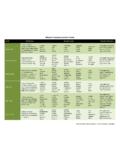
10 The first review process involved 96 students and 64 SCEs. The second review involved 60 student and 30 SCEs. The final review comprised of 64 student and 29 SCEs. After each period of observation, the descriptor were further revised, and sent to the lead faculty and the chair of nursing for review, feedback and approval. Page 4 of 11 , Department of nursing , Assessment Project, Final Report Results A 75 item rubric was developed, table 1. A total of 25 Level 3 descriptors were identified from the literature and current Clinical assessment documentation and represented senior level outcomes.