Transcription of ASSESSMENT TOOLS A Resource for Clinicians
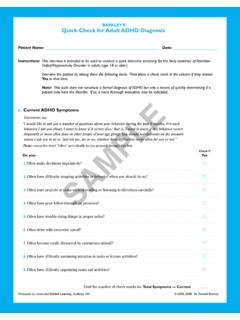
1 ASSESSMENT TOOLSA Resource for CliniciansAT-AAdult ADHD Self-Report ( ) Symptom ChecklistAT-BAdult ADHD Self-Report ( ) Screener (English)AT-CAdult ADHD Self-Report ( ) Screener (Spanish)AT-DBarkley s Quick-Check for Adult ADHD Diagnosis (Sample)AT-EBrief Semi-Structured Interview for ADHD in AdultsAT-FWeiss Functional Impairment Rating Scale Self-Report (WFIRS-S)AT-GADHD Medication Side Effects ChecklistAT-HMedication Response FormAT-IHamilton Anxiety Rating Scale (HAM-A)AT-JHamilton Depression Rating Scale (HDRS)AT-KCAGE Questionnaire Adapted to Include DrugsInstructionsAdult ADHD Self-Report ( ) Symptom Checklistfrom WHO Composite International Diagnostic Interview World Health OrganizationThe questions on the back page are designed to stimulate dialogue between you and your patients and tohelp confirm if they may be suffering from the symptoms of attention-deficit/hyperactivity disorder (ADHD).
2 Description: The Symptom Checklist is an instrument consisting of the eighteen DSM-IV-TR criteria. Six of theeighteen questions were found to be the most predictive of symptoms consistent with ADHD. These sixquestions are the basis for the ASRS Screener and are also Part A of the Symptom Checklist. Part B of theSymptom Checklist contains the remaining twelve :Symptoms1. Ask the patient to complete both Part A and Part B of the Symptom Checklist by marking an X in the box thatmost closely represents the frequency of occurrence of each of the Score Part A. If four or more marks appear in the darkly shaded boxes within Part A then the patient hassymptoms highly consistent with ADHD in adults and further investigation is The frequency scores on Part B provide additional cues and can serve as further probes into the patient ssymptoms.
3 Pay particular attention to marks appearing in the dark shaded boxes. The frequency-basedresponse is more sensitive with certain questions. No total score or diagnostic likelihood is utilized for thetwelve questions. It has been found that the six questions in Part A are the most predictive of the disorderand are best for use as a screening Review the entire Symptom Checklist with your patients and evaluate the level of impairment associatedwith the Consider work/school, social and family Symptom frequency is often associated with symptom severity, therefore the Symptom Checklist may alsoaid in the ASSESSMENT of impairments. If your patients have frequent symptoms, you may want to ask themto describe how these problems have affected the ability to work, take care of things at home, or get alongwith other people such as their spouse/significant Assess the presence of these symptoms or similar symptoms in childhood.
4 Adults who have ADHD neednot have been formally diagnosed in childhood. In evaluating a patient s history, look for evidence of early-appearing and long-standing problems with attention or self-control. Some significant symptoms should havebeen present in childhood, but full symptomology is not ADHD Self-Report Scale ( ) Symptom ChecklistPatient NameToday s DatePlease answer the questions below, rating yourself on each of the criteria shown using the scaleon the right side of the page. As you answer each question, place an X in the box that bestdescribes how you have felt and conducted yourself over the past 6 months. Please give thiscompleted checklist to your healthcare professional to discuss during today s Ai1. How often do you have trouble wrapping up the final details of a project, once thechallenging parts have been done?
5 2. How often do you have difficulty getting things in order when you have to do a taskthat requires organization?3. How often do you have problems remembering appointments or obligations?4. When you have a task that requires a lot of thought, how often do you avoid or delaygetting started?5. How often do you fidget or squirm with your hands or feet when you have to sit downfor a long time?6. How often do you feel overly active and compelled to do things, like you were drivenby a motor?NeverRarelySometimesOftenVery Often7. How often do you make careless mistakes when you have to work on a boring ordifficult project?8. How often do you have difficulty keeping your attention when you are doing boringor repetitive work?9. How often do you have difficulty concentrating on what people say to you, even whenthey are speaking to you directly?
6 10. How often do you misplace or have difficulty finding things at home or at work?11. How often are you distracted by activity or noise around you?12. How often do you leave your seat in meetings or other situations in which you areexpected to remain seated?13. How often do you feel restless or fidgety?14. How often do you have difficulty unwinding and relaxing when you have time to yourself?15. How often do you find yourself talking too much when you are in social situations?16. When you re in a conversation, how often do you find yourself finishing the sentencesof the people you are talking to, before they can finish them themselves?17. How often do you have difficulty waiting your turn in situations when turn taking is required?18. How often do you interrupt others when they are busy?
7 Part BResearch suggests that the symptoms of ADHD can persist intoadulthood, having a significant impact on the relationships, careers,and even the personal safety of patients who may suffer from this disorder is often misunderstood, many people who haveit do not receive appropriate treatment and, as a result, may neverreach their full potential. Part of the problem is that it can be difficultto diagnose, particularly in Adult ADHD Self-Report Scale (ASRS ) and scoring systemwere developed in conjunction with the World Health Organization(WHO) and the Workgroup on Adult ADHD, which included thefollowing team of psychiatrists and researchers:Lenard Adler, MDAssociate Professor of Psychiatry and NeurologyNew York University Medical SchoolRonald Kessler, PhDProfessor, Department of Health Care PolicyHarvard Medical SchoolThomas Spencer, MDAssociate Professor of PsychiatryHarvard Medical SchoolAs a healthcare professional, you can use the ASRS as a tool tohelp screen for adult ADHD patients.
8 Insights gained through thisscreening may suggest the need for a more in-depth clinician questions in the ASRS are consistent with DSM-IV criteria andaddress the manifestations of ADHD symptoms in adults. Content ofthe questionnaire also reflects the importance that DSM-IV places onsymptoms, impairments, and history for a correct screener takes less than 5 minutes to complete and can providesupplemental information that is critical to the diagnostic :1. Schweitzer, , Cummins, , Kant, Attention-deficit/hyperactivity Clin North Am. 2001;85(3):10-11, Barkley, Attention deficit hyperactivity disorder: a handbook for diagnosisand treatment (2nd ed.). Biederman, J., Faraone, , Spencer, T., Wilens, T., Norman, D., Lapey, K. A, et of psychiatric comorbidity, cognition, and psychosocial functioning inadults with ADHD.
9 Am J Psychiatry. 1993:150 American Psychiatric Association. Diagnostic and statistical manual of mentaldisorders, (4th ed., text revision). Washington, DC. 2000 Value of Screening for Adults with ADHD World Health OrganizationThe World Health Organization (WHO) does not endorse any specific companies, products or you living with Adult ADHD?The questions below can help you find ADHD Self-Report ( ) Screenerfrom WHO Composite International Diagnostic Interview World Health OrganizationMany adults have been living with Adult Attention-Deficit/HyperactivityDisorder (Adult ADHD) and don t recognize Because itssymptoms are often mistaken for a stressful life. If you ve felt this typeof frustration most of your life, you may have Adult ADHD acondition your doctor can help diagnose and following questionnaire can be used as a starting point to help you recognize the signs/symptoms of Adult ADHD but is not meantto replace consultation with a trained healthcare professional.
10 An accurate diagnosis can only be made through a clinicalevaluation. Regardless of the questionnaire results, if you haveconcerns about diagnosis and treatment of Adult ADHD, please discussyour concerns with your Adult Self-Report ( ) Screener is intended for people aged 18 years or Self-Report ( ) Screenerfrom WHO Composite International Diagnostic Interview World Health OrganizationPatient Name _____ Date _____Check the box that best describes how you have felt and conducted yourself over the past 6 months. Please give the completed questionnaire to your healthcare professional during yournext appointment to discuss the How often do you have trouble wrapping up the final details of a project, once thechallenging parts have been done?2. How often do you have difficulty getting things in order when you have to do a taskthat requires organization?