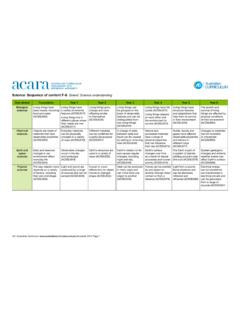
Transcription of Australian Curriculum - Progressive Framework - …
1 Australian Curriculum - Science (F-10)Based on Australian Curriculum ( ), acara materials downloaded from the Australian Curric website on 24/9/2014. acara does not endorse any changes that have been made to the Australian capabilityCritical and creative thinkingPersonal and social capabilityEthical understandingIntercultural understandingAboriginal and Torres Strait Islander histories and cultures Sustainability General CapabilitiesCross- Curriculum prioritiesAsia and Australia s engagement with Asia Australian Curriculum : Science - Science as a Human Endeavour - Strands and Sub-strands with ElaborationsSourced from 'The Overarching Ideas'The Overarching IdeasThere are a number of overarching ideas that represent key aspects of a scientific view of the world and bridge knowledge and understanding across the disciplines of science.
2 In the Australian Curriculum : Science, six overarching ideas support the coherence and developmental sequence of science knowledge within and across levels. The overarching ideas frame the development of concepts in the Science Understanding strand, support key aspects of the Science Inquiry Skills strand and contribute to developing students appreciation of the nature of science. The six overarching ideas that frame the Australian Curriculum : Science are:Patterns, Order and Organisation Form and Function Stability and Change Scale and Measurement Matter and Energy SystemsBOLDED TEXT DENOTES PROGRESSIONThe Progressive Curriculum Frameworks for Science (F-7) by Mr Anton Reiter ( ) is licensed under a CC Attribution-NonCommercial-ShareAlike International Update.
3 January 18, 2015 Page 1 of 6 THE SENSESSOLIDS, LIQUIDS, GASESMINI-BEASTS & HABITATS (Built & Natural)NATURAL DISASTERSMATHS & ANGLESWEATHER / THE ENVIRONMENTSUSTAINABILITYSPACEFORCESELEC TRICITY / HEAT / ENERGY / LIGHTC ontent DescriptorElaborationsContent DescriptorElaborationsFoundationScience involves exploring and observing the world using the senses (ACSHE013)* Recognising that observation is an important part of exploring and investigating the things and places around us* Sharing observations with others and communicating their experiences* Exploring and observing using hearing, smell, touch, seeing and tasteN/AN/AFoundation YearAchievement Standard NOTE: The Standards are not divided into Strands or Sub-strands in the Australian Curriculum documents. However, logic would dictate that the standards could be put into Strands and Sub-strands, as demonstrated to the and Influence of SciencePOTENTIAL STUDY UNITSHUMAN BODYS ourced from Level descriptions:The Science Inquiry Skills and Science as a Human Endeavour strands are described across a two-level band.
4 In their planning, schools and teachers refer to the expectations outlined in the Achievement Standard and also to the content of the Science Understanding strand for the relevant level to ensure that these two strands are addressed over the two-level period. The three strands of the Curriculum are interrelated and their content is taught in an integrated way. The order and detail in which the content descriptions are organised into teaching/learning programs are decisions to be made by the Level IndicatorsNature and Development of ScienceThe Progressive Curriculum Frameworks for Science (F-7) by Mr Anton Reiter ( ) is licensed under a CC Attribution-NonCommercial-ShareAlike International Update: January 18, 2015 Page 1 of 6 Australian Curriculum - Science (F-10)Based on Australian Curriculum ( ), acara materials downloaded from the Australian Curric website on 24/9/2014.
5 acara does not endorse any changes that have been made to the Australian SENSESSOLIDS, LIQUIDS, GASESMINI-BEASTS & HABITATS (Built & Natural)NATURAL DISASTERSMATHS & ANGLESWEATHER / THE ENVIRONMENTSUSTAINABILITYSPACEFORCESELEC TRICITY / HEAT / ENERGY / LIGHTC ontent DescriptorElaborationsContent DescriptorElaborationsYear 1 Science involves asking questions about, and describing changes in, objects and events(ACSHE021)* Jointly constructing questions about the events and features of the local environment with teacher guidance* Recognising that descriptions of what we observe are used by people to help identify changePeople use science in their daily lives, including when caring for their environment and living things(ACSHE022)* Considering how science is used in activities such as cooking, fishing, transport, sport, medicine and caring for plants and animals* Considering that technologies used by Aboriginal and Torres Strait Islander people require an understanding of how materials can be used to make tools and weapons, musical instruments, clothing, cosmetics and artworks* Exploring how musical instruments can be used to produce different sounds* Comparing how different light sources are used in daily life* Identifying ways that science knowledge is used in the care of the local environment such as animal habitats, and suggesting changes to parks and gardens to better meet the needs of native animalsNOTE.
6 The Standards are not divided into Strands or Sub-strands in the Australian Curriculum documents. year Level IndicatorsNature and Development of SciencePOTENTIAL STUDY UNITSUse and Influence of ScienceHUMAN BODYSUB-STRANDSThe Progressive Curriculum Frameworks for Science (F-7) by Mr Anton Reiter ( ) is licensed under a CC Attribution-NonCommercial-ShareAlike International Update: January 18, 2015 Page 2 of 6 year 1 Achievement StandardAustralian Curriculum documents. However, logic would dictate that the standards could be put into Strands and Sub-strands, as demonstrated to the 2 Achievement Standard Science involves asking questions about, and describing changes in, objects and events (ACSHE034)* Describing everyday events and experiences and changes in our environment using knowledge of science* Suggesting how everyday items work, using knowledge of forces or materials* Identifying and describing sources of waterPeople use science in their daily lives, including when caring for their environment and living things(ACSHE035)
7 * Monitoring information about the environment and Earth s resources, such as rainfall, water levels and temperature* Finding out about how Aboriginal and Torres Strait Islander people use science to meet their needs, including food supply* Exploring how different cultures have made inks, pigments and paints by mixing materials* Identifying the ways humans manage and protect resources, such as reducing waste and caring for water supplies* Recognising that many living things rely on resources that may be threatened, and that science understanding can contribute to the preservation of such resourcesYear 2 Achievement StandardNOTE: The Standards are not divided into Strands or Sub-strands in the Australian Curriculum documents. However, logic would dictate that the standards could be put into Strands and Sub-strands, as demonstrated to the describe examples of where science is used in people s daily Progressive Curriculum Frameworks for Science (F-7) by Mr Anton Reiter ( ) is licensed under a CC Attribution-NonCommercial-ShareAlike International Update: January 18, 2015 Page 2 of 6 Australian Curriculum - Science (F-10)Based on Australian Curriculum ( ), acara materials downloaded from the Australian Curric website on 24/9/2014.
8 acara does not endorse any changes that have been made to the Australian SENSESSOLIDS, LIQUIDS, GASESMINI-BEASTS & HABITATS (Built & Natural)NATURAL DISASTERSMATHS & ANGLESWEATHER / THE ENVIRONMENTSUSTAINABILITYSPACEFORCESELEC TRICITY / HEAT / ENERGY / LIGHTC ontent DescriptorElaborationsContent DescriptorElaborationsYear 3 Science involves making predictions and describing patterns and relationships (ACSHE050)* Making predictions about change and events in our environment* Researching how knowledge of astronomy has been used by some Aboriginal and Torres Strait Islander people* Considering how posing questions helps us plan for the futureScience knowledge helps people to understand the effect of their actions (ACSHE051)* Considering how heating affects materials used in everyday life* Investigating how science helps people such as nurses, doctors, dentists, mechanics and gardeners * Considering how materials including solids and liquids affect the environment in different ways* Deciding what characteristics make a material a pollutant* Researching Aboriginal and Torres Strait Islander people s knowledge of the local natural environment, such as the characteristics of plants and animalsYear 3 Achievement StandardNOTE: The Standards are not divided into Strands or Sub-strands in the Australian Curriculum documents.
9 However, logic would dictate that the standards could be put into Strands and Sub-strands, as demonstrated to They describe how they can use science investigations to respond to questions and identify where people use science knowledge in their STUDY UNITSN ature and Development of ScienceUse and Influence of ScienceYear Level IndicatorsHUMAN BODYSUB-STRANDSThe Progressive Curriculum Frameworks for Science (F-7) by Mr Anton Reiter ( ) is licensed under a CC Attribution-NonCommercial-ShareAlike International Update: January 18, 2015 Page 3 of 6and Sub-strands, as demonstrated to the 4 Science involves making predictions and describing patterns and relationships (ACSHE061)* Exploring ways in which scientists gather evidence for their ideas and develop explanations* Considering how scientific practices such as sorting, classification and estimation are used by Aboriginal and Torres Strait Islander people in everyday lifeScience knowledge helps people to understand the effect of their actions (ACSHE062)
10 * Investigating how a range of people, such as clothing designers, builders or engineers use science to select appropriate materials for their work* Considering methods of waste management and how they can affect the environment* Exploring how science has contributed to a discussion about an issue such as loss of habitat for living things or how human activity has changed the local environment* Considering how to minimise the effects of erosion caused by human activityYear 4 Achievement StandardNOTE: The Standards are not divided into Strands or Sub-strands in the Australian Curriculum documents. However, logic would dictate that the standards could be put into Strands and Sub-strands, as demonstrated to the identify when science is used to ask questions and make predictions.