Transcription of AUSTRALIAN PI DOTHEP (DOSULEPIN …
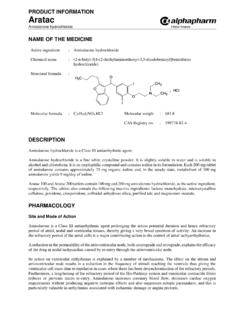
1 DOTHEP dothiepin hydrochloride PRODUCT INFORMATION Name of the Medicine Active ingredient: dothiepin (as hydrochloride) Chemical name: 3-(6H-dibenzo(b,e)-thiepin-11-ylidene) propyldimethylamine hydrochloride Structural formula: Molecular formula: C19H21NS. HCl Molecular Weight: 331. 9 CAS Registry No: 897-15-4 Description dothiepin hydrochloride is a white or faintly yellow, crystalline powder. It is freely soluble in water, in alcohol and in methylene chloride. DOTHEP capsules contain the following inactive excipients: lactose, povidone, sodium starch glycollate, lactose anhydrous, purified talc, magnesium stearate and purified water.
2 Pharmacology dothiepin is a thioanalogue of amitriptyline. It is generally equivalent to amitriptyline in antireserpine activity but less potent than imipramine. Site and mode of Action. The mechanism by which dothiepin and all tricyclic antidepressants produce an antidepressant effect is unknown, although the therapeutic site of action is thought to be in the CNS. dothiepin possesses anticholinergic, antihistamine and central sedative properties. It has been claimed that the cause of depression is associated with a functional abnormality of the biogenic amines, particularly the catecholamines, in the brain.
3 The tricyclics increase the availability of noradrenaline and 5-hydroxytryptamine at central noradrenergic synapses by inhibiting their uptake from nerve endings. Pharmacokinetics Absorption. dothiepin is well absorbed from the small intestine. There are substantial interindividual variations in plasma concentrations after a single dose due to the interaction of exogenous and endogenous processes. The relationship between dose and concentration in plasma can be quite dynamic and unpredictable, leading to extremely large interindividual differences in steady state drug concentrations in plasma.
4 After a single oral dose of 150 mg, a maximum concentration of ng/mL to ng/mL was achieved within 2 to 3 hours. Distribution. dothiepin crosses the blood-brain and placental barriers in animals and low concentrations are DOTHEP Product Information 2 excreted in breast milk. Studies in the dog and cat have shown maximal concentration after 24 hours in liver, uveal tract of the eye, lung, kidney, pituitary and thyroid in descending order. In dogs, the tissue/plasma ratio for uveal tract tissue was 257:1. Protein binding. Approximately 84% of unchanged drug is bound to serum protein. Metabolism. dothiepin is extensively demethylated by first-pass metabolism in the liver to its primary active metabolite, desmethyldothiepin (northiaden).
5 In man, 12 basic metabolites have been found in the urine. Paths of metabolism are thought to include N-demethylation, S-oxidation and glucuronic acid conjugation. There is active enterohepatic circulation in animals but this has not been shown in humans. Excretion. dothiepin is excreted in the urine, mainly in the form of its metabolites. Appreciable amounts are also excreted in the faeces. Following a 50 mg labelled dose, 71% is excreted in the urine and faeces within 4 days, with 56% being excreted by the renal route. Half-life. The elimination half-life is biphasic; the first phase is 15 to 18 hours.
6 Mean whole body elimination half-life is 51 hours. Indications For the treatment of major depression. The 75 mg tablet is indicated only for the maintenance treatment of major depression (see Precautions). Contraindications Epilepsy; seizure thresholds may be lowered by the drug. Tricyclic antidepressants should not be used concomitantly or within 14 days of treatment with monoamine oxidase inhibitors since cerebral excitation followed by coma and dangerous hyperthermia may occur following administration of this combination. Acute recovery phase following myocardial infarction; tricyclic anti-depressants may produce conduction defects and arrhythmias.
7 Hepatic failure (see Dosage and Administration: With impaired liver or renal function). Hypersensitivity to dothiepin . Precautions Due to its toxicity in overdose, DOTHEP should only be used in patients intolerant of or unresponsive to alternative treatment options (See Overdosage). Toxicity in overdose dothiepin is associated with high mortality in overdose. There is a low margin of safety between the (maximum) therapeutic dose and potentially fatal doses. Onset of toxicity occurs within 4-6 hours. A limited number of tablets should be prescribed to reduce the risk from overdose for all patients and especially for patients at risk of suicide.
8 A maximum prescription equivalent to two weeks supply of 75mg/day should be considered in patients with increased risk factors for suicide at initiation of treatment, during any dosage adjustment and until improvement occurs. Avoid concomitant medications that may increase the risk of toxicity associated with dothiepin (see Interactions with other Medicines). DOTHEP Product Information 3 Patients should be advised to store the medicine securely, out of sight and reach of children. In cases of overdose, patients should seek IMMEDIATE MEDICAL ATTENTION (see Overdosage). Clinical Worsening and Suicide Risk associated with Psychiatric Disorders The risk of suicide attempt is inherent in depression and may persist until significant remission occurs.
9 This risk must be considered in all depressed patients. Patients with depression may experience worsening of their depressive symptoms and/or the emergence of suicidal ideation and behaviour (suicidality), whether or not they are taking antidepressant medications, and this risk may persist until significant remission occurs. As improvement may not occur during the first few weeks or more of treatment, patients should be closely monitored for clinical worsening and suicidality, especially at the beginning of a course of treatment, or at the time of dose changes, either increases or decreases. Consideration should be given to changing the therapeutic regimen, including possibly discontinuing the medication, in patients whose depression is persistently worse, or who are experiencing emergent suicidality symptoms that may be precursors to worsening depression or suicidality, if these symptoms are severe, abrupt in onset, or were not part of the patient s presenting symptoms.
10 Patients with co-morbid depression associated with other psychiatric disorders being treated with antidepressants should be similarly observed for clinical worsening and suicidality. Pooled analyses of short-term placebo-controlled trials of antidepressant drugs (SSRIs and others) showed that these drugs increase the risk of suicidal thinking and behaviour (suicidality) in children, adolescents and young adults (aged 18-24) with major depressive disorder (MDD) and other psychiatric disorders. Short-term studies did not show an increase in the risk of suicidality with antidepressants compared to placebo in adults beyond age 24; there was a reduction with antidepressants compared to placebo in adults aged 65 and older.