Transcription of Background - UGC
1 An Emblem SymbolisingThe FutureUniversity Grants CommissionNew DelhiBackgroundIt was something that Prime Minister, Shri Atal BehariVajpayee, said during his speech on the occasion of theinitiation of the University Grants Commission (UGC) GoldenJubilee Year on 28 December 2002 that sparked off the ideaof revisiting the old UGC logo. In his speech, Shri Vajpayeespoke of the need to take a fresh look at the UGC Act, 1956in the light of the new challenges for the education sectoremerging in the twenty-first century. He also suggested thatthe Commission could consider changing its name to the`University education Development Commission . This nametruly captures the changed role of the UGC in recent , UGC was entrusted with the task of coordination,formulation and maintenance of the standards of universityeducation.
2 To this end, it engaged itself in, among otherthings, framing regulations on minimum standards ofeducation, determining standards of teaching, examinationand research in universities, monitoring developments in thefield of collegiate and university education , disbursing grantsto universities and colleges and setting up common facilities,services and programmes for a group of universities in theform of Inter-University , the higher education scenario has changedsignificantly over the years. The sector is now standing ata crossroads and is faced with multifarious challenges arisingfrom the exponential growth of higher education in the post-independence era, the changing global education scenario,changes in the global as well as domestic economy as wellas social and political changes.
3 The five key issues facingthe higher education sector today are: access and equity;relevance; quality and excellence; governance; and these issues requires innovative approachesand this is something the UGC has been attempting in asignificant manner over the last few increase access to education in the face of cripplingresource constraints, the UGC has been attempting totranscend geographical barriers by bringing about a synergybetween the conventional system of education and distanceAn Emblem Symbolising The Future1An Emblem Symbolising The Future2education. It is also working actively to leverage informationtechnology in a big way to help it in this task, with plans tolink all universities electronically in a phased that education cannot remain isolated fromthe requirements of the job market, the UGC is attemptingto take steps to increase the employability of students andencouraging universities to move, as the rest of the worldhas done, from the core teaching-learning process to aknowledge-linked learning process.
4 One of the approachesbeing adopted is to collapse the barriers between disciplinesand allowing students to pursue a professional degree alongwith their academic one. This will give students a basicgrounding in a discipline and equip them with professionalskills as UGC is also engaged in the task of preparing the highereducation sector to meet the challenges of globalisation andthe imperatives of the World Trade Organisation regime andthe General Agreement on Trade in Services (GATS). GATS would open India s education sector to foreign role of the public education system will become all themore important in this scenario since the private and foreignuniversities will not cater to students from non-metro andless affluent backgrounds. Apart from addressing the needsof its own students, India can also take a proactive approachand export Indian education , targeting the south East Asian,West Asian and african the UGC is now engaged in pursuing a forward-lookingstrategy which will meet the demand for skilled humanresources and safeguard the country s interests at the this changed role, it was felt that it was time to givea new look to the logo as well.
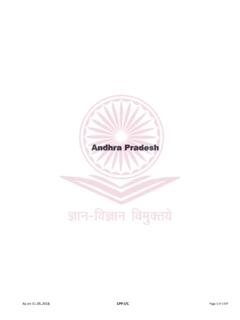
5 The old logo, adopted in 1992,also did not have a motto line that captured the essence ofthe Commission s goals and the essence of knowledgeThe logo and the motto line, Gyan-Vigyan Vimukte(Knowledge Liberates), convey the UGC s philosophy andavowed objective of uplifting the nation s destiny throughAn Emblem Symbolising The Future3quality education . Knowledge is like both light and light, it enlightens and empowers the individual andsociety as a whole, enabling them to overcome limitationsimposed by nature. And like sound, which seeps in throughthe most impermeable of barriers, knowledge cannot bestopped or barred in any chakra in the logo symbolises the Indian nation. Itstwenty-four spokes represent the continuous and uninterruptedflow of education , which is truly a life-long process.
6 The linesbelow the chakra portray an open book, the ultimate symbolof learning. The relevance of books has not diminished evenin this paperless era of e-learning and online education . Thelines are also symbolic of a pair of hands, because it isknowledge that supports and lifts the nation towardsdevelopment and ProcessThe process of finalising the new logowas a carefully considered one. Aconscious decision was taken withinthe UGC to tap the talent of youngIndia for the new logo. It was felt thatsince the logo was to represent thefuture UGC, the task should beentrusted to the country s future theyouth. This was also the view expressed by the three-memberexpert committee formed to oversee the process. The threeexperts are well-known names in the field of art: Prof. JeramPatel, former dean and head of the Department of AppliedArt at the University, Vadodara, Dr Rajeev Lochan,director of the National Gallery of Modern Art and Mr.
7 NandKatyal, former art director of Span magazine, who is closelyassociated with the Lalit Kala Akademi at Garhi, in process was formally launched in May 2003 and twenty-six institutions colleges, departments of arts/fine arts inuniversities were approached and requested to take partin the designing exercise. However, only sixteen of theseinstitutions accepted the invitation (Annexure A). The expertcommittee had a meeting with these institutions to work outProf. Jeram PatelMr Nand KatyalDr Rajeev LochanAn Emblem Symbolising The Future4the technical specifications of the Logo Design participating institutions were requested to holdcompetitions among their students and send in the ten bestentries to the UGC. So enthusiastic was the response amongthe students that the UGC received a total of 370 entriesagainst the expected expert committee went through all the 370 entries andzeroed in on five (Annexure B).
8 However, it felt that therewas scope for further improvement in all of these. A three-day workshop was then organised at the University,Vadodara in the last week of September 2003. The fiveshortlisted designers interacted with senior designers. Thedesigners modified their designs in the light of the suggestionsreceived and prepared variations of the selected entries finally emerged from the , the UGC had constituted another committeecomprising members of the Commission to decide on thelogo and motto line. The five members of the committeewere Prof. Rajasekharan Pillai, Prof. Tandon,Prof. Briz-Kishore, Prof. Vasant Gadre and Prof.(Mrs) Aruna Goel. This committee and the committee ofexperts then met to consider the thirty entries. They suggestedthat each of the shortlisted thirty entries, along with theconcept statement, be circulated to all members of theCommission for their comments and that a three-day exhibitionof these designs be held so that the UGC officers and otherstaff could air their opinions and provide further , in November 2003, the two committees met againto consider the designs in the light of the suggestions/opinionsthat were received.
9 The design executed by Ms PriyaJayanand, a final year student of the College of Fine Arts,Thiruvananthapuram was selected as the new UGC motto line, Gyan-Vigyan Vimukte (Knowledge Liberates),was suggested by Ms Aruna Goel and was acceptedunanimously since it was found to capture the essence ofknowledge and learning, besides reflecting the UGC s roleof promoting excellence in higher education and holisticdevelopment of Emblem Symbolising The Future5 The Winning DesignerTwenty-three year-old Priya Jayanand joined the College ofFine Arts at Thiruvananthapuram after completing her pre-degree in history from the Krishna Menon GovernmentWomen s College, Cannanore. She has been interested inpainting since she was a child, having been taught by herfather, a keen painter himself, and had decided on trainingin the arts after finishing Standard AList of participating of Art, New College of Art, Academy of Visual Art (CAVA)
10 , of Fine Art, of Fine Arts, Indira Kala SangitVishwavidyalaya, Fine Arts, Kurukshetra College of Fine Art, Institution of Fine Art, Bhawana, Visva Bharati University, of Fine Arts, University, of Fine Art, Faculty of Art education ,Jamia Millia Islamia University, College of Art, Design Centre, Indian Institute ofTechnology Institute of Design, College of Fine arts, Santram College of Fine Arts,Balabvidyanagar, GujaratAn Emblem Symbolising The Future6 Annexure BThe Shortlisted FiveMr. Shashank JhaFaculty of Fine Arts, , VadodaraMr. Nimesh ShahFaculty of Fine Arts, University, VadodaraMs. Priya JayanandCollege of Fine Arts, ThiruvananthapuramMr. Lakshay DharanFaculty of Fine Arts,Jamia Millia Islamia, DelhiMr.