Transcription of Bar Code Medication Administration - Leapfrog
1 1 Bar Code Medication AdministrationData by hospital on nationallyreported metricsReport Highlights Most reporting hospitals have a bar code Medication Administration (BCMA) system connected to an electronic Medication Administration record (eMAR), but only one-third fully meet Leapfrog s BCMA standard for safe and effective implementation of the system Hospitals not meeting the Leapfrog standard are most often failing by not scanning both the patient and Medication at least 95% of the time or not having adequate decision-support elements in place Nearly four out of five hospitals have all five of Leapfrog s recommended processes and structures in place to monitor and reduce workarounds that diminish the capacity of bar coding to improve patient safety Urban hospitals were more likely to fully meet the standard than rural hospitals, and teaching hospitals showed greater improvement from 2016 to 2017 than non-teaching institutionsMedication errors result in an estimated million adverse drug events (ADEs)
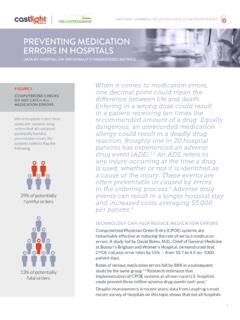
2 In the The typical hospitalized patient is exposed to at least one Medication error daily,2 with those mistakes contributing to an estimated 7,000 deaths each But with proper safeguards and use of technology such as bar code Medication Administration lives could be saved. Bar code Medication Administration (BCMA) systems scan a patient s wristband and Medication to be given in order to prevent Medication errors. Preventable Medication errors impact more than 7 million patients and cost almost $21 billion annually across all care In one study, the use of BCMA was associated with reducing Medication Administration errors by up to 93%.5 Leapfrog has developed the only national standard for using BCMA at the bedside and the annual Leapfrog Hospital Survey is the only source of publicly reported data on hospitals use of BCMA systems to prevent bedside Medication errors enabling patients to make well-informed choices about where to seek care. Minimizing Adverse Drug EventsAn ADE occurs when a patient is harmed due to Medication .
3 In these cases, a decimal point error, overlooking patient allergies or a potentially harmful drug interaction, and/or confusing similarly named drugs could cause death or a serious systems linked with eMARs are designed to prevent Medication errors at the point of administering Medication to patients at the bedside. A nurse or other clinician administering Medication scans a bar code on a patient s wristband to confirm he or she is the right patient, and then scans a bar code on the prescribed Medication to verify the right drug, dose, and time of delivery. The system also connects with the electronic medical record to check vital signs and allergies and call for backup support if needed. 2 Assembling a national panel of experts,6 The Leapfrog Group examined best practices for BCMA, including its proper use and how to avoid workarounds that could nullify the benefits in developing a standard for hospital adoption of BCMA. Publicly reported for the first time on the 2016 Leapfrog Hospital Survey, this report, based on the 2017 Survey, provides key insights into the progress made to date and the room for improvement that still Progress, but Significant Improvement NeededNearly all reporting hospitals ( ) have a BCMA system implemented in at least one inpatient unit with the vast majority of these hospitals ( ) using the system in all applicable However, only of reporting hospitals fully met all four requirements of the BCMA standard (Figure 1).
4 This represents an improvement from the of hospitals that fully met the standard in 2016. Another of reporting hospitals have made substantial progress toward the Leapfrog standard, meeting three of the four criteria. An additional of hospitals met two of the four requirements (Figure 2).A Closer Look at Where Hospitals are Falling ShortOf hospitals reporting that they lack at least one of the four requirements for Leapfrog s BCMA standard, the most disappointing lapse and dangerous from a patient safety perspective is that are failing to scan both the patient and the Medication for at least 95% of bedside Medication administrations. This means that more than two in five hospitals that have implemented BCMA technology simply aren t using it consistently enough to safeguard all their 1: About BCMAWhat it isAn electronic scanning system that intercepts Medication errors at the point of Administration . By scanning bar codes on a patient s wristband and on prescribed medications, nurses or other clinicians can confirm that they have the right patient, right Medication , and right dose, given at the right Ensures that patients receive the right Medication in the right dosages, when needed Provides a valuable double check on the clinical reasoning of pharmacists and nurses Adds efficiency by eliminating manual recording in a patient s chart and updating the hospital s electronic health record (EHR) systemLeapfrog s Standard Implement a BCMA system linked to an electronic Medication Administration record in 100% of the hospital s medical and/or surgical units (adult and pediatric), labor and delivery units, and intensive care units (adult, pediatric, and neonatal)
5 Scan both patient and Medication bar codes in 95% of bedside Medication administrations in BCMA-equipped units Use a BCMA system that includes all seven decision-support elements identified as best practices by the Leapfrog BCMA Expert Panel Implement all five best-practice processes and structures to prevent workarounds of the BCMA systemFIGURE 2: How Hospitals Measure up on meets standard(all 4 criteria)Substantial progress(meets 3 of 4 criteria)Some progress(meets 2 of 4 criteria)Willing to report (meets 0 or 1 criteria) 3 Another frequent omission ( ) was hospitals not having all seven decision-support elements in place to help guard against Medication errors. Only about three in five ( ) of reporting hospitals with a BCMA system in place in at least one inpatient unit had all seven types of decision support. The decision-support elements most likely to be missing were a built-in vital sign check ( of those reporting and missing one or more decision supports) and a patient-specific allergy check ( ) (Figure 3).
6 Working to Avoid Dangerous WorkaroundsHuman error is unavoidable. The effectiveness of any technology is only as good as the effectiveness of its implementation in the delivery of care. Even when BCMA systems are well designed, problems can arise that force users of the system to act outside of the prescribed norms. The Leapfrog BCMA standard incorporates five best-practice processes and structures to prevent the workarounds that undermine the efficacy of BCMA as a patient safety tool. These include: A formal committee to oversee BCMA use Backup systems for hardware failures A help desk to respond to BCMA issues in real-time Conducting real-time observations of staff using the BCMA system Engaging with nursing leadership on BCMA usageMost ( ) of the hospitals that have implemented BCMA systems have incorporated all five recommendations to guard against workarounds. This is a slight improvement over 2016 when of hospitals had all five in place. Of those that were missing one or more of these best practices to prevent workarounds, the most common slip was not conducting real-time staff observations ( ), followed by not establishing a formal committee to review data on BCMA use ( ).
7 In 2018, the Leapfrog Hospital Survey will be updated to ask hospitals about three additional processes to prevent workarounds. Nominal Difference Between Teaching and Non-Teaching HospitalsIn the 2017 Leapfrog Hospital Survey, of teaching hospitals and of non-teaching hospitals fully met the BCMA standard, indicating very little difference between the two types of facilities ability to implement BCMA and use it effectively. Teaching hospitals as a group did make the largest improvement between 2016 FIGURE 3: Missing Decision-Support Elements in BCMA SolutionsVital sign checkPatient-specific allergy checkSecond nurse check neededWrong time (early/late warning) Wrong dose Wrong patientWrong Medication 4: Real-time observation of staff helps ensure effective use of BCMA to avoid Medication Health, Spear Street, Suite 400 San Francisco, CA 94105 Tel: 415 829 2018 Castlight Health, Inc. Castlight Health is the registered trademark of Castlight Health, 2017, with the percent of teaching hospitals fully meeting the standard increasing by more than one-third (from ) in hospitals were more likely to meet the Leapfrog BCMA standard than rural hospitals, with of urban hospitals fully meeting the standard in 2017 compared with of rural Use and More Transparency NeededClearly, there s significant room for improvement in how hospitals use BCMA systems to deliver maximum patient safety benefits for patients.
8 In addition, a considerable number of hospitals still do not report on BCMA usage. Additional transparency from these facilities is critical to making true patient safety participating in the Leapfrog Hospital Survey, hospitals can assess their use of BCMA systems at the bedside and identify better ways to prevent harm to patients, while enabling patients to make more-informed decisions on where to seek Leapfrog Hospital SurveyThe Leapfrog Group invites all adult general acute care and free-standing pediatric hospitals in the United States to voluntarily report on topics such as maternity care, healthcare-associated infections, Medication safety , safe practices for better health care, and never events through its annual Survey. In 2017, nearly 2,000 hospitals submitted a Survey, representing two-thirds of inpatient beds nationwide. This report uses final hospital data from the 2017 Leapfrog Hospital Survey (data submitted through December 31, 2017).The Leapfrog Hospital Survey includes measures that are endorsed by the National Quality Forum (NQF) and/or aligned with those of other significant data collection entities, including the Centers for Medicare & Medicaid Services (CMS) and The Joint Commission.
9 Leapfrog partners with the Armstrong Institute for Patient safety and Quality at Johns Hopkins Medicine to review Survey measures and standards, and updates them annually to reflect the latest science. Additionally, panels of volunteer experts meet regularly to review the Survey measures and recommend performance standards for each subject area covered in the Leapfrog Hospital Survey. The full list of measures included in the Survey is available at is on a mission to make it as easy as humanly possible to navigate healthcare and live happier, healthier, more productive lives. Our health navigation platform connects with hundreds of health vendors, benefits resources, and plan designs, giving rise to the world s first comprehensive app for all health needs. We guide individuals based on their unique profile to the best resources available to them, whether they are healthy, chronically ill, or actively seeking medical care. In doing so, we help companies regain control over rising healthcare costs and get more value from their benefits investments.
10 Castlight revolutionized the healthcare sector with the introduction of data-driven price transparency tools in 2008 and the first consumer-grade wellbeing platform in 2012. Today, Castlight serves as the health navigation platform for millions of people and is a trusted partner to many of the largest employers in the more information, visit and connect with us on Tw i t t e r and LinkedIn and Facebook. Founded in 2000 by large employers and other purchasers, The Leapfrog Group is a national nonprofit organization driving a movement for giant leaps forward in the quality and safety of American health care. The flagship Leapfrog Hospital Survey collects and transparently reports hospital performance, empowering purchasers to find the highest-value care and giving consumers the lifesaving information they need to make informed decisions. The Leapfrog Hospital safety Grade, Leapfrog s other main initiative, assigns letter grades to hospitals based on their record of patient safety , helping consumers protect themselves and their families from errors, injuries, accidents, and Aspden P, Wolcott J, Bootman JL, Cronenwett LR, eds.