Transcription of MATERNITY CARE - Leapfrog
1 1 Giving birth marks one of life s most important milestones for many women and families. For privately-insured women ages 19-441, MATERNITY care accounts for the majority of all hospitalizations. Despite the significance of this area of care , there is substantial evidence that hospitals overuse medical interventions, exposing mothers and babies to unnecessary health risks from C-sections, episiotomies, and early elective deliveries. Private and public purchasers of health care have long pushed for public reporting of these important measures, and where that has occurred experts observe important quality improvements.
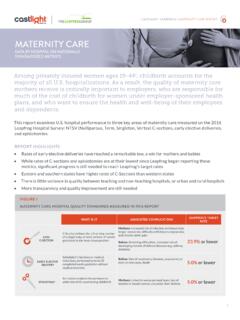
2 Public reporting of individual hospitals results can empower women to choose a hospital based on quality. However, not all hospitals participate in these transparency initiatives. And even for those that do, most are not meeting national performance targets for key MATERNITY care metrics (Figure 1). HOSPITALS OVERUSE MEDICAL INTERVENTIONS FOR LOW-RISK MOTHERS DELIVERING FULL-TERM BABIESAn episiotomy is an incision made in the perineum to widen the birth canal during childbirth. Because episiotomies have been linked to worse perineal tears, loss of bladder or bowel control, and pelvic floor defects2, medical guidelines recommend episiotomy in only a small proportion of cases3.
3 Leapfrog s target for all hospitals is 5%, meaning that no more 5% of women should be having an episiotomy for a vaginal delivery, except for a narrow set of medical necessities such as shoulder dystocia ( , where a baby s shoulder gets stuck during delivery). For the majority of reporting hospitals (68%), the episiotomy rate was above the target. EARLY ELECTIVE DELIVERY:C-SECTIONS: EPISIOTOMY: HIGH-RISK DELIVERY: MATERNITY CAREDATA BY HOSPITAL ON NATIONALLY STANDARDIZED METRICS CASTLIGHT - Leapfrog | MATERNITY care REPORT16% 60%68% 78% FIGURE 1 HOSPITALS FAIL TO COMPLY WITH NATIONAL MATERNITY care STANDARDSL eapfrog compared each hospital s performance to evidence - based standards set by its MATERNITY care Expert Panel.
4 The percentage of hospitals that did NOT fully meet Leapfrog s standards: 2 CASTLIGHT - Leapfrog | MATERNITY care REPORTS imilarly, at the majority of reporting hospitals (60%) the C-section rate was also above the target. Although different states and studies often use different measures to assess C-section rates, Leapfrog utilizes one standardized, endorsed measure for all hospitals nationwide (nulliparous term singleton vertex, or NTSV, C-section) to enable hospital comparisons across the country. This measure examines the percentage of first-time mothers giving birth to a single baby ( , no twins or other multiples) at term (at least 37 weeks gestation), in the head-down position.
5 With this standardized measure and Leapfrog s transparency, this is the first and only time that national reporting of C-section rates is available by s target for this measure is a rate of or below. Leapfrog s MATERNITY care Expert Panel set this target rate based on the goals of Healthy People 20204, a federal program that sets evidence - based benchmarks for improving the health of Americans. C-sections carry serious risks of infection and blood clots, and many women experience longer recoveries and difficulty with future pregnancies. C-sections can also cause problems for babies, like breathing difficulties that need treatment in a newborn intensive care unit (NICU).
6 In the long-term, research shows that C-sections can cause chronic pelvic pain in some women, and babies born by C-section are at increased risk of developing chronic childhood diseases like asthma and diabetes5. Compared to episiotomies and C-sections, Leapfrog s data shows that early elective deliveries are less frequently performed, meaning that hospitals are doing a better job of keeping mothers and babies safe from unnecessary risks. On average, more than four out of five hospitals have met Leapfrog s target of 5% or less for early elective deliveries, meaning that at most hospitals no more than 5% of mothers delivering newborns are being scheduled for a C-section or induction prior to 39 completed weeks of gestation without medical necessity.
7 The current nationwide average rate of represents tremendous progress compared to the average rate of 17% when Leapfrog first reported this measure in 2010. Leapfrog s public reporting sparked policymakers and hospitals to take steps to reduce early elective deliveries, and many other organizations have since collaborated to achieve results in this area. Because of these efforts, fewer infants face increased risk of complications that come with early elective delivery, including respiratory distress, pneumonia, or even, in rare cases, death6. APPROPRIATE EXPERIENCE WITH HIGH-RISK DELIVERIES IS LACKINGA hospital s level of experience can decrease the risk of infant mortality or complications, especially important for high-risk deliveries, or those in which the baby has a very low birth weight (less than 1500 grams or 3 pounds, ounces).
8 These babies are more likely to survive if their hospital has an experienced neonatal intensive- care unit (NICU) on-site7. FIGURE 2NO STATE HAD MORE THAN 50% OF HOSPITALS MEETING Leapfrog S STANDARDS FOR HIGH-RISK DELIVERYTHE PERCENTAGE OF HOSPITALS MEETING Leapfrog S STANDARDLess than five hospitals reporting in 20150-9%10-19%20-29%30-50%Visit to view performance by hospital. 3 CASTLIGHT - Leapfrog | MATERNITY care REPORTYet, 78% of reporting hospitals performing high-risk deliveries did not meet Leapfrog s standards. Leapfrog recommends that hospitals deliver at least 50 very-low birth weight babies per year and ensure that at least 80% of mothers receive antenatal steroids prior to delivery OR maintain a lower-than-average morbidity/mortality rate for very-low birth weight babies and ensure that at least 80% of mothers receive antenatal steroids prior to MOTHER S STATE OF RESIDENCE AND CHOICE OF HOSPITAL AFFECT THE care SHE AND HER BABY RECEIVEW hile performance over time has greatly improved on early elective deliveries and episiotomies.
9 Hospitals overall rate of NTSV C-sections and experience in delivering very low birth-weight babies is far from meeting Leapfrog s standard. A closer look at hospitals performance on the NTSV C-section and high-risk deliveries metrics reveal significant variation between certain states across the country. For high-risk deliveries, the percentage of hospitals meeting Leapfrog s standard varied from 0% in Utah and Missouri to 50% in Ohio and Nevada (Figure 2). That means that mothers living in Utah and Missouri do not have any hospital in their state that can provide the recommended care for their low birth-weight mother s state of residence partially determines the care that she and her baby receive, yet most mothers across the country can ensure they receive the best available care by using these publicly reported results to choose the hospital for their child s birth.
10 This choice can have a large impact on the care received, because hospital MATERNITY care quality varies significantly even within communities. For example, in the metropolitan area near one major East Coast city, the C-section rate ranged from 10% to 54% (Figure 3). MORE TRANSPARENCY AND QUALITY IMPROVEMENT ARE NEEDEDN ationwide, only 1% of reporting hospitals fully met the standard for all four of Leapfrog s MATERNITY care metrics. All hospitals should be striving towards improving the quality of MATERNITY care for mothers and babies, even those that are fully meeting standards. Moreover, some hospitals declined to report their data at all.