Transcription of Bat House Handbook2004
1 TheBat House Builder sH a n d b o o kTheBat House Builder sH a n d b o o kMerlin D. TuttleMark KiserSelena KiserUpdated and Revised - Box 162603, Austin, Texas 78716 Dear Friend:Thank you for your interest in helping bats. Building and installing a bat House can make a difference for bats and help promote a healthy environment. And you can accomplish even moreby joining Bat Conservation addition to funding critical conservation efforts around the world, BCI members receive: BATS magazine, our quarterly publication filled with full-color photos and the latest discoveries about bats Invitations to join workshops, field projects and ecotours, as well as opportunities to see theworld s largest bat colony emerge from Bracken Cave in central ll find additional details in this handbook .
2 We hope to hear from you illustration by David Chapman from artwork by Andrea PeytonBack cover:The spectacular sight of large numbers of bats in flight across the evening skies used to befar more common. Many North American bats have lost key roosting habitat, from caves to old-growth forests. Erecting bat houses and carefully observing the results give us a uniqueopportunity to help these magnificent animals. PHOTO ' MERLIN D. TUTTLE, BCI / 8406409A publication of Bat Conservation International, Inc. Copyright 1993, 2004, 2013 Bat Conservation International. Printed on recycled 0-9742379-1-4 Sincerely,Merlin D. TuttleFounder and PresidentBat Conservation International-1993-This edition was revised and updated in 2013by Jim Kennedy, Robert Locke and Dianne Odegard of Bat Conservation Internationaland Laura Seckbach Finn of Fly By Night, Bat House Builder s HandbookWhy Build a Bat House ?
3 4 Building a Community Bat House ..5 Building Your Bat Bat House Nursery House Rocket Box for Bat House Experimenters ..16 BCI Research Boosts Bat House We re Learning from for the Your Bat of Bat Asked Bat House Most Likely to Occupy Bat Need Your Help! ..35 ContentsAMERICA S BATS ARE AN ESSENTIAL PARTof a healthyenvironment. Nevertheless, many bat species arein alarming decline, largely because of unwar -ranted human fear and persecution and the loss of natural roosts. You can help by putting up a bat ll benefit directly from having fewer yard pests andwill enjoy learning about bats and sharing your knowl-edge with friends and neighbors. Few efforts on behalf ofwildlife are more fun or rewarding than helping primary predators of night-flying insects, bats playa vital role in maintaining the balance of nature.
4 By consuming vast numbers of pests, they rank amonghumanity s most valuable allies. Just one little brownmyotis can catch a thousand or more mosquito-sizedinsects in an hour, and a colony of 150 big brown batscan catch enough cucumber beetles each summer to pre-vent egg laying that otherwise could infest local gardenswith 33 million rootworms. Cucumber and June beetles,stinkbugs, leafhoppers, and cutworm and corn earwormmoths all well-known pests are just a few of themany insects consumed by these frequent users of bathouses. In addition, many pests flee areas where theyhear bat echolocation immediate goal is to preserve America s mostwidespread species in sufficient numbers to maintainnature s balance and reduce demands for chemical pesti-cides.
5 Thanks to a decade of BCI-sponsored bat houseresearch we are now able to accommodate 14 species ofNorth American bats in the bat houses described in thishandbook, including threatened and endangered speciessuch as the Indiana myotis and Wagner s bonneted houses are being used from Mexico and theCaribbean to British Columbia and of all, if you carefully follow instructions, yourodds of success exceed 80 percent. Isn t it about time toextend a helping hand in exchange for a healthier neighborhood?Why Build a Bat House ?Putting up a bat House is one of the more rewarding ways to helpwildlife. A maternity colony of several hundred little brown myotisraised young in this back-to-back pair (only one side shown) of nurseryhouses in British Columbia, Canada.
6 Bat houses like these are nowproviding shelter for thousands of North American bats each House designscontinue to boxes,invented by Forest Servicebiologists DanDourson and JohnMacGregor, arebeing used by atleast eight species ofcrevice-dwelling batsacross NorthAmerica (Figures 6and 7, pages 14-15).This design allowsbats to choosesunny or shadedsides, depending ontheir Bat House Builder s handbook Mark & Selena kiSer, BCi / 9151201 Mark & Selena kiSer, BCi / 9166305 SOMETIMES YOU NEED A REALLY BIG BAT House one that can handle thousands of bats. BCI canhelp with communities become more aware of the impor-tance of bats, humane exclusions are becoming the rulewhen bat colonies are dis-covered in buildings.
7 Butthe displaced bats still needa place to live, and thereoften are many more batsthan traditional bat housescan worked with archi-tects and engineers todesign a "community bathouse" that's 10 feet squareand mounted on utilitypoles. With hundreds ofremovable chambers, thestructure can House up toabout 30,000 bats. Initial constructionplans have been amendedto give the community bathouse broader utility and toensure it meets typical stateand local building of these structureshave been built recently byconservation-minded com-munities in Florida a Community Bat House The Bat House Project5 CourteSy of Cori lauSenConstruction plans for BCI's community bathouse are available free by contacting BCI'sArtificial Roosts Coordinator bat condo, based onBCI s plans, can House up to30,000 bats.
8 It was built atthe Creston Valley WildlifeManagement Area in BritishColumbia, WITHBCI s Bat House Project conduct-ed research on hundreds of bat houses and otherartificial roosts. The designs illustrated on the fol-lowing pages incorporate the most successful features iden-tified in those tests. The correct bat House for you dependson available tools and lumber, your skill as a carpenter, yourbudget and your expectations. You can, of course, modifyyour bat House to adjust for location-specific factors, such asclimate and the preferences of local Criteria for Successful Bat HousesDesignThe most successful bat houses have roost chambers atleast 20 inches tall and at least 14 inches wide. Taller andwider houses are even better.
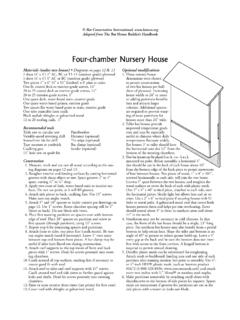
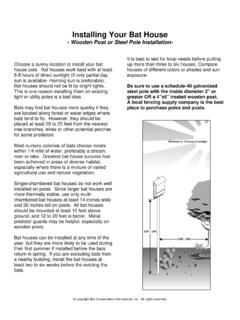
9 Rocket boxes, a newer pole-mounted design with continuous, 360 chambers, shouldbe at least 3 feet tall (Figure 6 on page 14). All housesshould have 3- to 6-inch landing areas extending below theentrances or recessed partitions with landing space number of roosting chambers is not critical, but ingeneral, the more chambers the better. Single-chamberedhouses (Figure 3 on page 10) should be mounted on wood-en or masonry buildings, which helps to buffer tempera-ture fluctuations. Houses with at least three chambers aremore likely to provide appropriate ranges of temperatureand better accommodate the larger numbers of bats typi-cal of nursery colonies. Two single-chamber houses can bemounted back-to-back on two poles to create a three-chamber bat nursery House plans on pages 11-13 (Figures 4 and5) represent the best compromise between bat needs andbuilder convenience.
10 The 171 2-inch width enables buildersto make two houses from a half-sheet each of 3 8-inch and 1 2-inch plywood and sharply reduces waste materials. Widthsof 24 inches or more and heights of 36 inches or more arepreferred by many bats. Greater heights are not often nec-essary but might be appreciated for their greater thermalgradients. Roost partitions should be carefully spaced 3 4inch to 1inch apart. Three-quarter inch is generally preferable,although some small myotis bats and tri-colored bats mayprefer roosting crevices between 1 2inch and 3 4inch, whileBuilding Your Bat HouseNew discoveries greatly enhanceour ability to attract bats ..larger bats may prefer 1 inch to 11 2inches. Chambersgreater than 3 4inch, however, are more likely to attractnon-target animals, such as wasps, rodents and and landing areas must be modified to pro-vide footholds for bats.