Example: bachelor of science
Bayesian Inference for the Normal Distribution
Bayesian Inference for the Normal Distribution 1. Posterior distribution with a sample size of 1 Eg. . is known. Suppose that we have an unknown parameter for which the prior beliefs can be express in terms of a normal distribution, so that where and are known. Please derive the posterior distribution of given that we have on observation
Tags:
Information
Domain:
Source:
Link to this page:
Documents from same domain
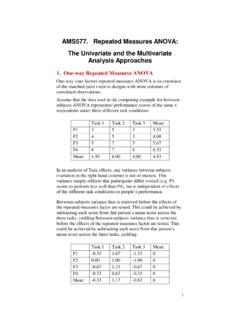
AMS577. Repeated Measures ANOVA: The …
www.ams.sunysb.edu1 AMS577. Repeated Measures ANOVA: The Univariate and the Multivariate Analysis Approaches 1. One-way Repeated Measures ANOVA One-way (one-factor) repeated-measures ANOVA is an extension
Repeated Measures ANOVA - Stony Brook
www.ams.sunysb.eduAs with any ANOVA, repeated measures ANOVA tests ... In the one-way analysis of variance without a repeated measure, we would have each subject receive
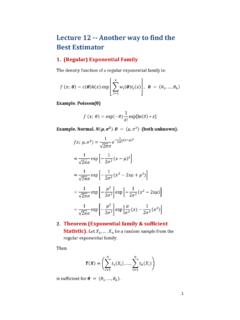
Lecture 12 -- Another way to find the Best Estimator
www.ams.sunysb.edu1 Lecture 12 -- Another way to find the Best Estimator 1. (Regular) Exponential Family The density function of a regular exponential family is:

Examples: Joint Densities and Joint Mass Functions
www.ams.sunysb.eduAMS 311 Joe Mitchell Examples: Joint Densities and Joint Mass Functions Example 1: X and Y are jointly continuous with joint pdf f(x,y) = ˆ cx2 + xy 3 if 0 ≤ x ≤ 1, 0 ≤ y ≤ 2

Chapter 3: The basic concepts of probability - Stony Brook
www.ams.sunysb.eduChapter 3: The basic concepts of probability Experiment: a measurement process that produces quantifiable results (e.g. throwing two dice, dealing cards, at poker, measuring heights of people, recording proton-proton collisions)
Vector Autoregression - Stony Brook
www.ams.sunysb.eduOverview Vector Autoregression (VAR) model is an extension of univariate autoregression model to multivariate time series data VAR model is a multi-equation system where all the variables are treated as endogenous (dependent) There is one equation for each variable as dependent variable. In its reduced form, the right-hand side of each
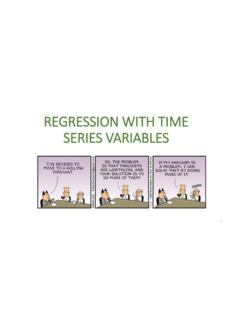
REGRESSION WITH TIME SERIES VARIABLES
www.ams.sunysb.edu•Regression modelling goal is complicated when the researcher uses time series data since an explanatory variable may influence a dependent variable with a time lag. This often necessitates the inclusion of lags of the explanatory variable in the regression. •If “time” is the unit of analysis we can still regress some dependent

Unit Root & Augmented Dickey-Fuller (ADF) Test
www.ams.sunysb.eduDickey-Fuller Tests • If a constant or trend belong in the equation we must also use D-F test stats that adjust for the impact on the distribution of the test statistic (* see problem set 3 where we included the drift/linear trend in the Augmented D-F test). • The D-F is generalized into the Augmented D-F test to accommodate the general

The Ordinary Least Squares (OLS) Estimator
www.ams.sunysb.eduGauss-Markov Theorem • Given OLS assumptions 1 through 6, the OLS estimator of β k is the minimum variance estimator from the set of all linear unbiased estimators of β
Related documents
Rules of Inference - Duke University
courses.cs.duke.edu•Inference rules are all argument simple argument forms that will be used to construct more complex argument forms. Next, we will discover some useful inference rules! Friday, January 18, 2013 Chittu Tripathy Lecture 05 Modus Ponens or Law of Detachment Example:
Inference Rules and Proof Methods - Engineering
www.site.uottawa.caFormal Proofs: using rules of inference to build arguments De nition A formal proof of a conclusion q given hypotheses p 1;p 2;:::;p n is a sequence of steps, each of which applies some inference rule to hypotheses or previously proven statements (antecedents) to yield a new true statement (the consequent).

Variational Inference - Princeton University
www.cs.princeton.eduinference is one of the central problems in Bayesian statistics. 3 Main idea We return to the general fx;zgnotation. The main idea behind variational methods is to pick a family of distributions over the latent variables with its own variational parameters, q(z 1:mj ): (5) Then, nd the setting of the parameters that makes qclose to the ...
Statistical Inference - Tanujit Chakraborty's Blog
www.ctanujit.orgTitle: Statistical Inference Author: George Casella, Roger L. Berger Created Date: 1/9/2009 7:22:33 PM

The Conjugate Prior for the Normal Distribution
people.eecs.berkeley.eduStat260: Bayesian Modeling and Inference Lecture Date: February 8th, 2010 The Conjugate Prior for the Normal Distribution Lecturer: Michael I. Jordan Scribe: Teodor Mihai Moldovan We will look at the Gaussian distribution from a Bayesian point of view. In the standard form, the likelihood has two parameters, the mean and the variance ˙2: P(x 1 ...

Inference in Bayesian Networks - MIT OpenCourseWare
ocw.mit.eduInference in Bayesian Networks Now that we know what the semantics of Bayes nets are; what it means when we have one, we need to understand how to use it. Typically, we’ll be in a situation in which we have some evidence, that is, some of the variables are instantiated,

4.2 Conditional Distributions and Independence
www.math.ntu.edu.tw4.2 Conditional Distributions and Independence Definition 4.2.1 Let (X,Y) be a discrete bivariate random vector with joint pmf f(x,y) andmarginal pmfs fX(x) and fY (y).For any x such that P(X = x) = fX(x) > 0, the conditional pmf of Y given that X = x is the function of y denoted by f(y|x) and defined by f(y|x) = P(Y = y|X = x) = f(x,y) fX(x) For any y such that P(Y = y) = fY (y) > 0, the ...