Example: air traffic controller
Bed Transfer Instructions with Log Rolling
Bed Transfer Instructions with Log Rolling. To get into your bed: Step 1: Position yourself toward the top of the bed. Lift. Step 2: Begin to scoot further back on the bed and shift your weight in a diagonal direction. Step 3: Bend your elbow and begin to lean on it. both legs at thesame time onto bed. Lie down.
Tags:
Information
Domain:
Source:
Link to this page:
Documents from same domain

Lower Extremity Strengthening Exercises in Supine
ahc.aurorahealthcare.orgLower Extremity Strengthening Exercises in Supine, Page 2 X19572bc (Rev. 04/10) ©AHC Lower Extremity The information presented is intended for general information and educational purposes.

Relaxation Exercises - Aurora Health Care
ahc.aurorahealthcare.orgX26017 (07/06) ©AHC Breathing/Relaxation Relaxation Exercises The information presented is intended for general information and educational purposes. It is not intended to replace the advice of your health care provider. Contact your health care provider if you believe you have a health problem.

Hip: Straight Leg Raise – Supine 4-Way - Aurora Health Care
ahc.aurorahealthcare.orgHip: Straight Leg Raise – Supine 4-Way Straight leg raise – flexion 1. Lie on your back. 2. Bend uninvolved knee and put foot on floor. 3. Slowly tighten the thigh muscle of the involved leg, performing a quad set. 4. Flex foot of involved leg toward nose. 5. Slowly lift entire leg 12 to 18 inches off floor.
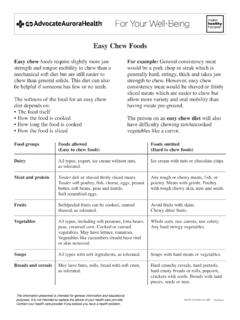
Easy Chew Foods - Aurora Health Care
ahc.aurorahealthcare.orgEasy Chew Foods. Easy chew foods require slightly more jaw strength and tongue mobility to chew than a mechanical soft diet but are still easier to chew than general solids. This diet can also be helpful if someone has few or no teeth. The softness of the food for an easy chew

“D (Rh) Type” and “D Variant” Antigen
ahc.aurorahealthcare.org“D (Rh) Type” and “D Variant” Antigen What is the D antigen? D antigen is a protein with many parts, found on the surface of red blood cells. The D antigen is also known as the “Rh factor” and it tells us your blood type. People are either D (Rh) negative or D (Rh) positive. If your blood type is D negative, your red

Vestibular Rehabilitation Exercises – Level 1
ahc.aurorahealthcare.orgVestibular Rehabilitation Exercises – Level 1, page 3 X20521 (Rev. 12/2019) ©AAHC Vertigo/Vestibular. The information presented is intended for general information and educational purposes. It is not intended to replace the advice of your health care provider. Contact your health care provider if you believe you have a health problem. 6.

Shoulder: Rotator Cuff Isometric Program – Standing
ahc.aurorahealthcare.orgX08252 (Rev. 11/2019) ©AAHC \OT Shoulder/Scapula Shoulder: Rotator Cuff Isometric Program – Standing. Isometric exercises are muscle tightening exercises performed with no joint movement. Their action is to increase circulation for healing and strengthening muscles with minimal joint irritation.
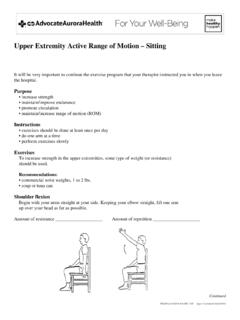
Upper Extremity Active Range of Motion – Sitting
ahc.aurorahealthcare.orgTo increase strength in the upper extremities, some type of weight (or resistance) should be used. Recommendations: • commercial wrist weights, 1 to 2 lbs. • soup or tuna can . Shoulder flexion Begin with your arms straight at your side. Keeping your elbow straight, lift one arm . up over your head as far as possible.
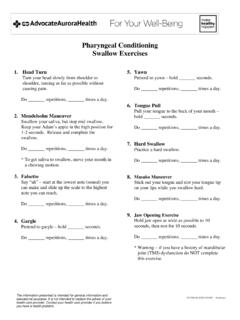
Pharyngeal Conditioning Swallow Exercises
ahc.aurorahealthcare.orgSwallow your saliva, but stop mid swallow. Keep your Adam’s apple in the high position for 1-2 seconds. Release and complete the swallow. Do _____ repetitions, _____ times a day. * To get saliva to swallow, move your mouth in a chewing motion. 3. Falsetto 8. Say “ah” – start at the lowest note (sound) you

Cervical Range of Motion and Isometrics Home Exercise …
ahc.aurorahealthcare.org3. Neck Flexion. Slowly bend your head forward, return to the starting position. Hold . Perform . seconds. Repeat times per day. times. 4. Neck Sidebending. Slowly tilt your head toward one shoulder, then slowly repeat . to the opposite side while keeping your face straight ahead. Hold . Perform . seconds. Repeat times per day. times. 5. Neck ...
Related documents
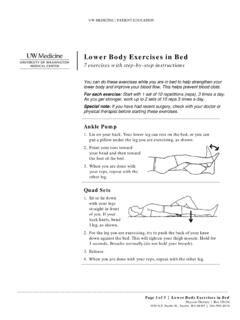
Lower Body Exercises in Bed - University of Washington
healthonline.washington.eduYou can do these exercises while you are in bed to help strengthen your lower body and improve your blood flow. This helps prevent blood clots. For each exercise: Start with 1 set of 10 repetitions (reps), 3 times a day. As you get stronger, work up to 2 sets of 15 reps 3 times a day.

Bed Positioning for Stroke Patients - Aurora Health Care
ahc.aurorahealthcare.orgBed Positioning for Stroke Patients. A. Lying on your back or sitting • Place a pillow under your head. • Place a pillow under affected shoulder, elbow, forearm, wrist and hand. • Use foot splint to prevent heel cord tightening and skin breakdown. B. Lying on unaffected side • Place a pillow under your head. • Ask someone to help you ...
Protect yourself from plague
www.cdc.gov5. Do not let pets sleep in the bed with you. This has been shown to increase your risk of getting plague. 6. Use insect repellent that contains DEET to prevent flea bites. Protect your pets 1. Treat dogs and cats for fleas regularly. 2. Keep pet food in rodent-proof containers. 3. Take sick pets to the veterinarian promptly. 4.
Swing Bed Services - CMS
www.cms.govswing bed stay must normally be within the same spell of illness as the qualifying stay. However, during the COVID-19 PHE, CMS waives the 3-day stay and the same spell of illness requirement. Background A hospital or CAH doesn’t have to locate their swing beds in a special facility section unless the hospital

Rigging Safety Guide - MCAA
www.mcaa.orgRIGGING SAFETY GUIDE Forward Experienced mechanical construction and service workers are experts in pipefitting, plumbing, or mechanical service work, but not necessarily in rigging.
Medicare coverage of skilled nursing facility care.
www.medicare.govlike getting in and out of bed, eating, bathing, dressing, and using the bathroom. It may also include care that most people do themselves, like using eye drops, oxygen, and taking care of colostomy or bladder catheters. Custodial care is often given in a nursing facility. See page 20 for ways to get help paying for custodial care. Generally ...

Pressure Ulcer Staging - mnhospitals.org
www.mnhospitals.orgbed. Often include undermining and tunneling. Unstageable: Full thickness tissue loss in which the base of the ulcer is covered by slough (yellow, tan, gray, green or brown) and/or eschar (tan, brown or black) in the wound bed. Suspected Deep Tissue Injury (sDTI): Purple or maroon localized area of discolored