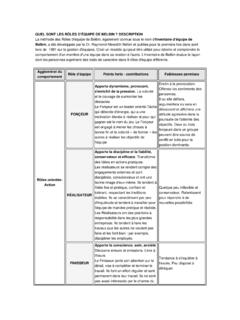
Transcription of Belbin and CIPD roles in creative process
1 roles and Behaviours of creative process Page | 1 C e n t r e f o r M a n a g e m e n t C r e a t i v i t y H i g h T r e n h o u s e M a lh a m M o o r S E T T L E N o r t h Y o r k s h i r e B D 2 4 9 P R T e l : 0 1 7 2 9 8 3 0 3 2 2 F a x: 0 1 7 2 9 8 3 0 5 1 9 e - m a i l : c m c @ c e n t r e f o r m a n a g e m e n t c r e a t i v i t y . c o m w w w . c e n t r e f o r m a n a g e m e n t c r e a t i v i t y . c o m Understanding and using CIPD Behaviours People have different talents in relation to how they manage processes.
2 Before you can assess those talents it is useful to understand the structure of processes. Different schemas explore the roles and behaviours required to achieve successful outcomes. What insight can we gain by exploring the relationship between Belbin s Team roles and CIPD s Professional Behaviours in the context of the processes they are supporting? Processes We are all involved in countless processes, many in parallel or overlapping. Everything we do involves a process of some sort some very brief, others lasting years.
3 Only occasionally do we have much awareness of processes or how we work in and through them. We rarely notice that we have different preferences and different capabilities in relation to the processes we use, although we are sometimes aware of repeating patterns. The process cycle helps make all this visible to those who are curious. Making processes more visible and conscious, can help us refine and improve the way we work. Processes are series of actions taking place over time to bring about an outcome. They begin with a need.
4 More particularly, they begin when our awareness of a need becomes sufficiently important or uncomfortable to prompt us towards action. Then relevant information can be scanned, accumulated and organised until the need can be matched by some design or envisioned outcome. Such a desired outcome remains a fantasy until we commit to it. Then it can be realised and the need is (hopefully) fulfilled. As, in some sense, the end is in the beginning, and to hint at the iteration that is usually involved, a process is often represented as a cycle.
5 In ancient mythology this principle was shown as a snake consuming its own tail (known as an ouroborus) An important feature of progress through time is the move from the concrete to the abstract and the return from the abstract to the concrete. The mid-point - the change of direction is characterised by tension. DIVERGENCE then CONVERGENCE pulse through the process . Divergence, tension and uncertainty are hard to bear. Sustaining uncertainty and indecision until the creative spark occurs is what brings about innovation.
6 Release of tension, masquerading as decisiveness, may be no more than an escape, hastening people to premature action! The circle represents a progression in linear time (indicated by the arrow heads), whereas the triangle is out of time it represents what accumulates or grows as a result of the temporal struggle. CMC s creative Cycle Diagram COHESION INTENT Exploration Optimisation Generation Action Definition Completion In-Forming Design Actualising AWARENESS Need Need Fulfilled roles and Behaviours of creative process Page | 2 C e n t r e f o r M a n a g e m e n t C r e a t i v i t y H i g h T r e n h o u s e M a lh a m M o o r S E T T L E N o r t h Y o r k s h i r e B D 2 4 9 P R T e l : 0 1 7 2 9 8 3 0 3 2 2 F a x.
7 0 1 7 2 9 8 3 0 5 1 9 e - m a i l : c m c @ c e n t r e f o r m a n a g e m e n t c r e a t i v i t y . c o m w w w . c e n t r e f o r m a n a g e m e n t c r e a t i v i t y . c o m The creative cycle explained A process kicks off when we are sufficiently aware of a need. Sufficiently aware means the awareness overcomes indifference, inertia, other priorities, shortage of resources, busyness etc. Awareness is thus a critical factor. Awareness is a state to be sustained, rather than something to be done.
8 The process moves into Exploration which brings together information, relevant to our issue. Without exploration we might have no idea what information is needed or where to begin to look. When someone is engaged in exploration, they poke around, they ask questions, they take trips, they rummage. Their friends wonder what is going on, as they are pre-occupied in an on-going search for anything that can help. All this is clearly divergent in nature. However, at some point, convergence is needed for the process to progress.
9 Convergence focuses the enquiry into a Specification of some kind. Its nature varies according to the circumstances but may typically take the form of a brief a clear description of the problem to be solved. To proceed we need to hold things together without Cohesion we easily fall prey to procrastination, to lassitude or to dispute about the problem or some other dysfunction that causes us to go back to the beginning. Cohesion is a quality of being the capacity to sustain relationships through thick and thin, usually involving countless acts of leadership.
10 Now we enter the design phase, the early part of which is characterised by Generation of a rich diversity of ideas ideas on table napkins, on the backs of envelopes; ideas in the bath, ideas on the bus. Emerging ideas dance with each other, seeking a part in the solution. Even as the design is being finalised, new ideas typically pop up. This creative flow has to be constrained to enable the process to move towards realisation. The second part of the design phase is thus convergent in nature, as it needs to achieve commitment of resources to complete the process .