Transcription of Team Roles in a Nutshell - belbin.com
1 1 of 2 team Roles in a NutshellEver wondered why some teams just seem to work and others hit the rocks?When thingsdon t work, it is obvious to all and it often has a profound effect on the people involved, as wellas the project or objective to be the 1970s, Dr Meredith belbin and his research team at Henley Management College setabout observing teams, with a view to finding out where and how these differences come wanted to control the dynamics of teams to discover if and how problems could be pre-empted and a period of nine years, international management teamswere studied. Each participantcompleted a battery of psychometric tests, so that attributes such as personality and behaviourcould be brought into play and their effects on the team couldbe accurately the research progressed, the research revealed that the difference between success andfailure for a team was not dependent on factors such as intellect, but more on behaviour.
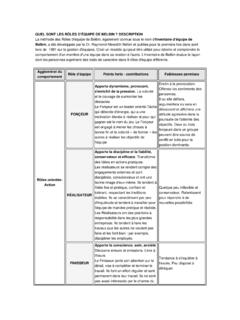
2 Theresearch team began to identify separate clusters of behaviour, each of which formed distinctteam contributions or team Roles . ATeam Rolecame to be defined as: A tendency tobehave,contributeandinterrelatewithoth ersinaparticularway. Itwasfoundthatdifferent belbin belbin is a registered trademark of belbin ,contributeandinterrelatewithothersinapa rticularway. Itwasfoundthatdifferentindividuals displayed different team Roles to varying first team Role to be identified was the Plant .The role was so-called because one suchindividual was planted in each team . They tended to be highly creative and good at solvingproblems in unconventional by one, the other team Roles began to emerge. TheMonitor Evaluatorwas needed toprovide a logical eye, make impartial judgements where required and to weigh up the team soptions in a dispassionate needed to focus on the team s objectives,draw out team members and delegate work the team was at risk of becoming isolated and inwardly-focused,Resource Investigatorsprovided inside knowledge on the opposition and made sure that the team s idea would carry tothe world outside the needed to plan a practical, workable strategyand carry it out as efficiently as Finisherswere most effectively used at theend of a task, to polish and scrutinise the work for errors,subjecting it to the highest standardsof quality the team to gel, using their versatility to identify thework required and complete it on behalf of the team .
3 Challenging individuals, known asShapers,provided the necessary drive to ensure that the team kept moving and did not lose focus of 2 Whilst some team Roles were more high profile and some teammembers shouted moreloudly than others, each of the behaviours was essential in getting the team successfully fromstart to finish. The key was balance. For example, Meredith belbin found that a team with noPlant struggled to come up with the initial spark of an idea with which to push , once too many Plants were in the team , bad ideas concealed good ones and non-starters were given too much airtime. Similarly, with no Shaper, the team ambled along withoutdrive and direction, missing deadlines. With too many Shapers, in-fighting began and morale well as the strength or contribution they provided, each team Role was also found to have an allowable weakness :a flipside of the behavioural characteristics, which is allowable in theteam because of the strength which goes with it.
4 For example,the unorthodox Plant could beforgetful or scatty; or the Resource Investigator might forget to follow up on a lead. Co-ordinatorsmight get over-enthusiastic on the delegation front and Implementers might be slow torelinquish their plans in favour of positive changes. Completer Finishers, often driven by anxietyto get things right, were found to take their perfectionism to extremes. Teamworkers, concernedwith the welfare and morale of the team , found it difficult tomake decisions where this moralemight be compromised or team politics, involved. Shapers risked becoming aggressive and bad-humoured in their attempts to get things , Specialist belbin belbin is a registered trademark of belbin , Specialist emerged. The simulated management exercises had been deliberately set up to require noprevious knowledge.
5 In the real world, however, the value ofan individual with in-depthknowledge of a key area came to be recognised as yet another essential team contribution orTeam Role. Just like the other team Roles , the Specialist also had a weakness: a tendency tofocus narrowly on their own subject of choice, and to prioritise this over the team s team Roles that Meredith belbin identified are used widely in thousands of organisations allover the world today. By identifying our team Roles , we can ensure that weuse our strengths toadvantage and that we manage our weaknesses as best we , this means beingaware of the pitfalls and making an effort to avoid people have a number of preferred team Roles or behaviours they frequently andnaturally display. We also have manageable Roles , Roles which might not be the most naturalcourse of behaviour for us, but which we can assume if required and might wish to , we have least preferred Roles , those we should not assume, since we ll be playing againsttype.
6 In this instance, the effort is likely to be great, and the outcome, poor. If work requiresTeam Roles other than our own, it is a much better bet to find and work with others who possessroles complementary to our own. Since people tend to displaymore than one preferred role, ateam of four could quite easily represent all nine belbin team , in a Nutshell , the belbin philosophy is about celebrating and making the most of individual differences. The message is that there is room for everyone in the team : all positive contributions are unique study of teams took place at the Administrative Staff College at Henley, Oxon, (nowknown as Henley Business School) which ran an internationally famous 10-week course forsuccessful managers with board of the course involved a business simulation in which the managers were put in tocompeting teams.
7 This simulation contained all the principal variables that typify the problemsof decision-making in a business environment. The experiment was designed along scientificlines with careful measurement at each 1969, Dr belbin was invited to use this business game as a starting point for a study of teambehaviour. He came to it as a highly respected academic/industrialist, chairman and co-founder of The Industrial Training Research Unit (ITRU), which was founded by the ManpowerServices an interest in group as well as individual behaviour,but with no particular theoriesabout teams, he enlisted the aid of three other scholars: Bill Hartston, mathematician andinternational chess master; Jeanne Fisher, an anthropologist who had studied Kenyan tribes;andRogerMottram, and Research belbin belbin is a registered trademark of belbin , task.
8 Three business games a year with eight teams in each game, and then in meetingafter meeting, observing, categorising and recording all the different kinds of contributionfrom team BUSINESS simulationThose participating were invited to take psychometric tests plus a test of high level reasoningability called the Critical Thinking Appraisal (CTA). Teams of various designs were composed onthe basis of these individual test scores. Every half minutethe contribution of the personspeaking was recorded and classified into one of seven categories by trained observers. At theend of the exercise, which ran off and on throughout a week, the results of each team (operating as a company) were presented financially, whichallowed more effective and lesseffective companies to be battery of psychometric tests was assembled, comprising measures of:High level reasoning ability (the Critical Thinking Appraisal) Personality (the 16 scales of theCattell Personality Inventory or 16PF) Outlook (the Personal Preference Questionnaire or PPQ,developed specifically for the purpose).
9 FINDINGSWhat was at first deemed to be likely was that high-intellectteams would succeed wherelower intellect teams would not. However, the outcome of this research was that certainteams, predicted to be excellent based on intellect, failedto fulfil their fact, it became apparent by looking at the various combinations that it was not intellect, butbalance, which enabled a team to succeed. Successful companies were characterised by thecompatibility of the Roles that their members played while unsuccessful companies weresubject to role conflict. Using information from psychometric tests and the CTA, predictionscould be made on the Roles that individuals played and ultimately on whether the companywould be more likely to figure among the winners or interesting point to observe from the experiment was that individuals reacted verydifferently within the same broad situation.
10 It is a common experience that individualdifferences can cause a group to fall apart. People just don t fit in. On the other hand, variationin personal characteristics can become a source of strengthif they are recognised and takenaccount of. So understanding the nature of these differences can become an essential first stepin the management of people, providing one can recognise what is useful for a given situationand what is , belbin belbin is a registered trademark of belbin , a range of different behaviours. Eight distinct clusters of behaviour turned out to bedistinctive and useful. These were called team Roles , andin fact, a ninth based on specialistknowledge was to emerge later. These team Roles have been used in organisations and teamsacross the world ever belbin was thirteen years of age when the Second World War broke out.