Example: bachelor of science
Belonging and Becoming for Educators - ACECQA
A sense of belonging for educators can also occur when they feel their work is valued, they are respected and accepted, and have positive relationships. In this safe environment, educators can draw on the support, practice and professional guidance of other educators.
Tags:
Information
Domain:
Source:
Link to this page:
Documents from same domain

THE EARLY YEARS LEARNING FRAMEWORK FOR AUSTRALIA
www.acecqa.gov.auChildren belong first to a family, a cultural group, a neighbourhood and a wider community. Belonging acknowledges children’s interdependence with others and the basis of relationships in defining identities. In early childhood, and throughout …

National Quality Framework - ACECQA
www.acecqa.gov.auApproved learning frameworks The NQS is linked to approved learning frameworks that recognise children learn from birth. Services are required to base their educational program on an approved learning framework. The approved learning frameworks are: • Belonging, Being and Becoming: The Early Years Learning Framework for

National Quality Standard Information sheet - …
www.acecqa.gov.auLINKS TO THE NATIONAL QUALITY STANDARD The importance of providing inclusive and sustainable learning environments that maximise and promote children’s

Reviewing your Quality Improvement Plan - …
www.acecqa.gov.au2 Information Sheet – Reviewing your Quality Improvement Plan • If your service is doing particularly well in one quality area you may choose to include statements about

National Quality Standard |Information sheet National ...
www.acecqa.gov.auLINKS TO THE NATIONAL QUALITY STANDARD The National Quality Standard (NQS) promotes and supports educators to engage in reflective practice through
Guide to the National Quality Framework - acecqa.gov.au
www.acecqa.gov.au8 Guide to the NQF Introduction Guide to the NQF Introduction INTRODUCTION Purpose of guide This guide aims to support education and care service providers, authorised officers and other regulatory authority staff understand the requirements under the

Guide to the National Quality Framework - ACECQA
www.acecqa.gov.auapproved provider 344 11. First tier review 346 12. Second tier review 351 SECTION 4 OPERATIONAL REQUIREMENTS 1. Operational requirements 358 Quality Area 1: Educational program and practice 359 1.1 Approved learning frameworks 359 1.2 Information to be kept and available 360 1.3 Documentation 361 Quality Area 2: Children’s health and safety 364

Work Health and Safety
www.acecqa.gov.au2 Work Health and Safety n cation an are Serices About the How To series The How To series has been created to offer professionals, working in the education and care sector in Australia, practical support to implement the National Quality Framework. The How To series consists of seven booklets promoting key areas of quality provision. Throughout each booklet, there are …
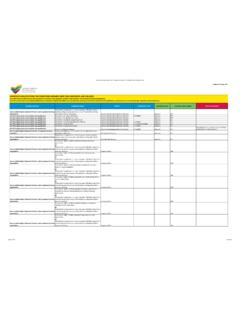
APPROVED QUALIFICATIONS FOR EDUCATORS WORKING …
www.acecqa.gov.auCertificate III in Early Childhood Education and Care 1 year qualified CHC30113 Australia QLD Any RTO registered (or was) to deliver this qualification Certificate III in Education (Aboriginal and Torres Strait Islander) 1 year qualified 39084QLD Australia QLD

Emergency and evacuation
www.acecqa.gov.auDifferent emergency situations may present different levels of risk and require different responses, dependent on where a service is located. For example, a service might be located in a flood prone region, or be surrounded by bushland making it more susceptible to bush fires. Policy and procedure guidelines These guidelines are part
Related documents

Identity and Belonging - Curriculum
curriculumonline.iesense of who they are is shaped by their characteristics, their behaviour, and their understanding of themselves, their family and others. Belonging is about having a secure relationship with or a connection with a particular group of people. When children feel a sense of belonging and sense of pride in their families,

A SENSE OF BELONGING AND PARTICIPATION - OECD
www.oecd.orgThis report considers sense of belonging and participation as important schooling outcomes in their own right. Engagement is seen as a disposition towards learning, working with others and functioning in a social institution, which is expressed in students’ feelings that they belong at …
6 Ways to Foster Belonging in the Workplace
hello.cultureamp.comThe belonging intervention experiments by Cohen and Walton [5, 6] are an important reminder of the power of openness and narrative Hearing frank and positive stories from all job levels can powerfully influence people’s sense of belonging Understanding another person’s story – the broader aspects of their life, such as hobbies or
PUTTING THE PIECES TOGETHER SCHOOL climate AND …
outreach.msu.eduSense of Belonging and Self-Esteem Supports Learning Interaction of teachers and staff with all students is caring, responsive, supportive, and respectful. Students trust teachers and staff. Morale is high among teachers and staff. Staff and students are friendly. The school is open to diversity and welcoming to all cultures.

BELONGING, BEING & BECOMING - ACECQA
www.acecqa.gov.auBelonging acknowledges children’s interdependence with others and the basis of relationships in defi ning identities. In early childhood, and throughout life, relationships are crucial to a sense of belonging. Belonging is central to being and becoming in that it shapes who children are and who they can become. “You belong in your house
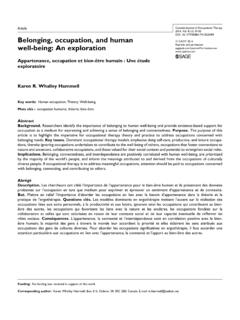
Belonging, occupation, and human ª well-being: An exploration
www2.uwe.ac.ukfosters a sense of connectedness—a sense of belonging, pur-pose and meaning that affirms the worth of the individual’’ (p. 198). Hammell (2004a) suggested that the concept of occupation might usefully be understood by focusing on the meanings that culturally diverse people attribute to …

OUTCOME 1: CHILDREN HAVE A STRONG SENSE OF …
k10outline.scsa.wa.edu.auBELONGING, BEING & BECOMING The Early Years Learning Framework for Australia 21 OUTCOME 1: CHILDREN HAVE A STRONG SENSE OF IDENTITY • Children feel safe, secure, and supported • Children develop their emerging autonomy, inter-dependence, resilience and sense of agency

Building belonging - Australian Human Rights Commission
humanrights.gov.aucommunity as a means of fostering a strong sense of personal identity and belonging.5 This idea is reflected in the Early Years Learning Framework and the National Quality Standard.6 By teaching respect for cultural diversity, educators will assist children to: • learn about their cultural background and develop a strong sense of self identity