Transcription of Benign Paroxysmal Positional Vertigo (BPPV)
1 Page 1 of 3 Benign Paroxysmal Positional Vertigo ( bppv ) This leaflet offers more information about bppv . If you have any further questions or concerns, please speak to the staff member in charge of your care. What is bppv ? bppv is one of the most common inner ear problems. Vertigo is just a word to describe the sensation of things moving when they are not. bppv is the specific diagnosis and each word describes the condition: Benign : this means it is not life-threatening, even though the symptoms can be very intense and distressing. Paroxysmal : this means it comes in sudden, short spells. Positional : certain head positions or movements can trigger a spell. Vertigo : feeling like you re spinning or the world around you is spinning. What causes bppv ? There are chalk-like crystals that are a normal part of our inner ear. They help the brain to detect body motion and keep us balanced. bppv is caused by the crystals becoming unglued from their normal place.
2 They begin to float around and get stuck in parts of the inner ear where they don t belong. When you move in certain ways, like when you lay down in bed, the moving crystals trigger dizziness. The dizziness is very quick, since the dizziness only occurs when the crystals are moving. What are the common symptoms and how can bppv affect me? The most common symptom is distinct spells of Vertigo . This is usually brought on by a position change like lying down, sitting up, looking up, or bending over. You may experience nausea or a sense of feeling unstable or like you are losing your balance. These symptoms will be intense for seconds to minutes. You can have lasting feelings of dizziness and instability, but at a lesser level, once the episode has passed. What caused my bppv ? Most cases of bppv happen for no reason. It can sometimes be associated with a head injury, migraine, other inner ear problems, diabetes, osteoporosis, and lying in bed for long periods of time (preferred sleep side, surgical procedures, and illness).
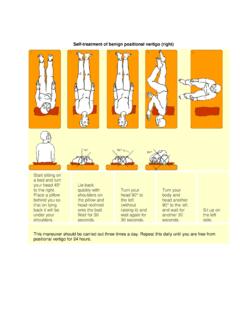
3 Page 2 of 3 How is bppv diagnosed? Scans and x-rays are not needed to confirm bppv . Your health care professional will complete simple bedside testing to confirm your diagnosis. The bedside testing requires the examiner to move your head into a position that makes the crystals move and will make you dizzy. The testing may include hanging your head a little off the edge of the bed or rolling your head left and right while lying in bed. The examiner will be watching your eyes to confirm your diagnosis. Can bppv be treated? Yes. Most bppv cases can get better with manoeuvres that usually take only a few minutes to complete. They have high success rates (eight out of every 10 people will respond immediately). Sometimes the treatment needs to be repeated a few times. These manoeuvres are designed to guide the crystals back to their original location in your inner ear. The manoeuvres are safe. Medicines are only needed to relieve symptoms such as nausea.
4 How do I know my bppv has gone away? The strong spinning sensations that have been triggered by position changes should be greatly reduced, or completely gone. How long will it take before I feel better? You can still feel a little bit sensitive to movement even after successful treatments for bppv . You can also feel unsteady at times. These mild symptoms can take up to a few months to slowly go away, but you should follow up with your physiotherapist if your symptoms do not get better within this time. Older adults with a history of falls or fear of falling may need further exercises for their balance. Is there anything I should or shouldn t do to help my bppv ? Your balance will be very poor, so you will need to take precautions so that you don t fall. You will feel more sensitive to movement until the bppv has healed. When your symptoms are fading, it is important to return to normal activities that you can do safely.
5 Exposure to motion and movement will help to speed your healing. Can bppv come back and/or can I prevent it? bppv is a condition that can sometimes return for no reason. You may only ever have a few episodes, or they may become more frequent. If you are low in Vitamin D there is some evidence to show that taking Vitamin D supplements may reduce the rate of attacks. For this reason we encourage you to have a blood test with your GP. What can I do if my symptoms come back? Your healthcare provider will talk to you about what to do if it comes back. If you have been treated in the vestibular physiotherapy department you will be able to return within two years. If you have been treated elsewhere you may need a referral. Acknowledgements This leaflet has been adapted from the American Academy of Otolaryngology. Page 3 of 3 For more information leaflets on conditions, procedures, treatments and services offered at our hospitals, please visit Additional services Patient Advice and Liaison Service (PALS) PALS can offer you on-the-spot advice and information when you have comments or concerns about our services or the care you have received.
6 You can visit the PALS office between and , Monday to Friday in the main corridor between Grosvenor and Lanesborough wings (near the lift foyer). Tel: 020 8725 2453 Email: NHS Choices NHS Choices provides online information and guidance on all aspects of health and healthcare, to help you make decisions about your health. Web: NHS 111 You can call 111 when you need medical help fast but it s not a 999 emergency. NHS 111 is available 24 hours a day, 365 days a year. Calls are free from landlines and mobile phones. Tel: 111 AccessAble You can download accessibility guides for all of our services by searching St George s Hospital on the AccessAble website ( ). The guides are designed to ensure everyone including those with accessibility needs can access our hospital and community sites with confidence. Reference: GME_BPPV_01 Published: October 2020 Review date: October 2022