Transcription of Benign paroxysmal positional vertigo (BPPV)
1 Patient information factsheet Benign paroxysmal positional vertigo ( bppv ). bppv is a common cause of dizziness. It occurs in people of all ages but is more common in middle-aged and elderly people. It causes short bursts of intense dizziness when the body or head is placed in certain positions such as lying on one side in bed or looking upwards. People can feel sick and are sometimes unsteady for a few hours after the dizziness has gone away. Benign this means the cause of dizziness is not a threat to your health. paroxysmal the dizziness comes in short bursts.
2 positional the dizziness is provoked by certain body or head positions. vertigo the medical name for the spinning sensation. Causes There is a collection of tiny crystals inside your ear. They have a valuable role to play when sitting in the correct position. bppv occurs when the crystals are dislodged from their correct position. They move into one or more of the semi-circular canals and either continue to float around or become attached to another part of the ear. Diagram 1 Semi-circular canals Sensitive part of the canal When you put your head into certain positions the crystals can move, making your brain think you are moving, even though you are not.
3 This causes your eyes to move in a particular way. If you stay in the position which makes you dizzy, the crystals will settle and the dizziness will wear off. The crystals can become dislodged from their normal position for a number of reasons. These include a head injury or an infection of the inner ear. More commonly it happens for no reason. bppv normally occurs in one ear but some people have it in both ears at the same time. Diagnosis Your description of your symptoms is helpful in diagnosing bppv . There are also tests to help diagnose bppv .
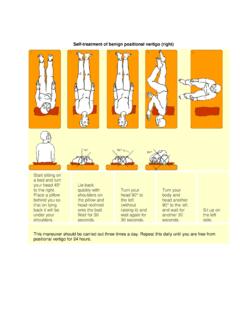
4 These tests involve moving from sitting to lying down, trying to recreate the positions that cause your symptoms. While you are lying down we will observe your eyes and may use some goggles to record your eye movements on a computer. During these tests we can assess if you have bppv in one ear or both and in which semi-circular canals the crystals are. Treatment It is common for bppv to clear up by itself after a few weeks or months and no treatment is required. If it does not resolve itself treatment is a safe, simple and quick procedure.
5 For most patients the dizziness is stopped after just one treatment, though occasionally the treatment may need to be repeated a second or third time. To stop the dizziness we have to move the crystals back to where they came from. This can be done by moving your body and head through a series of slow, controlled movements. The exact positions will depend on which canal the crystals are in and whether the crystals are floating around or have become attached to another part of the ear. Diagram 2 Crystals moving in semi-circular canal.
6 Your head is moved so the crystals can move around the semi-circular The crystals finish here, canal towards their correct place. in their correct place. Crystals in semi-circular canal. After the treatment Some people feel imbalanced or slightly unwell after treatment. This can last up to 48 hours. Following this, if the treatment has been successful, you should have no symptoms when in positions that used to make you dizzy. After a few days you may want to try the positions that made you dizzy. At your treatment appointment we will give you a plan for how we will assess if your symptoms have gone away.
7 This is normally a phone appointment. If your symptoms have gone away completely we will not need to see you again. If you have some or all of your dizzy symptoms we will arrange to see you again to repeat the treatment. Some bppv can return after treatment. This can be after a few months or even years. If it does return and lasts for a couple of weeks, you can contact us. We may be able to offer you an appointment and repeat the treatment. Further information Department of audiology and hearing Telephone: 02380 540188 Email: Level A, Royal South Hants Hospital, Brintons Terrace, Southampton SO14 0YG.
8 For a translation of this document, or a version in another format such as easy read, large print, Braille or audio, please telephone 023 8120 4688. For help preparing for your visit, arranging an interpreter or accessing the hospital, please visit Version 4. Published June 2020. Due for review June 2023. 1279.