Transcription of BIAN ”Banking Models Working Group”
1 BIAN Banking Models Working Group . Banking Industry Architecture Network Skin the Financial Services Onion A capability-based model to explain the (r)evolution of the banking industry 2018 BIAN | Platz der Einheit 1 | 60063 Frankfurt am Main | Germany Page 1 of 28. BIAN Banking Models Working Group . Organization Authors Name E-Mail Company Christof Hasse UBS Business Solutions AG. Ante Plazibat Business Engineering Institute St. Gallen AG. Martin Rindlisbacher UBS Business Solutions AG. Stephan Sachse University of Leipzig Adrian von Aesch DXC Technology Version No Comment / Reference Date Final Page 2 of 28 2018 BIAN | Platz der Einheit 1 | 60063 Frankfurt am Main | Germany BIAN Banking Models Working Group . Copyright Copyright 2018 by BIAN Association. All rights reserved. THIS DOCUMENT IS PROVIDED "AS IS," AND THE ASSOCIATION AND ITS MEMBERS, MAKE. NO REPRESENTATIONS OR WARRANTIES, EXPRESS OR IMPLIED, INCLUDING BUT NOT LIMITED. TO, WARRANTIES OF MERCHANTABILITY, FITNESS FOR A PARTICULAR PURPOSE, NONINFRINGEMENT, OR TITLE; THAT THE CONTENTS OF THIS DOCUMENT ARE SUITABLE FOR ANY.
2 PURPOSE; OR THAT THE IMPLEMENTATION OF SUCH CONTENTS WILL NOT INFRINGE ANY. PATENTS, COPYRIGHTS, TRADEMARKS OR OTHER RIGHTS. NEITHER THE ASSOCIATION NOR ITS MEMBERS WILL BE LIABLE FOR ANY DIRECT, INDIRECT, SPECIAL, INCIDENTAL OR CONSEQUENTIAL DAMAGES ARISING OUT OF OR. RELATING TO ANY USE OR DISTRIBUTION OF THIS DOCUMENT UNLESS SUCH DAMAGES ARE. CAUSED BY WILFUL MISCONDUCT OR GROSS NEGLIGENCE. THE FOREGOING DISCLAIMER AND LIMITATION ON LIABILITY DO NOT APPLY TO, INVALIDATE, OR LIMIT REPRESENTATIONS AND WARRANTIES MADE BY THE MEMBERS TO THE. ASSOCIATION AND OTHER MEMBERS IN CERTAIN WRITTEN POLICIES OF THE ASSOCIATION. 2018 BIAN | Platz der Einheit 1 | 60063 Frankfurt am Main | Germany Page 3 of 28. BIAN Banking Models Working Group . Table of contents 1 5. 2 Introduction .. 5. 3 Satisfaction of wants .. 6. Structuring of wants .. 7. 4 Capability basics .. 8. 9. Business model innovation and stress (basics) .. 10. Perspectives on 11. 5 Banking 12. Basic Banking Capabilities.
3 14. Additive Banking Capabilities .. 17. 6 Product and Service .. 17. 7 The traditional financial 18. 8 Business model innovation and stress trends .. 20. Trend I: Connectivity / OpenAPI .. 20. Trend II: From pipeline to mesh .. 21. Trend III: Artificial Intelligence (AI).. 24. Trend IV: Distributed ledger, Blockchain and Smart Contracts .. 24. 9 BEI's financial services periodic 25. 10 Conclusion .. 26. Call to action .. 27. 11 References .. 28. Page 4 of 28 2018 BIAN | Platz der Einheit 1 | 60063 Frankfurt am Main | Germany BIAN Banking Models Working Group . 1 Abstract Using technological breakthroughs nimble startups and FinTech businesses can quickly grow into major competitors for established players in the Financial Services Industry. This white paper proposes a framework how a capability-based approach can be used to assess multiple stressors and their possible impact on current business Models . The presented CONCENTRIC1-model uses a unique customer and capability perspective and shows how evolving customer demands coupled with technological advances are challenging traditional business Models .
4 The model allows for strategic analysis of industry sector capabilities and how the emerging mesh business Models may affect these. The work presented in this paper was conducted as part of BIAN's Banking Models Working Group with its objective to: Definition of a banking reference model as a global public domain industry standard that describes economically worthwhile business entity roles in the financial services markets. Description of these business entity roles based on elemental business capabilities (BIAN service domain). Determine the influence of a business entity role to its constituting elemental business capabilities (BIAN service domain). The work can also be seen as input for BIAN's Banking Business Capability Model Working Group which is developing a generic banking business capability model that can be used as a reference or starting point for creating one's own specific model. 2 Introduction Observing today's rapid technical and social developments is exciting.
5 Various financial services are provided to a wide community in a number of ways. Some predict the end of the traditional banks while others dismiss it as a hype which will fade away sooner or later. Regardless of the outcome, it is beneficial to understand the nature of change. This understanding might help especially incumbent banks to steer their development and adoption to stay relevant in the future - it is about finding or playing a role in a transformed financial services landscape. The main drivers are the possibilities arising from the increasing IT capabilities like processing power, connectivity/networking, storage, data and algorithms. The implications of these increasing IT capabilities are commonly called digitalization . However, this goes far beyond digitizing a form a customer had filled in and still being processed internally along the traditional analogue way. It means a true transformation of business and operating Models [1]. 1. CONCENTRIC-Model stands for outCome OrieNted CustomEr waNTs-addRessIng Capability - Model 2018 BIAN | Platz der Einheit 1 | 60063 Frankfurt am Main | Germany Page 5 of 28.
6 BIAN Banking Models Working Group . In their book BOLD [2] Diamandis and Kotler identified 6 key phenomena the 6. D's as the drivers which are disrupting today's incumbent companies [3] and enabling upstart entrepreneurs to go from I've got an idea' to I run a billion-dollar company'. far faster than ever before [4]. Besides 'Digitization' (the foundation), this is Deceptive' growth (or underestimating potential) resulting in Disruption', Dematerialization', Demonetization' and Democratization'. The last three are for us the key drivers which we will keep in focus during our investigations because the financial system was and still is a very closed industry with a rather limited focus on monetary aspects. In this paper, we will address the question: What are today's essential building blocks of banking and how are these building blocks affected by future trends? During our investigation we will ask three fundamental questions: What is the outcome of each building block that makes up banking?
7 How is the outcome accomplished? Who accomplishes the outcome? and the following three questions addressing the key stress factors to any business model 1. Is the value proposition (outcome) still needed tomorrow? 2. Is the outcome efficiently accomplished? 3. Are there others who can accomplish the same outcome? The document is structured as follow: We introduce our outcome -oriented approach where the outcome fulfills the client's wants followed by some basic principles about capabilities and the introduction of the fundamental banking capabilities. Subsequently, we explore the impact of the major trends (fueled by the increasing IT capabilities) on business Models and banking capabilities in general. We conclude the document with a view on BEI's 2 financial services periodic table which forms a basis of their FinTech radar. For the purpose of this paper, we will focus solely on banking, ignoring insurance- related capabilities. 3 Satisfaction of wants The phenomena of democratization' emphasize the role of the customer in today's business environment.
8 Thus, a strong emphasis on applying of the customer's perspective delivers new insights into understanding the purpose of banking. Traditional means of business modeling and optimization based on narrow definitions of customer journey typically fall too short. In [5] it is correctly stated that business process modeling (clarifying the how') is not business modeling (defining the what'. as the value exchanged between actors). We go a step further because even business modeling and narrow definitions of customer journeys, which only focus on 2. BEI: Business Engineering Institute St. Gallen ( ). Page 6 of 28 2018 BIAN | Platz der Einheit 1 | 60063 Frankfurt am Main | Germany BIAN Banking Models Working Group . the journey of the customer along the touchpoints of the provider, bears the risk of a biased inside-out view3. It does not explain why the customer should get in touch with the provider at all. Ultimately, someone's4 wants5 should be fulfilled. Consequently we move away from a provider's product and services view to an outcome-oriented view where the outcome fulfills a specific want.
9 The difference is rather fundamental and is amplified by the process of the dematerialization, demonetization and democratization. In the former product and service-oriented view, the customer gets something sold (maybe not even really wanted) while in the later outcome-oriented view, the customer seeks / buys something he/she wants. Today's technology (internet, search engines and platforms) allows searching globally until someone is capable to satisfy such wants. However, this emerging market structure poses new challenges for the consumer, such as an overwhelming complexity due to the variety of alternatives and potentially his/her low expertise. Given this background secondary wants such as simplicity , convenience , or trustworthiness become differentiating factors. If two or more offerings provide the same functional utility fulfilling a primary want ( transferring money abroad), the consumer facilitates secondary wants (non-functional attributes) to select the most appropriate alternative [6].
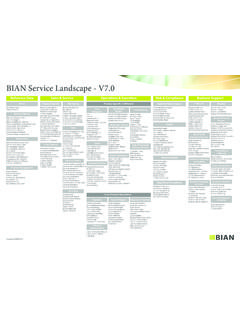
10 In this paper, we will mainly focus on primary wants and address secondary wants only where necessary. Structuring of wants Figure 1: Want categories 3. See BIAN Service Domain Landscape describing a blueprint for how a bank can implement Application Functions as part of an IT Model 4. Natural persons as well as a body corporate 5. Needs are basic requirements ( see Maslovs hierarchy of needs) and may turn into wants if not satisfied (wants imply some kind of lack). Note that there are many more wants than needs. Not everything wanted is needed. 2018 BIAN | Platz der Einheit 1 | 60063 Frankfurt am Main | Germany Page 7 of 28. BIAN Banking Models Working Group . To better understand current economic changes, such as the FinTech trends, we place the individual into the center, take a look through its eyes ( Me ) and introduce an open, non-exhaustive categorization of his wants which resemble classical industry sectors as shown in Figure 1: Want categories. As we shall see later, consumers do not necessarily think in these categories and often have wants spanning categories, one wants a house which might lead to the requirement of a mortgage in case one has not enough money or one wants a TV set which implies a payment.