Transcription of Billing and Coding Guidelines - CMS
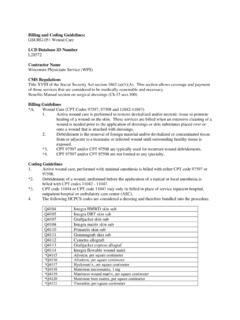
1 Billing and Coding Guidelines : GSURG-052 Application of Bioengineered skin Substitutes LCD Database ID Number L30135. Effective Date 08/16/2009. Contractor Name Wisconsin Physicians Service Insurance Corporation Contractor Number 00951, 00952, 00953, 00954. 05101, 05201, 05301, 05401, 05102, 05202, 05392, 05302, 05402. 52280. CMS Regulations Title XVIII of the Social Security Act section 1862 (a)(1)(A). This section allows coverage and payment of those services that are considered to be medically reasonable and necessary. NCD section on xenograft ( ).
2 Benefits Manual section on surgical dressings ( ). Coding Information Application of Bioengineered skin Substitutes and skin Grafting is performed on ulcers that are free of infection and underlying osteomyelitis. These Guidelines include both the care of the wounds prior to the application of the skin substitute. skin Replacement (CPT codes 15002 - 15005). (Below also applies to CPT codes 15000-15001 for DOS 01/01/2006-12/31/2006). 1. Per the definitions and the Guidelines in CPT Code Book codes CPT codes 15002/15005 are not appropriate codes to use when performing a non-surgical application of a skin substitute.
3 2. CPT code 15002/15005 are only appropriately used in place of service inpatient hospital, outpatient hospital or ambulatory surgical center with regional or general anesthesia to resurface an area damaged by burns, traumatic injury or surgery. An operative report is required and must be available upon request. *G0440 Application of tissue cultured allogeneic skin substitute or dermal substitute; for use on lower limb, includes the site preparation and debridement if performed; first 25 sq cm or less *G0441 Application of tissue cultured allogeneic skin substitute or dermal substitute; for use on lower limb, includes the site preparation and debridement if performed; each additional 25 sq cm *Application of skin Substitute (G0440-G0441).
4 *1. HCPT codes G0440 G0114 are used for the application of cultured allogeneic skin substitute or dermal substitute. 2. The name of the skin substitute must be placed in the narrative field of the claim. 3. Claims submitted for the application of a skin substitute without the name of the skin product in the narrative section of the claim will be denied Xenograft, skin CPT codes 15400-15431. Application of a non-human skin graft or biologic wound dressing (eg. porcine tissue or pigskin). to a part of the recipient's body following debridement of the burn wound or area of traumatic injury, soft tissue infection and/or tissue necrosis, or surgery 1.
5 When this service is rendered in place of service office, both the application of the skin graft (CPT codes 15430 - 15431) and the product used must be billed on the same claim. 2. This service has a 90-day global period under the Medicare Fee Schedule Data Base (MFSDB). The application code will be paid no more frequently than at 90-day intervals. Wound care performed within the 90-day period is considered part of the surgical procedure 3. These codes may not be billed with a modifier 58 (staged procedure). 4 CPT code 15431 is always related to CPT code 15430 and, per the MFSDB is always included in the global period of the other service.
6 5. Per the MFSDB - payment for bilateral procedures does not apply. 6. The following products may be billed with CPT codes 15430-15431. Q4102 skin Substitute, Oasis wound Matrix, per square centimeter Q4110 skin substitute, primatrix, per square centimeter Coding Guidelines 1. Active wound care, performed with minimal anesthesia is billed with either CPT code 97597 or 97598. *2. Significant debridement of a wound, performed before the application of a topical or local anesthesia is billed with CPT codes 11042 11047. *3. CPT codes 11044 and 11047 may only be billed in place of service inpatient hospital, outpatient hospital or ambulatory care center (ASC).
7 *4 Use CPT code 15340-15341 or CPT code 15360-15366 for the surgical preparation or creation of recipient site for the tissue skin graft. 5. To bill for an Apligraf (HCPCS Q4101) package (equal to 44-sq. cm.). If more than 44-sq. cm. is needed for additional grafting, bill according to the number of single units of Apligraf , indicate Apligraf in Item 19 of the CMS 1500 Claim Form or the Comment Field for EMC. claims. 6. Payment for Apligraf for any single ulcer will not be made for re-treatment within 1 year after initial treatment. 7. Dermagraft (HCPCS Q4106) is supplied frozen in a clear bag containing one piece of approximately 2 in.
8 X 3 in. (5 cm. x cm.) for a single use application. 8. Claims submitted for skin substitutes should bill the actual size used rounding up to the next whole number. 9. When submitting a claim for skin substitutes, providers are required to accept assignment for this service. Providers, who do not accept assignment, should bill the skin product on a separate claim from other services performed on the same day. *10. Products such as Integra are classified by the Federal Drug Administration as wound dressing and are thus not payable separately by Medicare Part B for outpatient services.
9 The application of Integra or similar FDA classified products may be payable as an inpatient for its FDA approved indication for the treatment of life-threatening full-thickness or deep partial-thickness burns. 11. For services on or after November 1, 2007, the Oasis Wound Matrix is covered and separately payable when used according to FDA labeled indications and in accordance with accepted standards of medical/surgical practice. 12. The application of Oasis Wound Matrix (CPT code 15430 - 15431) will be paid no more frequently than at 90-day intervals.
10 Though payment for the product is allowed appropriate to the clinical considerations, it is inappropriate to bill application codes multiple times within a 90-day period using such modifiers as 58, suggesting a staged procedure. Documentation Requirements 1. The medical record must clearly show that the criteria listed in LCD GSURG-052 under Indications and Limitation of Coverage and/or Medical Necessity have been met. 2. The medical record must clearly document that conservative pre-treatment wound management has been tried and failed to induce healing.