Transcription of BIOLOGY - CISCE
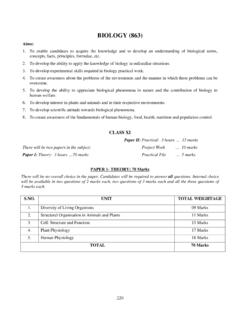
1 1 BIOLOGY (863) class XIIT here will be two papers in the subject: Paper I: Theory: 3 hours .. 70 marks . Paper II: Practical: 3 hours .. 15 marks Project Work .. 10 marks Practical File .. 5 marks PAPER I- THEORY: 70 Marks There will be no overall choice in the paper. Candidates will be required to answer all questions. Internal choice will be available in two questions of 2 marks each, two questions of 3 marks each and all the three questions of 5 marks each. S. TOTAL WEIGHTAGE 1. Reproduction 16 Marks 2. Genetics and Evolution 15 Marks 3. BIOLOGY and Human Welfare 14 Marks 4. Biotechnology and its Applications 10 marks 5. Ecology and Environment 15 Marks TOTAL 70 Marks 2 PAPER I THEORY 70 Marks All structures (internal and external) are required to be taught along with diagrams. (i)Reproduction in OrganismsModes of reproduction - asexual and sexualreproduction; asexual reproduction - binaryfission, sporulation, budding, gemmuleformation, fragmentation; vegetativepropagation in of life span; life span of a feworganisms (banana, rice, rose, banyan,butterfly, fruit fly, tortoise, crocodile, parrot,crow, elephant, dog, horse, and cow).
2 Asexual reproduction definition, types(binary fission in Amoeba and Paramoecium,budding in yeast and Hydra, conidia inPenicillium, zoospores in Chlamydomonas,gemmules in sponges), definition of propagation definition,vegetative propagules (tuber of potato,rhizome of ginger, bulbil of Agave, leaf budsof Bryophyllum, offset of water hyacinth,runner of grass, sucker of pineapple, bulb ofonion).Sexual reproduction: Plants definition,phases of life cycle (juvenile/vegetative,reproductive and senescence), unusualflowering phenomenon (bamboo andStrobilanthes kunthiana). Animals continuous and seasonal breeders (definition,differences and examples).Chromosome number in the cells of housefly, fruit fly, butterfly, human beings, rat,dog, maize, apple, onion, cat, rice,Ophioglossum; differences between asexualand sexual reproduction.(ii)Sexual reproduction in flowering plantsDevelopment of male and femalegametophytes; pollen-pistil interaction;double fertilization; post fertilizationevents - development of endosperm andembryo, special modes - apomixis,parthenocarpy, structures and of microsporangium, of anther microsporogenesis, structure and development of pollen grain, viability of pollen grain, economic importance of pollen grain.
3 Pistil structure of megasporangium ( of anatropous ovule), megasporogenesis, structure and development of female gametophyte. Pollen-pistil interaction in terms of incompatibility/compatibility, events leading to fertilisation, definition of triple fusion and double fertilization. Significance of double fertilization. Apomixis, polyembryony, parthenocarpy to be explained briefly. Post-fertilisation events - embryo formation (dicot); types of endosperm (cellular, nuclear and helobial); definition of perisperm. (iii) Human ReproductionMicroscopic anatomy of testis and ovary;gametogenesis - spermatogenesis an doogenesis; menstrual cycle; fertilisation,embryo development upto blastocystformation, implantation; pregnancy andplacenta formation (elementary idea);parturition (elementary idea); lactation(elementary idea).
4 Internal structure of testis and ovary to betaught with the help of diagrams;gametogenesis- spermatogenesis (includingspermiogenesis and spermiation) oogenesis;hormonal control of gametogenesis, structureof sperm and mature ovum, menstrual cycle-different phases and hormone action,menarche and menopause, physico-chemicalevents during fertilisation, implantation,embryonic development up to blastocystformation, important features of humanembryonic development (formation of heart,limbs, digits, appearance of hair on head,eyelashes, separation of eye lids, externalgenital organs and first movement of foetuswith reference to time period) placenta andits functions. Parturition; lactation hormonal control and importance. 3 (iv)Reproductive HealthNeed for reproductive health and preventionof Sexually Transmitted Diseases (STDs);birth control - need and methods,contraception and medical termination ofpregnancy (MTP); amniocentesis; infertilityand assisted reproductive technologies -IVF, ZIFT, GIFT (elementary idea forgeneral awareness).
5 Definition of reproductive health, programsof reproductive health (family planning,RCH), contraceptive methods and theirmethods of action (natural-periodicabstinence, withdrawal or coitus interruptus,lactational amenorrhea; artificial barriers,IUDs, oral pills, implants and surgicalmethods, definition of medical termination ofpregnancy (MTP) and reasons for it; causesof infertility. Amniocentesis and its role indetecting genetic defects. Assistedreproductive technologies: IVF, IUT, ZIFT,ICSI, GIFT, AI, IUI. - definition andapplication only. Causes, symptoms andmethods of prevention of sexually transmitteddiseases (gonorrhoea, syphilis, genitalherpes, chlamydiasis, genital warts,trichomoniasis, hepatitis- B, AIDS). and Evolution(i)Principles of inheritance and variationHeredity and variation: Mendelianinheritance; deviations from Mendelism -incomplete dominance, co-dominance,multiple alleles and inheritance of bloodgroups, pleiotropy; elementary idea ofpolygenic inheritance; chromosomal theoryof inheritance; chromosomes and genes; sexdetermination - in humans, fruit fly, birdsand honey bee; linkage and crossing over;mutation; Mendelian disorders in humans;chromosomal disorders in of the terms heredity andvariation; Mendel's Principles ofinheritance; reasons for Mendel's success;back cross and test cross, definitions to be taught with simple examples using Punnett square.)
6 Incomplete dominance with examples from plants (snapdragon - Antirrhinum) and co-dominance in human blood group, multiple alleles blood groups, polygenic inheritance with one example of inheritance of skin colour in humans (students should be taught examples from human genetics through pedigree charts. They should be able to interpret the patterns of inheritance by analysis of pedigree chart). Biological importance of Mendelism. Pleiotropy with reference to the example of starch synthesis in pea seeds. Chromosomal theory of inheritance; autosomes and sex chromosomes (sex determination in humans, fruit fly, birds, honey bees and grasshopper), definition and significance of linkage and crossing over. Mutation: spontaneous, induced, gene (point transition, transversion and frame-shift); chromosomal aberration: euploidy and aneuploidy; human genetic disorders: phenylketonuria, thalassaemia, colour blindness, sickle cell anaemia; chromosomal disorders: Down s syndrome, Klinefelter s syndrome, Turner s syndrome.
7 (ii)Molecular basis of InheritanceSearch for genetic material and DNA asgenetic material; structure of DNA andRNA; DNA packaging; DNA replication;central dogma; transcription, genetic code,translation; gene expression and regulation-lac operon; human genome project;DNA operties of genes such as ability to replicate, chemical stability, mutability and inheritability. Search for DNA as genetic material - Hershey and Chase s experiment, double helical model of DNA (contributions of Meischer, Watson and Crick, Wilkins, Franklin and Chargaff); Differences between DNA and RNA; types of RNA (tRNA, mRNA and rRNA, snRNA, hnRNA); central dogma 4 concept only; reverse transcription (basic idea only), Meselson and Stahl s experiment, replication of DNA (role of enzymes, namely DNA polymerase and ligase), transcription, essential features of genetic code. Definition of codon.
8 Protein synthesis - translation in prokaryotes. Gene expression in prokaryotes; lac operon in E. coli. Human Genome Project: goal; methodologies [Expressed Sequence Tags (EST), Sequence Annotation], salient features and applications. DNA finger printing technique, application and ethical issues to be discussed briefly. (iii) EvolutionOrigin of life; biological evolution andevidences for biological evolution(palaeontology, comparative anatomy,embryology and molecular evidences);Darwin's contribution, modern synthetictheory of evolution; mechanism ofevolution - variation (mutation andrecombination) and natural selection withexamples, types of natural selection; geneflow and genetic drift; Hardy - Weinberg'sprinciple; adaptive radiation; of life - abiogenesis and biogenesis,effect of oxygen on evolution to show thatreducing atmosphere is essential for abioticsynthesis.
9 Modern concept of origin of life,Oparin Haldane theory, definition ofcoacervates, vestigial organs; Miller andUrey experiment. Evidences of evolution:morphological evidences, definition anddifferences between homologous andanalogous organs (two examples each fromplants and animals). Embryologicalevidences theory of recapitulation,definition and differences between ontogenyand phylogeny. Palaeontological evidence definition of fossils. Geological time scale(with reference to dominant flora and fauna)Biogeographical evidence definition ofbiogeography, molecular (genetic) evidences-for example genome similarity, universalgenetic code; Darwin's finches (adaptiveradiation).Darwinism: salient features of Darwinism,contribution of Malthus, criticism ofDarwinism. Examples of natural selection Long neck of giraffe, industrial melanism,resistance of mosquitoes to DDT andresistance of bacteria to antibiotics, Neo-Darwinism (Modern Synthetic Theory);Variation - causes of variation, Hugo deVries theory of mutation - role of mutation inevolution; Hardy Weinberg s principle,factors affecting Hardy Weinbergequilibrium: gene migration or gene flow,genetic drift (Founder s effect, bottle-neckeffect), mutation, genetic recombination andnatural selection, types of natural selection(directional, disruptive and stabilizing).
10 3. BIOLOGY and Human Welfare(i)Human Health and DiseasesPathogens; parasites causing humandiseases (common cold, dengue,chikungunya, pneumonia, malaria, ringworm) and their control; Basic concepts ofimmunology - vaccines; cancer, HIV andAIDS; Adolescence - drug and non-communicablediseases; modes of transmission, causativeagents, symptoms and prevention; viraldiseases (common cold, chikungunya anddengue), bacterial diseases (pneumonia,diphtheria and plague), protozoal diseases(malaria, graphic outline of life cycle ofPlasmodium); fungal (ringworm); cancer -types of tumour (benign, malignant),causes, diagnosis and treatment,characteristics of cancer cells (loss ofcontact inhibition and metastasis).Immunity (definition and types innate andacquired, active and passive, humoral andcell-mediated), Interferons definition,source and function; structure of a typicalantibody molecule, types of antibodies - IgG, 5 IgA, IgM, IgD and IgE (function and occurrence, e,g.)