Transcription of Bode Plot: Example 1 - utoledo.edu
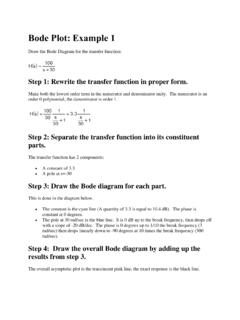
1 Bode Plot: Example 1 Draw the Bode Diagram for the transfer function: Step 1: Rewrite the transfer function in proper form. Make both the lowest order term in the numerator and denominator unity. The numerator is an order 0 polynomial, the denominator is order 1. Step 2: Separate the transfer function into its constituent parts. The transfer function has 2 components: A constant of A pole at s=-30 Step 3: Draw the Bode diagram for each part. This is done in the diagram below. The constant is the cyan line (A quantity of is equal to dB).
2 The phase is constant at 0 degrees. The pole at 30 rad/sec is the blue line. It is 0 dB up to the break frequency, then drops off with a slope of -20 dB/dec. The phase is 0 degrees up to 1/10 the break frequency (3 rad/sec) then drops linearly down to -90 degrees at 10 times the break frequency (300 rad/sec). Step 4: Draw the overall Bode diagram by adding up the results from step 3. The overall asymptotic plot is the translucent pink line, the exact response is the black line. Bode Plot: Example 2 Draw the Bode Diagram for the transfer function: Step 1: Rewrite the transfer function in proper form.
3 Make both the lowest order term in the numerator and denominator unity. The numerator is an order 1 polynomial, the denominator is order 2. Step 2: Separate the transfer function into its constituent parts. The transfer function has 4 components: A constant of A pole at s=-10 A pole at s=-100 A zero at s=-1 Step 3: Draw the Bode diagram for each part. This is done in the diagram below. The constant is the cyan line (A quantity of is equal to -20 dB). The phase is constant at 0 degrees. The pole at 10 rad/sec is the green line.
4 It is 0 dB up to the break frequency, then drops off with a slope of -20 dB/dec. The phase is 0 degrees up to 1/10 the break frequency (1 rad/sec) then drops linearly down to -90 degrees at 10 times the break frequency (100 rad/sec). The pole at 100 rad/sec is the blue line. It is 0 dB up to the break frequency, then drops off with a slope of -20 dB/dec. The phase is 0 degrees up to 1/10 the break frequency (10 rad/sec) then drops linearly down to -90 degrees at 10 times the break frequency (1000 rad/sec). The zero at 1 rad/sec is the red line.
5 It is 0 dB up to the break frequency, then rises at 20 dB/dec. The phase is 0 degrees up to 1/10 the break frequency ( rad/sec) then rises linearly to 90 degrees at 10 times the break frequency (10 rad/sec). Step 4: Draw the overall Bode diagram by adding up the results from step 3. The overall asymptotic plot is the translucent pink line, the exact response is the black line. Bode Plot: Example 3 Draw the Bode Diagram for the transfer function: Step 1: Rewrite the transfer function in proper form. Make both the lowest order term in the numerator and denominator unity.
6 The numerator is an order 1 polynomial, the denominator is order 2. Step 2: Separate the transfer function into its constituent parts. The transfer function has 4 components: A constant of A pole at s=-3 A pole at s=0 A zero at s=-10 Step 3: Draw the Bode diagram for each part. This is done in the diagram below. The constant is the cyan line (A quantity of is equal to 30 dB). The phase is constant at 0 degrees. The pole at 3 rad/sec is the green line. It is 0 dB up to the break frequency, then drops off with a slope of -20 dB/dec.
7 The phase is 0 degrees up to 1/10 the break frequency ( rad/sec) then drops linearly down to -90 degrees at 10 times the break frequency (30 rad/sec). The pole at the origin. It is a straight line with a slope of -20 dB/dec. It goes through 0 dB at 1 rad/sec. The phase is -90 degrees. The zero at 10 rad/sec is the red line. It is 0 dB up to the break frequency, then rises at 20 dB/dec. The phase is 0 degrees up to 1/10 the break frequency (1 rad/sec) then rises linearly to 90 degrees at 10 times the break frequency (100 rad/sec).
8 Step 4: Draw the overall Bode diagram by adding up the results from step 3. The overall asymptotic plot is the translucent pink line, the exact response is the black line. Bode Plot: Example 4 Draw the Bode Diagram for the transfer function: Step 1: Rewrite the transfer function in proper form. Make both the lowest order term in the numerator and denominator unity. The numerator is an order 1 polynomial, the denominator is order 3. Step 2: Separate the transfer function into its constituent parts. The transfer function has 4 components: A constant of -10 A pole at s=-10 A doubly repeated pole at s=-1 A zero at the origin Step 3: Draw the Bode diagram for each part.
9 This is done in the diagram below. The constant is the cyan line (A quantity of 10 is equal to 20 dB). The phase is constant at -180 degrees (constant is negative). The pole at 10 rad/sec is the blue line. It is 0 dB up to the break frequency, then drops off with a slope of -20 dB/dec. The phase is 0 degrees up to 1/10 the break frequency then drops linearly down to -90 degrees at 10 times the break frequency. The repeated pole at 1 rad/sec is the green line. It is 0 dB up to the break frequency, then drops off with a slope of -40 dB/dec.
10 The phase is 0 degrees up to 1/10 the break frequency then drops linearly down to -180 degrees at 10 times the break frequency. The magnitude and phase drop twice as steeply as those for a single pole. The zero at the origin is the red line. It has a slope of +20 dB/dec and goes through 0 dB at 1 rad/sec. The phase is 90 degrees. Step 4: Draw the overall Bode diagram by adding up the results from step 3. The overall asymptotic plot is the translucent pink line, the exact response is the black line. Bode Plot: Example 5 Draw the Bode Diagram for the transfer function: Step 1: Rewrite the transfer function in proper form.
![CHAP. 7] BLOCK DIAGRAM ALGEBRA AND TRANSFER …](/cache/preview/5/5/8/8/1/3/4/c/thumb-5588134cce7b9b85f7cd5a0611a184e9.jpg)