Transcription of Bonding Basics - Ionic Bonds Name Complete the chart for ...
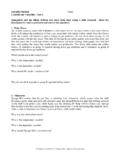
1 Bonding Basics - Ionic BondsName _____Complete the chart for each element. Follow your teacher s directions to Complete each Ionic bond .(1) Potassium + Fluorine(2) Magnesium + IodineT. Trimpe 2002 Element# of Protons# of Electrons# of Valence Electrons Oxidation NumberSodiumChlorineBerylliumFluorineLit hiumOxygenPhosphorus(3) Sodium + Oxygen(4) Sodium + Chlorine(5) Calcium + Chlorine(6) Aluminum + ChlorineT. Trimpe 2002 Bonding Basics - Ionic Bonds Answer Key/Teacher NotesComplete the chart for each element. Follow your teacher s directions to Complete each Ionic bond .(1) Potassium + Fluorine1- Write the symbols for each - Use Fruity Pebbles (or other cereal/candy with morethan one color) to create the Lewis structure for - Draw an arrow (or more if needed) to show thetransfer of electrons and move the cereal to the new - Determine the charge for each ion and write the formula.
2 5 - Make sure the sum of the oxidation numbers is zeroand write the chemical - Have the students use a pencil or crayon to draw theelectrons as they remove the pieces of cereal.(2) Magnesium + IodineT. Trimpe 2002 NOTE: I have the students use a red pen/pencil to change the # of electrons to the amount it would be if the valence electrons were removed or added. They can see the difference between the number of protons (+) and electrons (-), which relates to the charge or oxidation number. If the ion has more protons (+), it would be a positive ion. If it has more electrons (-), it would be a negative ion. Element# of Protons# of Electrons# of Valence Electrons Oxidation NumberSodium111111+Chlorine171771-Beryll ium4422+Fluorine9971-Lithium3311+Oxygen8 862-Phosphorus151553--> 10-> 18-> 2-> 10-> 2-> 10-> 18 KFStep 2 Step 1 Step 3K would have a charge of 1+ since it lost an electronFluorine would have a charge of 1- since it gained an +F1-KFMgIIMg would have a charge of 2+ since it lost two I ion would have a charge of 1- since each gained an electron.
3 A subscript 2 is used to show that two ions were used in the I MgI222+1-Students will start with one magnesium and one iodine atom. Since the oxidation numbers must equal zero, they will need to add another iodine atom. (3) Sodium + Oxygen(4) Sodium + Chlorine(5) Calcium + Chlorine(6) Aluminum + ChlorineT. Trimpe 2002 Each Na ion would have a charge of 1+ since each lost an electron. A subscript 2 is used to show that two ions were used in the O ion would have a charge of 2- since it gained two electrons. NaONaNa O Na2O1+2-2 Students will start with one sodium and one oxygen atom. Since the oxidation numbers must equal zero, they will need to add another sodium atom. NaClNa would have a charge of 1+ since it lost an electronCl would have a charge of 1- since it gained an +Cl1-NaClCaClClCa would have a charge of 2+ since it lost two Cl ion would have a charge of 1- since each gained an electron.
4 A subscript 2 is used to show that two ions were used in the Cl CaCl222+1-The Al ion would have a charge of 3+ since it lost three electrons. Each Cl ion would have a charge of 1- since each gained an electron. A subscript 3 is used to show that three ions were used in the Cl 3+1-3 ClClCl