Example: stock market
CALCULATION METHODOLOGY FOR CARBON DIOXIDE …
CALCULATION METHODOLOGY FOR CARBON DIOXIDE EMISSIONS The value of the Carbon Dioxide (CO2) emission reductions has been calculated and included in the benefits attributable to the proposed project. The CO2 emission reductions are based on the travel distance savings resulting from the bypass and fleet fuel consumption.
Tags:
Information
Domain:
Source:
Link to this page:
Related documents

Energy, Fossil Fuels, and the Carbon Cycle
ag.purdue.eduoxygen atoms bond to form carbon dioxide. The burning of coal and other fossil fuels results in the release of carbon dioxide and other gases, all of which are air pollutants (carbon monoxide, sulfur oxides, nitrogen oxides). Natural gas (methane) and petroleum contain hydrogen atoms as well as carbon atoms, they are called hydrocarbons.
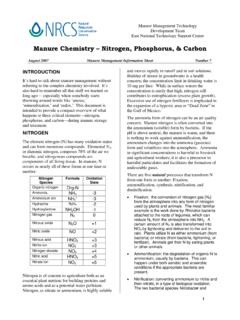
Manure Chemistry – Nitrogen, Phosphorus, & Carbon
www.nrcs.usda.govNitrogen dioxide NO 2 +4 Nitric acid HNO 3 +5 Nitrate ion NO 3-+5 Nitrogen is of concern to agriculture both as an essential plant nutrient for building proteins and amino acids and as a potential water pollutant. Nitrogen, as nitrate or ammonium, is highly soluble and moves rapidly in runoff and in soil solutions.

The greenhouse effect and carbon dioxide - Harvard University
courses.seas.harvard.edupheric constituents, nitrogen and molecu-lar oxygen, have no absorption properties at infrared wavelengths and the main greenhouse gas is water vapour, with car-bon dioxide the next most important. The spectral properties of HO and CO are por-Figure 2. Absorption coefficients calculated using a line-by-line radiative transfer model (Francis and
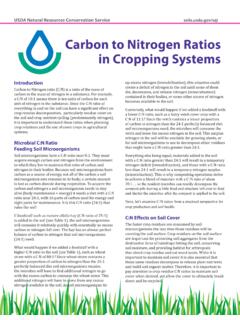
Carbon to Nitrogen Ratios in Cropping Systems - USDA
www.nrcs.usda.govacquire enough carbon and nitrogen from the environment . in which they live to maintain that ratio of carbon and nitrogen in their bodies. Because soil microorganisms burn carbon as a source of energy, not all of the carbon a soil microorganism eats remains in its body; a certain amount is lost as carbon dioxide during respiration. To acquire the
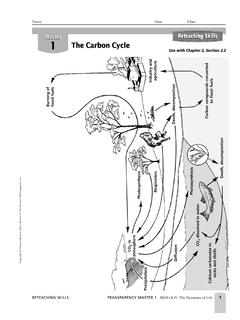
Carbon and Nitrogen Cycle Worksheets - Ms. Murray's Biology
msmurraybiology.weebly.com3. respiration, decomposition, diffusion of carbon dioxide from water to the atmosphere, burning of fossil fuels 4. the air and the oceans 5. Carbon is found as dissolved carbon dioxide, as carbon compounds in the bodies of fish and other marine organisms, and as calcium car-bonate in rocks and shells. 6. Plants remove carbon dioxide from the ...
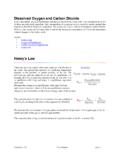
Dissolved Oxygen and Carbon Dioxide
butane.chem.uiuc.eduDissociation of Carbon Dioxide Carbon dioxide reacts with water. The carbon atom of CO 2 is electron poor with an oxidation state of IV. The electron rich oxygen of water donates an electron pair to the carbon. After proton transfer from water to an oxygen of the CO 2 unit, carbonic acid is formed. The reaction between water and dissolved ...

The Carbon Cycle and Atmospheric Carbon Dioxide
www.ipcc.chThe Carbon Cycle and Atmospheric Carbon Dioxide 185 Executive Summary CO 2 concentration trends and budgets Before the Industrial Era, circa 1750, atmospheric carbon dioxide (CO 2) concentration was 280 ±10 ppm for several thousand years. It has risen continuously since then, reaching 367 ppm in 1999.
A INTRODUCTION TO THE GLOBAL CARBON C
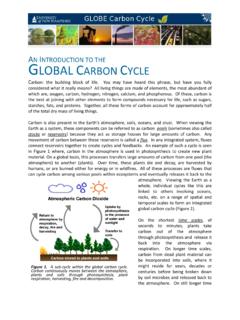
globecarboncycle.unh.eduAtmospheric Carbon Dioxide Transfer to soils Carbon stored in plants and soils Return to atmosphere by respiration, decay, fire and harvesting atmosphere by of water and Figure 1. A sub -cycle within the global carbon c ycle. Carbon continuously moves between the atmosphere, plants and soils through photosynthesis, plant

Greenhouse CO e, and Carbon - Ecometrica
ecometrica.comCarbon dioxide equivalent (CO2e) “Carbon dioxide equivalent” or “CO2e” is a term for describing different greenhouse gases in a common unit. For any quantity and type of greenhouse gas, CO2e signifies the amount of CO2 which would have the equivalent global warming impact.

NITROGEN DIOXIDE HAZARD SUMMARY
nj.govNITROGEN DIOXIDE page 3 of 6 * On skin contact with Nitrogen Dioxide, immediately wash or shower to remove the chemical. At the end of the workshift, wash any areas of the body that may have contacted Nitrogen Dioxide, whether or not known skin contact has occurred. * Do not eat, smoke, or drink where Nitrogen Dioxide is