Transcription of CALCULATION OF WIND LOADS ON STRUCTURES …
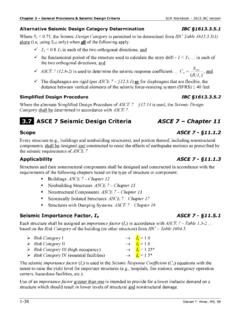
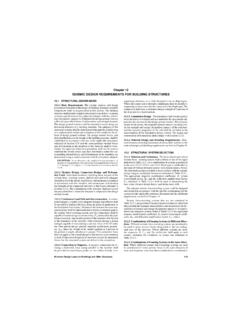
1 202. CALCULATION OF WIND LOADS ON STRUCTURES ACCORDING TO. asce 7 2005. Wind Load CALCULATION Procedures The design wind LOADS for buildings and other STRUCTURES shall be determined according to one of the following procedures: (1) Method 1 Simplified procedure for low-rise simple diaphragm buildings (2) Method 2 Analytical procedure for regular shaped building and STRUCTURES (3) Method 3 Wind tunnel procedure for geometrically complex buildings and STRUCTURES . Method 2 Analytical Procedure Wind LOADS for buildings and STRUCTURES that do not satisfy the conditions for using the simplified procedure can be calculated using the analytical procedure provided that they are not geometrically complex STRUCTURES . The steps of analytical procedure, described in asce 7 Section only, are as follows: 1.
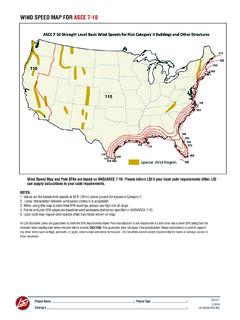
2 Determine the basic wind speed, V, and wind directionality factor, Kd in accordance with asce 7 Section Table ( ): Wind Directionality Factor Kd 203. 2. Determine the importance factor, I, in accordance with ASCE Section Table (6-1): Wind Importance Factors 204. 3. Determine the exposure category or exposure categories and velocity pressure exposure coefficient, K z or Kh , as applicable, for each wind direction according to asce 7 Section Surface Roughness B: Urban and suburban areas, wooded areas, or other terrain with numerous closely spaced obstructions having the size of single-family dwellings or larger. Surface Roughness C: Open terrain with scattered obstructions having heights generally less than 30 ft ( m). This category includes flat open country, grasslands, and all water surfaces in hurricane prone regions.
3 Surface Roughness D: Flat, unobstructed areas and water surfaces outside hurricane prone regions. This category includes smooth mud flats, salt flats, and unbroken ice. Table (6-3): Velocity pressure exposure coefficients, Kh and Kz 205. 4. Determine the topographic factor, K zt , if applicable, according to asce 7 . Section If site conditions and locations of STRUCTURES do not meet all the conditions specified in Section then K zt = (level ground). 5. Determine the gust effect factor G , in accordance with asce 7 Section For rigid STRUCTURES as defined in Section , the gust-effect factor shall be taken as or calculated by a formula. 6. Determine the external pressure coefficients, C p , in accordance with asce 7 . Section or Table (6-6): Wall pressure coefficients, C p 7. Determine the velocity pressure, q z or qh , as applicable, in accordance with asce 7 Section The velocity pressure, q z evaluated at height z is calculated by the following equation: q z = K z K zt Kd V 2 I ( kg / cm2 ; V in km / hr ).
4 206. 8. Determine the design wind load, F, as applicable, in accordance with asce 7 . Section and The design wind load, F, on open buildings and other STRUCTURES is determined by the following formula: F = q z G C p Af where q z = Velocity pressure evaluated at height z of the centroid of area Af 2. Af = Projected area normal to the wind (m ). 207. Example (8): It is required to calculate the lateral wind LOADS acting on the 8-story building considering the wind is acting first in the North-South direction, and second in the East-West direction. The building which is used as a headquarter for police operation is 30 m x 15 m in plan as shown in the figure, and located right on the Gaza Beach. Note: Use a basic wind speed of 100 Km/hr and asce 7 -05 Procedure. Plan Elevation 208. Wind Acting in North-South Direction: The building is categorized as exposure D.
5 K z = (Interpolating values given in Table , for exposure D). I = , police operations K zt = (Topographic factor leveled ground). K d = (Wind directionality factored evaluated from Table ). The static wind pressure q h = Kh K zt Kd V 2 I. = ( ) ( ) ( )(100 )2 ( ). = Kg / m2. 15. For L / B = = and using Table ( ) the external pressure coefficients are 30. shown in the figure. For the leeward side, C p = and the gust factor G = . Wind pressure (leeward side) = qh G C p = ( )( ) = Kg / m2. For the sides parallel to the wind direction, 209. the wind pressure = qh G C p = ( )( ) = Kg / m2. For the windward direction, q z = (K z ) ( ) ( )(100 )2 ( ) = K z Kg / m2 and p = q z G C p = K z ( )( ) = K z Kg / m 2 (varies with height). Pressure distribution at a height of 25 m Pressure distribution along the height Wind Acting in East-West Direction: 30.
6 For L / B = =2 and using Table ( ) the external pressure coefficients are as 15. follows. Windward, C p = Leeward, C p = Sides, C p = Windward pressure at a height of 25 m, p = ( )( )( ) = Kg / m2. Leeward pressure at a height of 25 m, p = ( )( )( ) = Kg / m2. Side pressure at a height of 25 m, p = ( )( )( ) = Kg / m2.