Transcription of Calculus Cheat Sheet - Lamar University
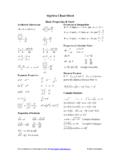
1 Calculus Cheat Sheet Visit for a complete set of Calculus notes. 2005 Paul Dawkins Limits Definitions Precise Definition : We say ()limxafxL = if for every 0e> there is a 0d>such that whenever 0xad<-< then ()fxLe-<. Working Definition : We say ()limxafxL = if we can make ()fx as close to L as we want by taking x sufficiently close to a (on either side of a) without letting xa=. Right hand limit : ()limxafxL+ =. This has the same definition as the limit except it requires xa>. Left hand limit : ()limxafxL- =. This has the same definition as the limit except it requires xa<. Limit at Infinity : We say()limxfxL = if we can make ()fx as close to L as we want by taking x large enough and positive. There is a similar definition for ()limxfxL - = except we require x large and negative. Infinite Limit : We say ()limxafx = if we can make ()fx arbitrarily large (and positive) by taking x sufficiently close to a (on either side of a) without letting xa=.
2 There is a similar definition for ()limxafx =- except we make ()fx arbitrarily large and between the limit and one-sided limits ()limxafxL = fi ()()limlimxaxafxfxL+- == ()()limlimxaxafxfxL+- == fi ()limxafxL = ()()limlimxaxafxfx+- fi ()limxafx Does Not Exist Properties Assume ()limxafx and ()limxagx both exist and c is any number then, 1. ()()limlimxaxacfxcfx = 2. ()()()()limlimlimxaxaxafxgxfxgx = 3. ()()()()limlimlimxaxaxafxgxfxgx = 4. ()()()()limlimlimxaxaxafxfxgxgx = provided ()lim0xagx 5. ()()limlimnnxaxafxfx = 6. ()()limlimnnxaxafxfx = Basic Limit Evaluations at Note : ()sgn1a= if 0a> and ()sgn1a=- if 0a<.1. limxx = e & lim0xx - =e 2. ()limlnxx = & ()0limlnxx+ =- 3. If 0r>thenlim0rxbx = 4. If 0r> and rxis real for negative x thenlim0rxbx - = 5.
3 N even : limnxx = 6. n odd : limnxx = & limnxx - =- 7. n even : ()limsgnnxaxbxca +++= L 8. n odd : ()limsgnnxaxbxca +++= L 9. n odd : ()limsgnnxaxcxda - +++=- L Calculus Cheat Sheet Visit for a complete set of Calculus notes. 2005 Paul Dawkins Evaluation Techniques Continuous Functions If()fxis continuous at a then()()limxafxfa = Continuous Functions and Composition ()fx is continuous at b and ()limxagxb = then ()()()()()limlimxaxafgxfgxfb == Factor and Cancel ()()()2222226412limlim2268lim42xxxxxxxxx xxxx -++-=--+=== Rationalize Numerator/Denominator ()()()()()()2299299333limlim8181391limli m8139311186108xxxxxxxxxxxxxxx --+=--+--==-+++-==- Combine Rational Expressions ()()()()002001111limlim111limlimhhhhxxhh xhxhxxhhhxxhxxhx -+ -= ++ --===- ++ L Hospital s Rule If ()()0lim0xafxgx = or ()()limxafxgx = then, ()()()()limlimxaxafxfxgxgx = a is a number, or - Polynomials at Infinity ()px and ()qx are polynomials.
4 To compute ()()limxpxqx factor largest power of x in ()qxout of both ()px and ()qx then compute limit. ()()222222445533343limlimlim52222xxxxxxx xxxxx - - - ---===----Piecewise Function ()2limxgx - where ()25if 213if 2xxgxxx +<-= - - Compute two one sided limits, ()222limlim59xxgxx-- - -=+= ()22limlim137xxgxx++ - -=-= One sided limits are different so ()2limxgx - doesn t exist. If the two one sided limits had been equal then ()2limxgx - would have existed and had the same value. Some Continuous Functions Partial list of continuous functions and the values of x for which they are Polynomials for all x. 2. Rational function, except for x s that give division by zero. 3. nx(n odd) for all x. 4. nx(n even) for all 0x . 5. xe for all x. 6. lnx for 0x>. 7. ()cosx and ()sinx for all x. 8. ()tanx and ()secx provided 33,,,,,2222xpppp --LL 9.
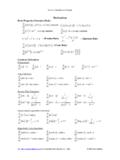
5 ()cotx and ()cscx provided ,2,,0,,2,xpppp --LL Intermediate Value Theorem Suppose that ()fx is continuous on [a, b] and let M be any number between ()fa and ()fb. Then there exists a number c such that acb<< and ()fcM=. Calculus Cheat Sheet Visit for a complete set of Calculus notes. 2005 Paul Dawkins Derivatives Definition and Notation If ()yfx= then the derivative is defined to be()()()0limhfxhfxfxh +- =. If ()yfx= then all of the following are equivalent notations for the derivative. ()()()()dfdydfxyfxDfxdxdxdx ===== If()yfx=all of the following are equivalent notations for derivative evaluated at xa=. ()()xaxaxadfdyfayDfadxdx=== ==== Interpretation of the Derivative If ()yfx= then, 1. ()mfa = is the slope of the tangent line to ()yfx= at xa=and the equation of the tangent line at xa= is given by ()()()yfafaxa =+.
6 2. ()fa is the instantaneous rate of change of ()fx at xa=. 3. If ()fx is the position of an object at time x then ()fa is the velocity of the object at xa=. Basic Properties and Formulas If ()fx and ()gx are differentiable functions (the derivative exists), c and n are any real numbers, 1. ()()cfcfx = 2. ()()()fgfxgx = 3. ()fgfgfg =+ Product Rule 4. 2ffgfggg -= Quotient Rule 5. ()0dcdx= 6. ()1nndxnxdx-= Power Rule 7. ()()()()()()dfgxfgxgxdx = This is the Chain Rule Common Derivatives ()1dxdx= ()sincosdxxdx= ()cossindxxdx=- ()2tansecdxxdx= ()secsectandxxxdx= ()csccsccotdxxxdx=- ()2cotcscdxxdx=- ()121sin1dxdxx-=- ()121cos1dxdxx-=-- ()121tan1dxdxx-=+ ()()lnxxdaaadx=()xxddx=ee ()()1ln,0dxxdxx=>()1ln,0dxxdxx= ()()1log,0lnadxxdxxa=> Calculus Cheat Sheet Visit for a complete set of Calculus notes.
7 2005 Paul Dawkins Chain Rule Variants The chain rule applied to some specific functions. 1. ()()()()1nndfxnfxfxdx- = 2. ()()()()fxfxdfxdx =ee 3. ()()()()lnfxdfxdxfx = 4. ()()()()sincosdfxfxfxdx = 5. ()()()()cossindfxfxfxdx =- 6. ()()()()2tansecdfxfxfxdx = 7. []()[][]()()()()secsectanfxfxfxfxddx = 8. ()()()()12tan1fxdfxdxfx- = + Higher Order Derivatives The Second Derivative is denoted as ()()()222dffxfxdx == and is defined as ()()()fxfx =, the derivative of the first derivative,()fx . The nth Derivative is denoted as ()()nnndffxdx= and is defined as ()()()()()1nnfxfx- =, the derivative of the (n-1)st derivative,()()1nfx-. Implicit Differentiation Find y if ()2932sin11xyxyyx-+=+e. Remember()yyx= here, so products/quotients of x and y will use the product/quotient rule and derivatives of y will use the chain rule.
8 The trick is to differentiate as normal and every time you differentiate a y you tack on a y (from the chain rule). After differentiating solve for y . ()()()()()()2922329222929223329329292229 32cos1111232932cos1129cos29cos1123xyxyxy xyxyxyxyyxyxyyyyxyyxyxyyyyyxyyxyyyxy---- --- -++=+-- -++=+fi=-- --=--eeeeeee Increasing/Decreasing Concave Up/Concave Down Critical Points xc= is a critical point of ()fx provided either 1. ()0fc = or 2. ()fc doesn t exist. Increasing/Decreasing 1. If ()0fx > for all x in an interval I then ()fx is increasing on the interval I. 2. If ()0fx < for all x in an interval I then ()fx is decreasing on the interval I. 3. If ()0fx = for all x in an interval I then ()fx is constant on the interval I. Concave Up/Concave Down 1. If ()0fx > for all x in an interval I then ()fx is concave up on the interval I.
9 2. If ()0fx < for all x in an interval I then ()fx is concave down on the interval I. Inflection Points xc= is a inflection point of ()fx if the concavity changes at xc=. Calculus Cheat Sheet Visit for a complete set of Calculus notes. 2005 Paul Dawkins Extrema Absolute Extrema 1. xc=is an absolute maximum of()fx if()()fcfx for all x in the domain. 2. xc= is an absolute minimum of()fx if()()fcfx for all x in the domain. Fermat s Theorem If ()fx has a relative (or local) extrema at xc=, then xc= is a critical point of ()fx. Extreme Value Theorem If ()fx is continuous on the closed interval [],ab then there exist numbers c and d so that, 1. ,acdb , 2. ()fc is the abs. max. in [],ab, 3. ()fd is the abs. min. in [],ab. Finding Absolute Extrema To find the absolute extrema of the continuous function ()fx on the interval [],ab use the following process.
10 1. Find all critical points of ()fx in [],ab. 2. Evaluate ()fx at all points found in Step 1. 3. Evaluate ()fa and ()fb. 4. Identify the abs. max. (largest function value) and the abs. min.(smallest function value) from the evaluations in Steps 2 & 3. Relative (local) Extrema 1. xc= is a relative (or local) maximum of ()fx if()()fcfx for all x near c. 2. xc= is a relative (or local) minimum of ()fx if()()fcfx for all x near c. 1st Derivative Test If xc= is a critical point of ()fx then xc= is 1. a rel. max. of()fx if()0fx > to the left of xc= and()0fx < to the right of xc=. 2. a rel. min. of()fx if()0fx < to the left ofxc=and()0fx >to the right of xc=. 3. not a relative extrema of()fx if()fx is the same sign on both sides of xc=. 2nd Derivative Test If xc= is a critical point of ()fx such that ()0fc = then xc= 1.