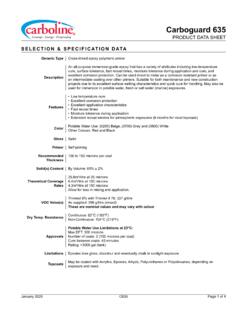
Transcription of Carboguard 893 - Carboline
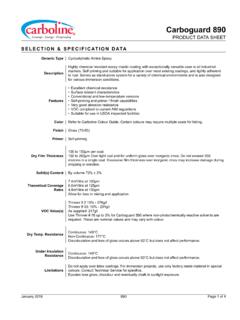
1 Carboguard 893 PRODUCT DATA SHEET June 20190988 Page 1 of 5 SELECTION & SPECIFICATION DATA Generic TypeCycloaliphatic Amine Epoxy DescriptionHigh solids corrosion resistant primer and intermediate. Used either as a primer or an intermediatecoat over steel and inorganic zinc primers. Can be topcoated with a broad variety of highperformance finish coats. Features Excellent corrosion protection Excellent film build and edge protection Used as a primer or an intermediate coating Good abrasion resistance Cures down to 40 F VOC compliant to current AIM regulations ColorRed (0500); Gray (0700); White (0800); Yellow (0600) FinishEggshell PrimerSelf-priming. May be applied over organic and inorganic zinc rich primers. A mist coat may berequired to minimize bubbling over zinc rich primers. Dry Film Thickness76 microns (3 mils) per coat102 - 152 microns (4 - 6 mils) per coat mils for mild environments and as an intermediate coat over inorganic zincs.
2 4-6 mils for moresevere environments. Do not exceed mils (250 microns) in a single coat. Excessive filmthickness over inorganic zincs may increase damage during shipping or erection. Solids ContentBy Volume 77% +/- 2% Theoretical m /l at 25 microns (1235 ft /gal at mils) m /l at 75 microns (412 ft /gal at mils) m /l at 150 microns (206 ft /gal at mils)Allow for loss in mixing and application. VOC ValuesAs Supplied : lbs/gal (195 g/l)Thinner 2 : 16 oz/gal = lbs/gal (261 g/l)Thinner 230 : 13 oz/gal = lbs/gal (252 g/l)Thinner 33 : 32 oz/gal = lbs/gal (329 g/l) These are nominal values and may vary slightly with color. *Maximum thinning for 250 g/l restrictedareas is 12 oz/gal with Thinner 2, and 11 oz/gal with Thinner 33 or 230. Use Thinner 76 where non-photochemically reactive solvents are required (up to 11 oz/gal) Dry Temp. ResistanceContinuous: 93 C (200 F)Non-Continuous: 121 C (250 F) Discoloration and loss of gloss is observed above 200 F (93 C).
3 LimitationsNot recommended for immersion service TopcoatsMay be coated with Acrylics, Epoxies, Alkyds, or Polyurethanes depending on exposure and 893 PRODUCT DATA SHEET June 20190988 Page 2 of 5 SUBSTRATES & SURFACE PREPARATION GeneralSurfaces must be clean and dry. Employ adequate methods to remove dirt, dust, oil and all othercontaminants that could interfere with adhesion of the coating. SteelSSPC-SP6 with a mil (25-50 micron) surface profile. Galvanized SteelPrime with specific Carboline primers as recommended by your Carboline Sales to the specific primer s Product Data Sheet for substrate preparation requirements. Concrete or CMUC oncrete must be cured 28 days at 75 F (24 C) and 50% relative humidity or equivalent. Preparesurfaces in accordance with ASTM D42582 Surface Cleaning of Concrete and ASTM D4259 Abrading Concrete. Voids in concrete may require DATA All test data was generated under laboratory conditions. Field testing results may vary.
4 Test MethodSystemResultsASTM B117 Salt FogBlasted Steel 1ct. IOZ 1 ct. 893No blistering, rusting and nocreepage at scribe after 4000 hoursASTM D 1735 Water FogBlasted Steel 1ct. IOZ 1 ct. 893No blistering softening orrusting after 5000 hoursASTM D2583 HardnessBlasted Steel 1 ct. 89373, barcol Test, 1 week cure, 5 mils DFTASTM D4060 AbrasionBlasted Steel 1ct. 89388 mg. loss after 1000 cycles,CS17 wheel, 1000 gm. loadASTM G26 WeatherometerBlasted Steel 1ct. IOZ 1 ct. 893No blistering softening orrusting after 4000 hours Test reports and additional data available upon written & THINNING MixingPower mix separately, then combine and power mix. DO NOT MIX PARTIAL KITS. A 30-minute sweat-in time is highly recommended for applications below 50 F and will improve cure response. ThinningSpray: Up to 16 oz/gal (12%) w/ Thinner 2 or up to 13 oz/gal (10%) w/ Thinner 230 Brush: Up to 32 oz/gal (25%) w/ Thinner 33 Roller: Up to 32 oz/gal (25%) w/ Thinner 33 Mist coating: Thin up to 32 oz/gal with Thinner 2 or 33 in VOC restricted ( ) areas.
5 May thinup to 48 oz/gal where VOC restricted levels are at lb/gal for mist coat only. If necessary, useThinner 230 only in hot (above 100 F/38 C) and windy conditions, to slow down the evaporationrate. Use of thinners other than those supplied or recommended by Carboline may adversely affectproduct performance and void product warranty, whether expressed or implied. *See VOC valuesfor thinning Thinner 236E or 225E (up to 10% or 13 oz/gal) may also be used to thin this product tominimize HAP and VOC emissions. Consult Carboline Technical Service for guidance. Ratio1:1 Ratio (A to B) Pot Life4 Hours at 75 F (24 C) Pot life ends when coating loses body and begins to sag. Pot life times willbe less at higher temperatures. Thinning rates above 16 oz/gal will shorten the working time to 893 PRODUCT DATA SHEET June 20190988 Page 3 of 5 APPLICATION EQUIPMENT GUIDELINES Listed below are general equipment guidelines for the application of this product.
6 Job site conditions may require modificationsto these guidelines to achieve the desired results. Spray Application(General)This is a high solids coating and may require adjustments in spray techniques. Wet film thicknessis easily and quickly achieved. The following spray equipment has been found suitable and isavailable from manufacturers such as Binks, DeVilbiss and Graco. Conventional SprayPressure pot equipped with dual regulators, 3/8 minimum material hose, .070 fluid tip andappropriate air cap. Airless SprayPump Ratio: 30:1 (min.)GPM Output: (min.)Material Hose: 3/8 (min.)Tip Size: . Output PSI: 2100-2300 Filter Size: 60 meshTeflon packings are recommended and available from the pump manufacturer. Brush & Roller(General)Multiple coats may be required to obtain desired appearance, recommended dry film thickness andadequate hiding. Avoid excessive re-brushing or re-rolling. For best results, tie-in within 10 minutesat 75 F (24 C).
7 BrushUse a medium bristle brush. RollerUse a short-nap synthetic roller cover with phenolic CONDITIONS ConditionMaterialSurfaceAmbientHumidityM inimum4 C (40 F)4 C (40 F)4 C (40 F)0%Maximum32 C (90 F)57 C (135 F)43 C (110 F)90% This product simply requires the substrate temperature to be above the dew point. Condensation due to substrate temperaturesbelow the dew point can cause flash rusting on prepared steel and interfere with proper adhesion to the substrate. Specialapplication techniques may be required above or below normal application 893 PRODUCT DATA SHEET June 20190988 Page 4 of 5 CURING SCHEDULE Surface to HandleDry to TopcoatDry to TouchMaximumRecoat Timew/ AcrylicsMaximumRecoat Timew/ EpoxiesMaximumRecoat Time w/Polyurethanes4 C (40 F)24 Hours72 Hours6 Hours14 Days30 Days90 Days10 C (50 F)16 Hours24 Hours5 Hours14 Days30 Days90 Days16 C (60 F)12 Hours16 Hours4 Hours14 Days30 Days90 Days24 C (75 F)6 Hours8 Hours3 Hours14 Days30 Days90 Days32 C (90 F)3 Hours4 Hours2 Hours14 Days15 Days30 Days These times are based on a mil (100 micron) dry film thickness.
8 Higher film thickness, insufficient ventilation or coolertemperatures will require longer cure times and could result in solvent entrapment and premature failure. Excessive humidity orcondensation on the surface during curing can interfere with the cure, can cause discoloration and may result in a surface haze or blush must be removed by water washing before recoating. During high humidity conditions, it is recommended thatthe application be done while temperatures are increasing. If the maximum recoat time is exceeded, the surface must be abradedby sweep blasting or sanding before the application of additional coats. When cured below 50 F a slight softening is typicallyobserved as the temperature rises above 50 F and is considered & SAFETY CleanupUse Thinner 2 or Acetone. In case of spillage, absorb and dispose of in accordance with localapplicable regulations. SafetyRead and follow all caution statements on this product data sheet and on the MSDS for thisproduct.
9 Hypersensitive persons should wear protective clothing, gloves and use protective creamon face, hands and all exposed areas. VentilationWhen used in enclosed areas and product is thinned, thorough air circulation must be usedduring and after application until the coating is cured. The ventilation system should be capable ofpreventing the solvent vapor concentration from reaching the lower explosion limit for the solventsused. User should test and monitor exposure levels to insure all personnel are below guidelines. Ifnot sure or if not able to monitor levels, Use MSHA/NIOSH approved supplied air , HANDLING & STORAGE Shelf LifePart A: Min. 36 months at 75 F (24 C)Part B: Min. 24 months at 75 F (24 C) *Shelf Life: (actual stated shelf life) when kept at recommended storage conditions and in originalunopened containers. Shipping Weight(Approximate)2 Gallon Kit - 29 lbs (13 kg) 10 Gallon Kit - 143 lbs (65 kg) Storage Temperature &Humidity40 - 110 F (4 -43 C)0-90% Relative Humidity Flash Point (Setaflash) Carboguard 893 Part A: 61 F (16 C) Carboguard 893 Part B: 59 F (15 C) StorageStore Indoors.
10 This product is solvent based and not affected by excursions below these published storagetemperatures, down to 10 F, for a duration of no more than 14 days. Always inspect the productprior to use to make sure it is smooth and homogeneous when properly 893 PRODUCT DATA SHEET June 20190988 Page 5 of 5 WARRANTYTo the best of our knowledge the technical data contained herein is true and accurate on the date of publication and is subjectto change without prior notice. User must contact Carboline Company to verify correctness before specifying or ordering. Noguarantee of accuracy is given or implied. We guarantee our products to conform to Carboline quality control. We assume noresponsibility for coverage, performance, injuries or damages resulting from use. Carbolines sole obligation, if any, is to replaceor refund the purchase price of the Carboline product(s) proven to be defective, at Carbolines option. Carboline shall not be liablefor any loss or damage.