Transcription of Carbozinc 11 HS - Carboline
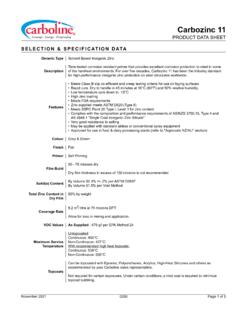
1 Carbozinc 11 HSPRODUCT DATA SHEET June 20170249 Page 1 of 5 SELECTION & SPECIFICATION DATA Generic TypeSolvent Based Inorganic Zinc DescriptionUltra-low VOC member of the Carbozinc family with extraordinary corrosion resistance 11 HS combines unparalleled performance characteristics with an ultra-low VOCformulation that meets some of the most stringent VOC restrictions. Features Meets Class B slip co-efficient and creep testing criteria for use on faying surfaces Rapid cure. Dry to handle in 1 hour at 75 F (24 C) and 50% relative humidity Low temperature cure down to 15 F (-9 C) High zinc loading Very good resistance to salting May be applied with airless or conventional spray Excellent as a lining for solvent storage* (Green color only) May be used as a weldable pre-construction primer Exhibits long-term corrosion resistance Ultra-low VOC level for solvent-based inorganic zincs ColorStandard: Green (0300)Special Order.
2 Grey (0700) FinishFlat PrimerSelf Priming TopcoatAcrylics, Epoxies, Polyurethanes, High Heat Silicones, Silicates and others as recommended byyour Carboline sales representative. Not required for certain exposures. A mist-coat/full-coat spray technique is often required tominimize topcoat bubbling. Service TemperatureUntopcoatedContinuous: 750 F (400 C)Non-Continuous: 800 F (427 C)With recommended high heat topcoats:Continuous: 1000 F (538 C)Non-Continuous: 1200 F (649 C) Dry Film Thickness51 - 76 microns (2 - 3 mils) per coat mils (12-25 microns) per coat for weldable, pre-construction primer.
3 Mils for OEMapplications in controlled environments. Dry film thickness in excess of mils (150 microns) percoat is not recommended. Total Zinc Content inDry Film84% by weight Solids ContentBy Volume 75% +/- 2% Measured in accordance with ASTM D 2697. Zinc Content in DryFilmBy Weight 84% in dry film Theoretical m /l at 25 microns (1203 ft /gal at mils) m /l at 50 microns (602 ft /gal at mils) Carbozinc 11 HSPRODUCT DATA SHEET June 20170249 Page 2 of 5 SELECTION & SPECIFICATION DATA m /l at 75 microns (401 ft /gal at mils)Allow for loss in mixing and application. VOC ValuesAs Supplied : (288 g/l)Thinner 236 E : 38 oz/gal: (288 g/l)Thinner 254 : 8 oz/gal: lbs/gal (327 g/l)Thinner 26 : oz/gal: (354 g/l)Thinner 33 : oz/gal: (354 g/l) These are nominal values.
4 When used as a pre-construction primer thin up to 38 oz/gal usingexempt Thinner 236 E. TopcoatsAcrylics, Epoxies, Polyurethanes, High Heat Silicones, Silicates and others as recommended byyour Carboline sales representative. Not required for certain exposures. A mist-coat/full-coat spray technique is often required tominimize topcoat & SURFACE PREPARATION GeneralSurfaces must be clean and dry. Employ adequate methods to remove dirt, dust, oil and all othercontaminants that could interfere with adhesion of the coating. SteelSSPC-SP6 Surface Profile: mils (25-75 micron). Consult Carboline Technical Service forappropriate surface preparation guidelines regarding tank lining DATA All test data was generated under laboratory conditions.
5 Field testing results may vary. Test MethodSystemResultsAASHTO M300 Blasted Steel 1 ct. CZ 11 HSNo blistering or rusting ofcoating or any bare steel areasASTM A-325 or A-490 Slip co-efficient1 ct. CZ 11 meets requirements for Class B ratingASTM B117 Salt SprayBlasted Steel 1 ct. CZ 11 HSNo rusting or blistering; slight rust in scribe,no creepage at scribe after 70,000 hoursASTM D3363 Pencil hardness1 ct. CZ 11 HSPencil Hardness 3 HMIXING & THINNING MixingPower mix base (Part A), then combine and power mix as follows. Pour zinc filler (Part B) veryslowly into premixed base (Part A) with continuous agitation.
6 Mix until free of lumps. Then addactivator (Part C) and mix for another 2 minutes. Pour mixture through a 30 mesh screen. Siftingzinc through a screen will aid in the mixing process by breaking up or catching dry zinc lumps. DONOT MIX PARTIAL KITS. Note: Will not cure without the use of the Activator as defined below. ThinningNormally not required but may be thinned up to 11 oz per gal kit or 55 oz per gal kit withThinner 26, 33 or 254. Use of thinners other than those supplied by Carboline may adversely affectproduct performance and void product warranty, whether expressed or use as a weldable zinc primer to achieve a recommended DFT of mils, thin thisproduct starting with 10% (and up to 30%) with Thinner 236E.
7 Consult Carboline Technical Servicefor guidance. Carbozinc 11 HSPRODUCT DATA SHEET June 20170249 Page 3 of 5 MIXING & THINNING Gal KitPart A (Base): Short fill 1-galPart C (Activator): fl. B (Zinc Filler): Gal KitPart A (Base): Short fill 5-galPart C (Activator): 32 fl. B (Zinc Filler): 73 lbs Pot Life8 Hours at 75 F (24 C) and less at higher temps. Pot life ends when coating becomes too EQUIPMENT GUIDELINES Listed below are general equipment guidelines for the application of this product. Job site conditions may require modificationsto these guidelines to achieve the desired results.
8 Spray Application(General)The following spray equipment has been found suitable and is available from equipmentmanufacturers. Keep material under mild agitation during application. If spraying stops for morethan 10 minutes, recirculate the material remaining in the spray line. Do not leave mixed primer inthe hoses during work stoppages. Conventional SprayAgitated pressure pot equipped with dual regulators, 3/8 minimum material hose, with amaximum length of 50 feet; .070 fluid tip and appropriate air cap. Airless SprayPump Ratio: 30:1 (min.)GPM Output: (min.)Material Hose: 3/8 (min.)
9 Tip Size: Output PSI: 2100-2500 Filter Size: 60 meshPTFE packings are recommended and available from the pump manufacturer. BrushFor touch-up of areas less than one square foot only. Use medium bristle brush and avoidrebrushing. RollerNot CONDITIONS ConditionMaterialSurfaceAmbientHumidityM inimum-9 C (15 F)-9 C (15 F)-9 C (15 F)30%Maximum35 C (95 F)66 C (150 F)49 C (120 F)95% This product simply requires the substrate temperature to be above the dew point. Condensation due to substrate temperaturesbelow the dew point can cause flash rusting on prepared steel and interfere with proper adhesion to the substrate.
10 Specialapplication techniques may be required above or below normal application conditions which are as follows: material 60 F-85 F(16 C-29 C), surface & ambient 40 F-95 F (4 C-35 C) and humidity 40-90%. Carbozinc 11 HSPRODUCT DATA SHEET June 20170249 Page 4 of 5 CURING SCHEDULE Surface to HandleDry to Topcoat-9 C (15 F)16 Hours7 Days4 C (40 F)4 Hours72 Hours16 C (60 F)2 Hours36 Hours24 C (75 F)1 Hour18 Hours38 C (100 F)45 Minutes14 Hours These times are based on a mil (75 micron) dry film thickness. Higher film thickness, insufficient ventilation or coolertemperatures will require longer cure times and could result in solvent entrapment and premature failure.