Example: dental hygienist
Carers Week 2020 Research Report
support for an ill, older or disabled family member, or friend. They are unpaid carers but for many they are just a wife, husband, child, parent, friend or good neighbour. The amount and type of support that unpaid carers provide varies considerably. It can range from a few hours a week, such as picking up
Tags:
Information
Domain:
Source:
Link to this page:
Documents from same domain
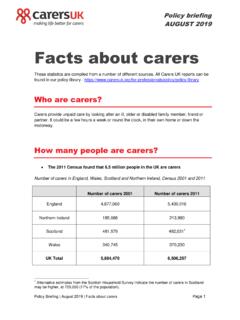
Facts about carers - Home - Carers UK
www.carersuk.orgPolicy briefing OCTOBER 2015 Policy Briefing | August 2015 | Facts about carers 1 Facts about carers Who are carers? Carers provide unpaid care by looking after an ill, older or disabled family member, friend or

Assessments - Carers UK
www.carersuk.orgIf it helps, you can have a family member, a friend or a carer support worker from a carers’ organisation with you. Assessments can be done over the phone or online, but this should only happen if you agree. If you think you can easily express your needs over the phone or online, then this method may be the right one for you. Online
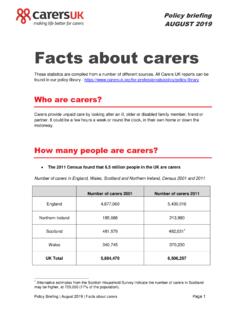
Facts about carers
www.carersuk.org75 and 84. Carers over 85 are more likely to be male (59%) than female (41%) 22 – many caring for their partners. Black, Asian and Minority Ethnic (BAME) carers The 2011 Census showed that there were just under 600,000 BAME carers in England and Wales. 2011 data indicates that a smaller proportion of the BAME population provides care than the

Carer’s Allowance
www.carersuk.orgfactsheet Carer’s Allowance is the main benefit for carers. If you . are looking after someone for 35 hours a week or more, you may be eligible.

The drama triangle - Carers UK
www.carersuk.orgThe Drama Triangle SATELLITE 1 ... people. It was created by a man called Steven Karpman and comes from a theory called transactional analysis created by Eric Berne. ...
Understanding and using the Health and Social Care ...
www.carersuk.org8 | Understanding and using the Health and Social Care Standards The Standards most applicable to carers are listed below. 1.13 I am assessed by a qualified person, who involves other people and

Assessments and the Care Act - Carers UK
www.carersuk.orgAssessments can be done over the phone or online, but this should only happen if you agree. If you think you can easily express your needs over the phone or online then this method may be the right one for you. Online or telephone assessments are unlikely to ever be appropriate for people who lack capacity or have difficulties with communication.

Personal Independence Payment
www.carersuk.orgfactsheet If you are looking after someone who has a disability or illness and is aged from 16 to below their state pension age, they may be entitled to Personal Independence Payment (PIP).

Carer’s Allowance
www.carersuk.orgthe middle or the higher rate of the care component of Disability Living Allowance (DLA) or . Factsheet UK1025 – Carer’s Allowance 4 either rate of the daily living component of Personal Independence Payment (PIP) or either rate of Attendance Allowance or Constant Attendance
Related documents

Dementia in the Family: The Impact on Carers
www.alzheimersresearchuk.orgfamily carers for people with dementia. In addition to spending a day with each family observing them as they cared for their loved one, the carers were asked to complete a diary in which they recorded their experiences of providing care over the course of a week. Their experiences are presented in this report and in a series of short films.
Responding to Family Violence Capability Framework
www.vic.gov.auvictim or non-family carers whilst people from diverse cultural, linguistic and faith backgrounds experience distinct forms of family violence, migration abuse and other forms of violence including forced marriage and dowry-related abuse. • In an Aboriginal context, factors contributing to family violence include the history of colonisation,

Short breaks for carers of disabled children - GOV.UK
assets.publishing.service.gov.uk1.4 Impairments vary in severity and their impact on family life. Caring for children with profound and multiple disabilities, complex health needs and challenging behaviour may be particularly demanding for families. The impact, particularly on the health and wellbeing of carers and brothers and sisters, is hugely variable and will

The lives of young carers in England - GOV.UK
assets.publishing.service.gov.ukcarers' projects and young carer respite services; and screening from an online panel. Research visits lasted 3-4 hours and used a mixture of exploratory discussions with families, observations of family interaction, in-depth interviews with children who were
Assessments - Carers UK
www.carersuk.orgIf it helps, you can have a family member, a friend or a carer support worker from a carers’ organisation with you. Assessments can be done over the phone or online, but this should only happen if you agree. If you think you can easily express your needs over the phone or online, then this method may be the right one for you. Online

Questions and Answers for Parents / Carers on Lateral Flow ...
news.wrexham.gov.ukQuestions and Answers for Parents / Carers on Lateral Flow Testing What are the symptoms of Covid 19? a new continuous cough a high temperature loss of or change to sense of smell or taste (Anosmia) Did you know? Up to one third of people who have coronavirus experience no symptoms! What is a Lateral Flow Test?
Promoting less restrictive practice
local.gov.ukand family life). If these restrictions are significant they may need to considered by The Court of Protection. MCA Guiding Principles The Mental Capacity Act sets out the guiding principles which underpin all work with people from the age of 16. Principle 1: Assumption of capacity. This means that everyone from the age of 16 is assumed to