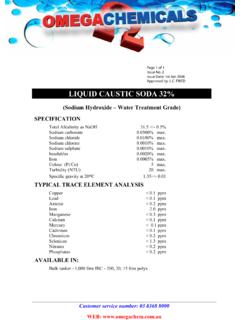
Transcription of Caustic Soda 50 % Material Safety Data Sheet
1 Caustic soda 50 % Material Safety Data Sheet 1. IDENTIFICATION OF THE SUBSTANCE/PREPARATION AND COMPANY/ UNDERTAKING Material Name : Caustic soda 50 % (Membrane) Uses : Use in chemical industry as industrial cleaner or within alumina production. Supplier : Sahara & Ma aden Petrochemical Company (SAMAPCO) PO Box 11166 Jubail Industrial City Saudi Arabia, 31961 Telephone : +966 3 3567777 Fax : +966 3 3589900 Emergency Telephone Number : +966 3 3567779 2. COMPOSITION/INFORMATION ON INGREDIENTS Synonyms : Sodium hydroxide Lye solution CAS No. : 1310-73-2 Hazardous Components Chemical Name CAS EINECS Symbol(s) R-phrase(s) Sodium Hydroxide 1310-73-2 215-185-5 C R35 >= % Water 7732-18-5 231-791-2 <= % Additional Information : Refer to chapter 16 for full text of EC R-phrases.
2 3. HAZARDS IDENTIFICATION Health Hazards Causes severe burns. Severely irritating to the respiratory tract causing chemical burns which may result in permanent damage to the nose, throat and lungs. Causes digestive tract burns. Signs and Symptoms Swallowing of corrosive chemicals may cause immediate pain and burning in the mouth, throat, and stomach followed by vomiting and diarrhea. Burns and tearing of the esophagus and stomach are possible. Corrosive to eyes. Contact can cause severe eye damage including chemical burns, pain, clouding of the eye surface, inflammation of the eye, and may result in permanent loss of vision. Corrosive to skin. Contact with the skin can cause chemical burns, redness, swelling, and tissue damage. Caustic soda 50 % Material Safety Data Sheet Aggravated Medical Condition Pre-existing medical conditions of the following organ(s) or organ system(s) may be aggravated by exposure to this Material : Respiratory system.
3 Eyes. Skin. Safety Hazards Highly reactive. At high temperatures, fuming may occur, giving off a strong, corrosive gas. Do not enter without wearing protective equipment suitable for the situation. Environmental Hazards No specific hazards under normal use conditions. 4. FIRST AID MEASURES Inhalation Remove to fresh air. If rapid recovery does not occur, transport to nearest medical facility for additional treatment. Skin Contact DO NOT DELAY. Remove contaminated clothing. Flush exposed area with water and follow by washing with soap if available. Cover the burn area loosely with a sterile dressing, if available. If persistent irritation occurs, obtain medical attention. Eye Contact DO NOT DELAY. Immediately flush eyes with large amounts of water for at least 30 minutes while holding eyelids open.
4 Transport to the nearest medical facility for additional treatment. Ingestion DO NOT DELAY. Do not induce vomiting. If victim is alert, rinse mouth and drink 1/2 to 1 glass of water to help dilute the Material . Do not give liquids to a drowsy, convulsing, or unconscious person. Transport to nearest medical facility for additional treatment. Advice to Physician Treat symptomatically. Esophagos copy is recommended after ingestion to detect potential lesions in the esophagus. 5. FIRE FIGHTING MEASURES Specific Hazards Reacts violently with water. Caustic soda 50 % Material Safety Data Sheet Extinguishing Media Foam, water spray or fog. Dry chemical powder, carbon dioxide, sand or earth may be used for small fires only. Unsuitable Extinguishing Media Do not use water in a jet. Protective Equipment for Firefighters Proper protective equipment including breathing apparatus must be worn when approaching a fire in a confined space.
5 6. ACCIDENTAL RELEASE MEASURES Protective measures Avoid contact with skin and eyes. Prevent from spreading or entering into drains, ditches or rivers by using sand, earth, or other appropriate barriers. Prevent from spreading or entering into waterways, sewers, basements or confined areas. Use appropriate containment to avoid environmental contamination. Clean Up Methods Neutralize contaminated area as appropriate for acid or base spill. Soak up residue with an absorbent such as clay, sand or other suitable Material and dispose of properly. Prevent from spreading by making a barrier with sand, earth or other containment Material . For large liquid spills (> 1 drum), transfer by mechanical means such as vacuum truck to a salvage tank for recovery or safe disposal. Do not flush away residues with water.
6 Retain as contaminated waste. Allow residues to evaporate or soak up with an appropriate absorbent Material and dispose of safely. Remove contaminated soil and dispose of safely. For small liquid spills (< 1 drum), transfer by mechanical means to a labeled, sealable container for product recovery or safe disposal. Allow residues to evaporate or soak up with an appropriate absorbent Material and dispose of safely. Remove contaminated soil and dispose of safely. 7. HANDLING AND STORAGE General Precautions Use the information in this data Sheet as input to a risk assessment of local circumstances to help determine appropriate controls for safe handling, storage and disposal of this Material . Avoid contact with skin, eyes, and clothing. Storage : Ambient. Recommended Materials : Nickel alloys.
7 Steel. Fiberglass acceptable if temperatures are not elevated. Unsuitable Materials : Aluminum, Zinc, Tin. Additional Information : Ensure that all local regulations regarding handling and storage facilities are followed. Caustic soda 50 % Material Safety Data Sheet 8. EXPOSURE CONTROLS/PERSONAL PROTECTION Occupational Exposure Limits Material Source Type ppm mg/m3 Notation Sodium Hydroxide ACGIH Ceiling 2 mg/m3 Exposure Controls Personal protective equipment (PPE) should meet recommended national standards. Check with PPE suppliers. Eye washes and showers for emergency use. Where Material is heated, sprayed or mist formed, there is greater potential for airborne concentrations to be generated. Wash hands before eating, drinking, smoking and using the toilet. Personal Protective Equipment Personal protective equipment (PPE) should meet recommended national standards.
8 Check with PPE suppliers. Respiratory Protection If engineering controls do not maintain airborne concentrations to a level which is adequate to protect worker health, select respiratory protection equipment suitable for the specific conditions of use and meeting relevant legislation. Check with respiratory protective equipment suppliers. Where air-filtering respirators are unsuitable ( , airborne concentrations are high, risk of oxygen deficiency, confined space) use appropriate positive pressure breathing apparatus. Where air filtering respirators are suitable, select an appropriate combination of mask and filter. Select a filter suitable for combined particulate/inorganic gases and vapours meeting EN141 & 143. Where respiratory protective equipment is required, use a full face mask.
9 Hand Protection Suitability and durability of a glove is dependent on usage, frequency and duration of contact, chemical resistance of glove Material , glove thickness, dexterity. Always seek advice from glove suppliers. Contaminated gloves should be replaced. Manufacturer recommends the use of: Butyl rubber. Natural rubber. Neoprene rubber. Nitrile rubber. PVC. Personal hygiene is a key element of effective hand care. Gloves must only be worn on clean hands. After using gloves, hands should be washed and dried thoroughly. Application of a non-perfumed moisturizer is recommended. Eye Protection : Mono goggles (EN166) Protective Clothing Use protective clothing which is chemical resistant to this Material . Safety shoes and boots should also be chemical resistant. Where risk of splashing or in spillage clean up, use chemical resistant one-piece overall with integral hood and chemical resistant gloves.
10 Otherwise use chemical resistant apron and gauntlets. Caustic soda 50 % Material Safety Data Sheet Environmental Exposure Controls Adequate ventilation to control airborne concentrations. Eye washes and showers for emergency use. Where Material is heated, sprayed or mist formed, there is greater potential for airborne concentrations to be generated. 9. PHYSICAL AND CHEMICAL PROPERTIES Appearance : Water white to slightly turbid Liquid. Odour : Odourless pH : 14 at 20 C / 68 F Boiling point : 140 C / 284 F Melting / freezing point : Data not available. Flash point : Not applicable. Explosion / Flammability: Not applicable limits in air Vapour pressure : hPa Specific gravity : Data not available. Density : g/cm3 at 15 C / 59 F Water solubility : Completely Soluble Solubility in other solvents : Data not available.