Transcription of CBSE X Science - 2016 - NextGurukul
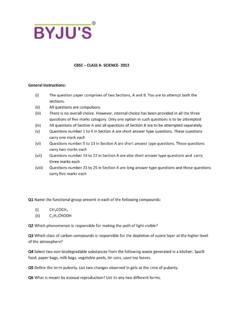
1 cbse X Science - 2016 _____ _____ Next Education India Pvt. Ltd. All rights reserved. Page 1 of 6 Time allowed: 3 hours; Maximum Marks: 90 General Instructions: 1. The question paper comprises of two Sections, A and B. You are to attempt both the sections. 2. All questions are compulsory. 3. There is no choice in any of the questions. 4. All questions of Section A and all questions of Section B are to be attempted separately. 5. Question numbers 1 to 3 in Section A are one-mark questions. These are to be answered in one word or in one sentence.
2 6. Question numbers 4 to 6 in Section A are two-marks questions. These are to be answered in about 30 words each. 7. Question numbers 7 to 18 in Section A are three-marks questions. These are to be answered in about 50 words each. 8. Question numbers 19 to 24 in Section A are five-marks questions. These are to be answered in about 70 words each. 9. Question numbers 25 to 33 in Section B are multiple choice questions based on practical skills. Each question is a one-mark question. You are to select one most appropriate response out of the four provided to you. 10. Question numbers 34 to 36 in Section B are two-marks questions based on practical skills.
3 These are to be answered in brief. Section A 1. Write the name and structure of an aldehyde with four carbon atoms in its molecule. 2. List two functions ovary of human female reproductive system. 3. In a food chain of frog, grass, insect and snake, assign trophic level to frog. 4. The refractive indices of glass and water with respect to air are 3/2 and 4/3 respectively. If speed of light in glass is 2 x 10⁸ m/s, find the speed of light in water. 5. List four stakeholders which may be helpful in the conservation of forests. 6. The construction of large dams leads to social and environmental problems. List two problems of each category.
4 7. The position of eight elements in the Modern Periodic Table is given below where atomic numbers of elements are given in the parenthesis. Period No. 2 Li(3) Be(4) 3 Na(11) Mg(12) 4 K(19) Ca(20) 5 Rb(37) Sr(38) (i) Write the electronic configuration of Ca. (ii) Predict the number of valence electrons in Rb. (iii) What is the number of shells in Sr? cbse X Science - 2016 _____ _____ Next Education India Pvt. Ltd. All rights reserved. Page 2 of 6 (iv) Predict whether K is a metal or a non metal.
5 (v) Which one of these elements has the largest atom in size? (vi) Arrange Be, Ca, Mg and Rb in the increasing order of the size of their respective atoms. 8. Write three different chemical reactions showing the conversion of ethanoic acid to sodium ethanoate. Write balanced chemical equation in each case. Write the name of the reactants and the products other ethanoic acid and sodium ethanoate in each case. 9. An element X belong to 3rd period and group 13 of the Modern Periodic Table. (a) Determine the valence electrons and the valency of X . (b) Molecular formula of the compound formed when X reacts with an element Y (atomic number=8).
6 (c) Write the name and formula of the compound formed when X combines with chlorine. 10. An element X has mass number 35 and number of neutrons 18. Write atomic number and electronic configuration of X . Also write group number, period number and valency of X . 11. (a) List two reasons for the appearance of variations among the progeny formed by sexual reproduction. (b) (i) Name the part marked A in the diagram. (ii) How dose A reaches part B ? (iii) State the importance of the part C . (iv) What happens to the part marked D after fertilization is over? 12. Define reproduction. How does it help in providing stability to the population of species?
7 cbse X Science - 2016 _____ _____ Next Education India Pvt. Ltd. All rights reserved. Page 3 of 6 13. Explain the term Regeneration as used in relation to reproduction of organisms. Describe briefly how regeneration is carried out in multicellular organisms like Hydra. 14. Two areas of study namely evolution and classification are interlinked . Justify this statement. 15. How do Mendel s experiment show that traits are inherited independently? 16. The activities of man had adverse effects on all forms of living organisms in the biosphere.
8 Unlimited exploitation of nature by man disturbed the delicate ecological balance between the living and non-living components of the biosphere. The unfavorable conditions created by man himself threatened the survival not only of himself but also of the entire living organisms on the mother earth. One of your classmates is an active member of Eco club of your school which is creating environmental awareness amongst the school students, spreading the same in the society and also working hard for preventing environmental degradation of the surroundings. (a) Why is it necessary to conserve our environment? (b) State the importance of green and blue dust-bins in the safe disposal of the household waste.
9 (c) List two values exhibited by your classmate who is an active member of Eco-club of your school. 17. The image formed by a spherical mirror is real, inverted and is of magnification -2. If the image is at a distance of 30 cm from the mirror, where is the object placed? Find the focal length of the mirror. List two characteristics of the image formed if the object is moved 10 cm towards the mirror. 18. Describe an activity to show that colors of white light splitted by a glass prism can be recombined to get white light by another identical glass prism. Also draw ray diagram to show the recombination of the spectrum of white light.
10 19. It is desired to obtain an erect image of an object, using concave mirror of focal length of 12 cm. (i) What should be the range of distance of an object placed in front of the mirror? (ii) Will the image be smaller or larger than the object? Draw ray diagram to show the formation of image in this case. (iii) Where will the image of this object be, if it is placed 24 cm in front of the mirror? Draw ray diagram for this situation also justify your answer. Show the positions of pole, principal focus and the center of curvature in the above ray diagrams. 20. Define evolution. How does it occur? Describe how fossils provide us evidences in support of evolution.