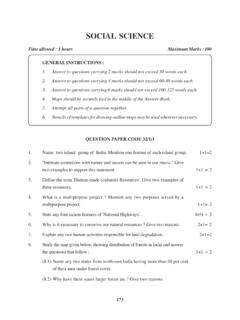
Transcription of The Question Paper will include value based …
1 83 Time : 3 Hours Marks : 90 UNIT 1. India and the Contemporary World I 2. India Land and the People 3. Democratic Politics I 4. Understanding Economic Development I 5. Disaster Management (Through Project & Assignments). TERM 2 23 23 22 22 - TOTAL 90 The Question Paper will include value based Question (s) To the extent of 3-5 marks. The Problem Solving Assessment will be conducted for all students of class IX in Jan Feb 2013 and the details are available in a separate circular. The `Problem Solving Assessment ( cbse -PSA) will be counted towards FA-4 which is 10% of total assessments of Class IX. This assessment will also be carried forward towards the FA-4 in Class X. This score will be reflected in one Language (English or Hindi), Mathematics, Science and social Science the session 2012-2013 for Class IX and 2013 14 for Class X.
2 The same score will be reflected in FA-4 for class IX and Class X. The students will have the option to improve their PSA Score in Class X, as they can sit for the test with Class IX students of the Session 2013-2014 in January February 2014. The best scores will be reflected in the final certificate in case of those applying for improvement. The schools which have already planned their time table and other details regarding FA-4 will take the best scores of FA-3 and FA-4 to count towards the total 10%, now available for FA-3 and FA-4 taken together. Annexure G Visit For All NCERT solutions, cbse sample papers, Question papers, Notes for Class 6 to 12 Please Visit For Video lectures of all subjects Class 9 to 12 social Science (087) Class IX SA-II 84 The prescribed syllabus will be assessed using formative and summative assessments in the following manner: Term I Term-II PSA Total Formative Assessment 1 and 2, 3 and 4 20% 10% 10% 40% Summative Assessment 30% 30% 60% Total 50% 40% 10% 100% The formative assessment will comprise of Projects, assignments, activities and Class Tests/ periodic tests for which Board has already issued guidelines to the schools.
3 The Summative Assessment will comprise of Theory Paper as per the prescribed design of the Question Paper . Class IX Unit 1 : India and the Contemporary World I 40 Periods Themes Objectives Term II Sub-unit : Economies and Livelihoods The themes in this section will focus on how different social groups grapple with the changes in the contemporary world and how these changes affect their lives. Any one theme of the following: 1. Pastoralists in the modern world. (a) Pastoralism as a way of life. (b) Different forms of pastoralism. (c) What happens to pastoralism under colonialism and modern states? Case studies: focus on two pastoral groups, one from Africa and one from India. (Chapter 5) 2. Forest society and colonialism : (a) Relationship between forests and livelihoods.
4 (b) Changes in forest societies under colonialism. Case studies: focus on two forest movements one in colonial India (Bastar) and one in Indonesia. (Chapter 4) 3. Farmers and peasants : (a) Histories of the emergence of different forms of farming and peasant societies. (b) Changes within rural economies in the modern world. Case studies : focus on contrasting forms of rural change and different forms of rural societies (expansion of large-scale wheat and cotton farming in USA, rural economy and the Agricultural Revolution in England, and small peasant production in colonial India) (Chapter 6) Consider what happens to pastoralists and pastoralism in the modern world, with the formation of modern states, marking of boundaries, processes of sedentarization, contraction of pastures, and expansion of markets.
5 Points to the varying patterns of developments within pastoral societies in different places. Look at the impact of colonialism on forest societies, and the implication of scientific forestry. Discuss the social and cultural world of forest communities through the study of specific revolts. Understand how oral traditions can be used to explore tribal revolts. Show the different processes through which agrarian transformation may occur in the modern world. Understand how agricultural systems in India are different from that in other countries. Familiarize students with the idea that large scale farming, small scale production, shifting agriculture operate on different principles and have different histories. Visit For All NCERT solutions, cbse sample papers, Question papers, Notes for Class 6 to 12 Please Visit For Video lectures of all subjects Class 9 to 12 85 Term II Sub-unit : Culture, Identity and Society The themes in this unit will consider how issues of culture are linked up to the making of contemporary world.
6 Any one of the following : 4. Sports and politics : The story of cricket (a) The emergence of cricket as an English sport. (b) Cricket and colonialism. (c) Cricket nationalism and de-colonialization. (Chapter 7) 5. Clothes and cultures. (a) A short history of changes in clothing. (b) Debates over clothing in colonial India. (c) Swadeshi and the movement for Khadi. (Chapter 8) Suggest how sports also have a history and that it is linked up with the politics of power and domination. Introduce students to some of the stories in cricket that have historical significance. Show how clothing has a history, and how it is linked to questions of cultural identity. Discuss how clothing has been the focus of intense social battles.
7 Unit 2 : India Land and the People Themes Objectives Term II 1. Climate: factors influencing the climate; monsoon its characteristics, rainfall and temperature distribution; seasons; climate and human life. (Chapter 4) 2. Natural Vegetation: vegetation types, distribution as well as altitudinal variation, need for conservation and various measures. (Chapter 5) 3. Wildlife : major species, their distribution, need for conservation and various measures. (Chapter 5) 4. Population : size, distribution, age-sex, composition, population change- migration as a determinant of population change, literacy, health, occupational structure and national population policy: adolescents as under-served population group with special needs.
8 (Chapter 6) 5. Map Work (3 marks) To understand the river systems of the country and explain the role of rivers in the evolution of human society. To find out the nature of diverse flora and fauna as well as their distribution; To develop concern about the need to protect the bio-diversity of our country; To analyze the uneven nature of population distribution and show concern about the large size of our population; To understand the various occupations of people and explain various factors of population change; To explain various dimension of national policy and understand the needs of adolescents as underserved group. Project / Activity Learners may identify songs, dances, festivals and special food preparations associated with certain seasons in their particular region, and whether they have some commonality with other regions of India.
9 Collection of material by learners on the flora and fauna of the region in which their school is situated. It should include a list of endangered species of the region and also information regarding efforts being made to save them. Posters River pollution Depletion of forests and ecological imbalance. Visit For All NCERT solutions, cbse sample papers, Question papers, Notes for Class 6 to 12 Please Visit For Video lectures of all subjects Class 9 to 12 86 Unit 3 : Democratic Politics I 40 Periods Themes Learning Objectives Term II 1. Electoral politics in democracy: Why and how do we elect representatives? Why do we have a system of competition among political parties? How has the citizens participation in electoral politics changed?
10 What are the ways to ensure free and fair elections? (Chapter 4) 2. Institutions of parliamentary democracy : How is the country governed? What does Parliament do in our democracy? What is the role of the President of India, the Prime Minister and the Council of Ministers? How do these relate to one another ? (Chapter 5) 3. Citizens rights in democracy : Why do we need rights in a constitution? What are the Fundamental Rights enjoyed by the citizen under the Indian constitution? How does the judiciary protect the Fundamental Rights of the citizen? How is the independence of the judiciary ensured (Chapter 6). Develop an appreciation of citizen s increased participation in electoral politics Recognize the significance of the Election Commission Provide an overview of central governmental structures Sensitize to the key role of the Parliament and its procedures Distinguish between nominal and real executive authorities and functions Understand the parliamentary system of executive s accountability to the legislature Develop a citizens awareness of their rights Introduction to and appreciation of the Fundamental Rights.