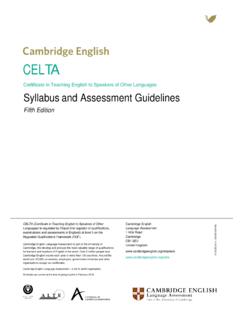
Transcription of CELTA Syllabus and assessment guidelines
1 CELTAC ertificate in Teaching English to Speakers of Other LanguagesSyllabus and assessment guidelinesJuly 2021 ContentsIntroduction 2 Syllabus overview 4 Topic descriptions 6 Topic 1 Learners and teachers, and the teaching 6 and learning context Topic 2 language analysis and awareness 7 Topic 3 language skills: reading, listening, 8 speaking and writing Topic 4 Planning and resources for different 10 teaching contextsTopic 5 developing teaching skills 11 and professionalism Course requirements and components 13of assessmentAssessment requirements 13 The two components of assessment 13 Certificate grades 14 Component 1: Planning and teaching 15 Component 2: Classroom-related 17written assignments CELTA (Certificate in Teaching English to Speakers of Other Languages) is regulated by Ofqual (the regulator of qualifications, examinations and assessments in England) at level 5 on the Regulated Qualifications Framework.
2 2 Introduction Certificate in Teaching English to Speakers of Other Languages ( CELTA )Target candidatureThe Certificate in Teaching English to Speakers of Other Languages ( CELTA ) is an introductory course for candidates who have little or no previous English language teaching experience. It may also be suitable for candidates with some experience but little previous training. Course aimsThe course enables candidates to: acquire essential subject knowledge and familiarity with the principles of effective teaching acquire a range of practical skills for teaching English to adult learners demonstrate their ability to apply their learning in a real teaching who complete the course successfully can begin working in a variety of English for Speakers of Other Languages (ESOL) teaching contexts around the overviewThis document outlines the Syllabus and assessment criteria for CELTA .
3 The following Syllabus is a reflection of the pre-service entry point of prospective candidates and outlines both the subject knowledge and the pedagogic knowledge and skills required for beginner ESOL teachers. The Syllabus consists of five specific topic areas: Topic 1 Learners and teachers, and the teaching and learning context Topic 2 language analysis and awareness Topic 3 language skills: reading, listening, speaking and writing Topic 4 Planning and resources for different teaching contexts Topic 5 developing teaching skills and overviewCELTA is awarded to candidates who have completed the course and who have met the assessment criteria for all written and practical overall assessment aims for each topic are that candidates should be able to:1.
4 Assess learner needs, and plan and teach lessons which take account of learners backgrounds, learning preferences and current needs2. demonstrate language knowledge and awareness , and appropriate teaching strategies 3. demonstrate knowledge about language skills and how they may be acquired4. plan and prepare lessons designed to develop their learners overall language competence5. demonstrate an appropriate range of teaching skills at this level and show professional awareness and frameworkThere are two components, Component One: Planning and teaching and Component Two: Classroom-related written assignments (of which there are four in total). CELTA is internally assessed and externally moderated by a Cambridge English approved assessor, who samples portfolios and teaching practice, and who discusses and agrees the grades for all 1 outlines the relationship of the assessment aims to the assessed work: indicates a main assessment area indicates a secondary assessment areaTable 1 assessment gridComponent One: Planning and teachingComponent Two: Classroom-related written assignmentsAimLesson plansTeachingAssignment 1 Assignment 2 Assignment 3 Assignment 412345 Table 2 Summary of the primary assessment tasks for each topicTopicsAssessment1.
5 Learners and teachers, and the teaching and learning contextPlanning and teaching Written assignment 12. language analysis and awarenessPlanning and teaching Written assignment 23. language skills: reading, listening, speaking and writingPlanning and teaching Written assignment 34. Planning and resources for different teaching contextsPlanning and teaching Written assignment 45. developing teaching skills and professionalismPlanning and teaching Written assignment 5 Cambridge English reserves the right to request samples of any work during and up to six months after the programmesCertificate course programmes are designed by individual centres using the Syllabus and course objectives. Courses will have a minimum of 120 contact hours including: input supervised lesson planning teaching practice (six assessed hours) feedback on teaching peer observation observation of experienced teachers (minimum six hours) consultation will need to dedicate a minimum of 80 hours for the required reading, research, pre- and post-session tasks, assignments and lesson overviewWhen classroom is referred to throughout, it may relate to the physical or online 1 Learners and teachers, and the teaching and learning context1.
6 1 Cultural, linguistic and educational Motivations for learning English as an Learning and teaching Context for learning and teaching Varieties of Multilingualism and the role of first languagesTopic 2 language analysis and awareness2 .1 Basic concepts and terminology used in ELT to discuss language form and use Grammar: grammatical frameworks: rules and conventions relating to words, sentences, paragraphs and Lexis: word formation, meaning and use in Phonology: the formation and description of English phonemes; features of connected The practical significance of similarities and differences between Reference materials for language Key strategies and approaches for developing learners language knowledgeTopic 3 language skills: reading, listening, speaking and writing3.
7 1 Basic concepts and terminology used for describing reading Purposes of Decoding Potential barriers to Basic concepts and terminology used for describing listening Purposes of Features of listening Potential barriers to Basic concepts and terminology used for describing speaking Features of spoken language Paralinguistic Phonemic Basic concepts and terminology used for describing writing Subskills and features of written Stages of teaching Adult English spelling and Key strategies and approaches for developing learners receptive and productive skills5 Topic 4 Planning and resources for different teaching contexts4 .1 Principles of planning for effective teaching of adult learners of Lesson planning for effective teaching of adult learners of Evaluation of lesson The selection, adaptation and evaluation of materials and resources in planning (including computer and other technology-based resources) Knowledge of commercially produced resources and non-published materials and classroom resources for teaching English to adultsTopic 5 developing teaching skills and professionalism5.
8 1 The effective organisation of the Classroom presence and Teacher and learner The use of teaching materials and Practical skills for teaching at a range of The monitoring and evaluation of Evaluation of the teaching/learning Professional development: Professional development: support systems6 Topic descriptionsTopic 1 Learners and teachers, and the teaching and learning contextRefSyllabus contentLearning outcomesSuccessful candidates are able to:Assessment1 .1 Cultural, linguistic and educational backgroundsunderstand the range of backgrounds and experiences that adult learners bring to their classesTeaching practice: Planning and teachingAssignment: Focus on the for learning English as an adulta.
9 Understand the different motivations and expectations that adults bring to learning Englishb. identify ways in which personal factors may affect language learningc. make practical use of this knowledge and understanding to plan and teach with sensitivityd. develop and maintain motivation, identify and respond to and teaching preferencesa. demonstrate an awareness of the different learning preferences that adults bring to learning Englishb. demonstrate an awareness of the different roles teachers may adopt at different stages of teaching and in different teaching/learning contextsc. make practical use of this awareness in planning and for learning and teaching Englisha. understand in broad terms the context in which teaching is taking place with special reference to the learners, the physical or online environment and the availability of resourcesb.
10 Understand the broad range of learning needs including the needs of learners with learning difficulties and/or disabilitiesc. make practical use of this understanding in adapting teaching to contexts and learners of Englisha. understand the main ways that varieties of English differ from one anotherb. demonstrate awareness of the need for teachers and learners to make informed choices about language models for teaching and learning c. make practical use of this knowledge and awareness in planning and and the role of first languagesunderstand the kinds of language backgrounds that learners may come from ( multilingual/monolingual; standard/non-standard) and how a learner s language background might influence the learning of 1 assessmentKey assignmentSee Focus on the learner on page teaching practice criteriaSee page 15 for criterion 4a and criteria 1a c.