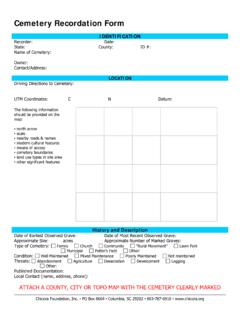
Transcription of Cemetery Disaster Planning - Chicora
1 Cemetery . Disaster . Planning . 2013 Chicora Foundation, Inc. Is your Cemetery prepared for the unexpected, such as a tornado, hurricane, earthquake, or flood? Do you have a plan to minimize damage and recover afterwards? If not, this publication can help you, your staff, and your volunteers prepare for the unthinkable. The cover photograph is of the Muncie, Indiana Beech Grove Cemetery during the March 1913 flood. Rainfall of 6 inches to 8 inches fell in Muncie from the afternoon of March 23 through the afternoon of March 26, changing to snow late on the 26th.
2 Accumulations reached 1 to 2 inches by the following day and the river crested at feet on March 25th, the highest level ever recorded. When floodwaters finally receded, at least 200 Indiana residents had lost their lives. The Great Flood of 1913 affected the entire midwestern section of the United States and resulted in at least 600 deaths. Chicora Foundation, Inc. PO Box 8664. Columbia, SC 29202-8664. 803-787-6910. TABLE OF CONTENTS. Does Your Cemetery Have A Plan 1. How Disasters Affect Your Cemetery 2.
3 Hurricanes 2. Tornadoes 3. Flooding 4. Other Disasters 5. Evaluate Your Risks 7. Getting Ready 8. Trees 8. Other Vegetation 9. Drains 9. Dangerous Monuments 10. A Lot Depends on Your Staff 11. Training 12. Budget Considerations 12. Equipment and Supplies 12. Pre-establish Contacts 13. Inventories and Mapping 14. Storage of Critical Data 14. Loss of Human Remains 15. Before the Event 16. Little or No Warning 16. Minimal Warning 17. With Adequate Time 17. After the Event 18. First, Safety 18. Documentation 19.
4 Road Clearing 20. Grounds Clearing 20. Monuments 22. Insurance 23. FEMA 24. Plot Owners 25. So You Have A Plan 25. Additional Sources 26. Cemetery Disaster Planning Cemetery Disaster Planning DOES YOUR Cemetery HAVE A PLAN? A 2005 study by the World Bank and Columbia University found that the number of disasters worldwide has been steadily increasing. Flood and wind events, in particular, have caused much greater economic loss. Much of the United States falls into a region identified as a multi-hazard, high-mortality, and total economic loss hotspot.
5 These areas will require huge amounts of future Disaster relief funding. In fact, the world's largest reinsurer, Munich Re, recently released a study showing the escalating cost of disasters . both to insurers and to those lacking insurance. Meteorological events, including tropical storms, winter storms, severe weather, hail, tornadoes, caused 59% of all losses. The other Disaster classes, including geophysical events (such as earthquakes), hydrological events (such as floods), and climatological events (such as wildfire and drought) each account for between 12 and 16% of the disasters.
6 However you look at it, the costs of not being prepared are escalating. Cemeteries can be affected by a range of significant climatic disasters, including river flooding, hurricane winds, storm surges, tornadoes, and drought. In addition, issues such as vandalism, theft, and even homelessness can cause significant harm to the Cemetery landscape. So, does your Cemetery have a plan? A plan to mitigate or minimize as much risk as possible? A plan for recovery should the unthinkable actually happen? Chances are you don't.
7 And that is likely to make the Disaster far worse through indecision and inappropriate actions. This brochure will help your Cemetery understand the risk, take precautions, and plan for recovery. But this isn't a replacement for careful study, coordination with local emergency management agencies, or discussions with your Cemetery governing board and attorney. Page 1. Chicora Foundation, Inc. HOW DISASTERS AFFECT YOUR Cemetery . It's important to understand that your Cemetery is vulnerable, as well as to realize the nature of the damage that you face.
8 Let's examine a few of the more common disasters. Hurricanes Hurricanes result in wind and water damage. A Category 1 hurricane will have sustained winds of 74-95 mph. A Category 4. hurricane will have sustained winds of 131-155 mph. These winds will damage vegetation, removing branches or entire trees. They will blow other debris into your Cemetery , including awnings, sheds and marsh grass. Even boats have been blown and washed into cemeteries. And the sand will scour stones. Trees will topple and crush monuments.
9 Debris will complicate your clean-up efforts. Salt water spray will kill or damage many plants. The wind may damage structures on your Cemetery 's property (such as your office), as well as destroy signage. You will probably be without power anywhere from a few days to weeks. Hurricane Katrina flooded this New Orleans, Louisiana Cemetery . Water is never just water. It contains sewage, toxic waste, and other contaminants. It may also include large quantities of salt that will damage your stones and kill vegetation (Photo courtesy FEMA).
10 Hurricanes may also result in a storm surge water pushed toward the shore by the force of the winds. Much of our coast lies less than 10 feet above mean sea level. The surge is dependent on local factors, forward speed, size, central pressure, and even the angle of approach to the coast, not just the category of the hurricane. You should consult NOAA weather forecasts for storm surge information. Pay particular attention to what are called the SLOSH (Sea Lake Overland Surge [from] Hurricanes) models. If your Cemetery is in a hurricane prone area (take a look at the map below), be certain that you begin Planning for hurricane season (June 1 through November 30 on the East Coast and May 15 through November 30 on the Pacific Coast).