Transcription of Chapter 1 Introduction to Construction Equipments
1 Chapter 1. Introduction to Construction Equipments General Mechanization is the process of shifting from working largely or exclusively by hand to do that work using machines. Construction projects are becoming more demanding and complicated in Construction and delay of projects would arise if conventional Construction method is used. Delays in Construction are costly and have prompted developers to embrace mechanization. Construction machineries are used in order to achieve larger output, cost-effective, execution of work that is not feasible by manual efforts, reduce the amount of heavy manual work which would cause fatigue, maintaining large output, and finalize projects on time.
2 Motivations for Mechanization of Construction Industry The work can be done speedily which avoid time and cost over-runs. Large quantity of materials can be handled, so the size of the project can be increased The complex projects involving high grade material. High quality standards can be maintained. Time schedule can be kept. Optimum use of material, man power and finance. Shortage of skilled and efficient man power. To control on the duration and cost implications by using mechanized equipment over the Conventional method, which can be used in the planning of Construction project. Lower insurance costs for builders. Easier and safer work for Construction workers. Increased sustainability over a building's lifetime.
3 Little to no building-site Construction waste. Chapter 1 Page 1. The common types of Construction Equipments to be discussed in this Chapter are: Surveying equipment Earth excavation Equipments Hauling Equipments Dozing Equipments Compaction Equipments Grading Equipments Trenchers Scrapers Tunneling and rock drilling equipment Lifting Equipments Concrete mixing Equipments Truck mixers Pumping and de- watering equipment Concrete vibrating Equipments Asphalt drum mix plants 1. Surveying Equipment Theodolites A theodolite is an instrument for measuring both horizontal and vertical angles, as used in triangulation networks. It is a key tool in surveying and engineering work, particularly on inaccessible ground.
4 A modern theodolite consists of a movable telescope mounted within two perpendicular axes, the horizontal or turn-on axis and the vertical axis. When the telescope is pointed at a desired object, the angle of each of these axes can be measured with great precision, typically on the scale of arc seconds. Total Stations A total station is an electronic/optical instrument used in modern surveying. It is an electronic theodolite (transit) integrated with an electronic distance meter (EDM) to read distances from the instrument to a particular point where an assistant staff holds reflector. Robotic total stations Chapter 1 Page 2. allow the operator to control the instrument from a distance via remote control.
5 This eliminates the need for an assistant staff member as the operator holds the reflector and controls the total station from the observed point. Automatic level It is an instrument to take levels of any surface. Good level instrument shall have property of automatic horizontal adjustment of the line of sight, an erect figure and a horizontal circle of 0 - 360 and large ribbed control buttons to simplify the adjustment of the instrument. The compensator shall be magnet damped, so that after the instrument has been set almost horizontal, the line of sight can be carefully leveled using the automatic compensation mechanism. Global Positioning System For accurate navigation in the field applying the Global Positioning System (GPS) which uses satellite signals is used for navigation.
6 GPS are available as a manageable, lightweight, waterproof (and floating) instrument with a clearly readable LCD screen. These equipment works on principle of navigation. Navigation using up to 12 satellites, WAAS enabled (Wide Area Augmentation System is System of satellites and ground stations that provide GPS signal corrections), memory for up to 500 landmarks and 50 routes. These Equipments have built-in database showing the location of towns and cities and have large user friendly control buttons and menu controlled software. They have accuracy for position less than 15 meters. The accuracy of position can be increased to within 3 meters applying WAAS. Compasses A compass is a navigational instrument for determining direction relative to the Earth's magnetic poles.
7 It consists of a magnetized pointer (usually marked on the North end) free to align itself with earth's magnetic field. A compass is any magnetically sensitive device capable of indicating the direction of the magnetic north of a planet's magnetosphere. The face of the compass generally highlights the cardinal points of north, south, east and west. Compass is used to measure horizontal angle from north-south direction. The equipment should have underlying mirror which allows very simple sighting with a high accuracy of one degree. Chapter 1 Page 3. The needles shall be rotating on sapphire bearings in antistatic fluid with adjustable declination scale. Measuring tape A tape measure or measuring tape is a flexible form of ruler.
8 It consists of a ribbon of cloth, plastic, fiber glass or metal strip with linear measurement markings. It is a common measuring tool. Its flexibility allows for a measure of great length to be easily carried in pocket or toolkit and permits one to measure around curves or corners. Surveyors use tape measures in lengths of over 100 m. Plumb Bobs A plumb bob or a plummet is a weight, usually with a pointed tip on the bottom, which is suspended from a string and used as a vertical reference line or plumb line. It is also used in surveying to establish the nadir with respect to gravity of a point in space. They are used with a variety of instruments including levels, theodolites and steel tapes to set the instrument exactly over a fixed survey marker or to transcribe positions onto the ground for placing a marker.
9 2. Earth Excavators Excavators are heavy equipment consisting of a boom, bucket and cab on a rotating platform known as the control room. The house sits atop an under carriage with tracks or wheels. All movement and functions of the excavator are accomplished through the use of hydraulic fluid, be it with rams or motors. Types of excavator : Compact excavator Crawler excavator Wheeled excavators Backhoe loader Dragline excavator Long reach excavator Power shovel Suction excavator Chapter 1 Page 4. Excavators are used in many ways: Digging of trenches, holes and foundations Material handling Brush cutting with hydraulic attachments Forestry work Demolition General grading/landscaping Heavy lift, lifting and placing of pipes Mining, especially, but not only open-pit mining River dredging Driving piles, in conjunction with a Pile Driver 1.
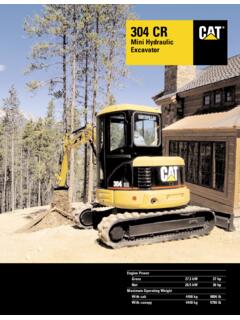
10 Compact excavator A compact or mini excavator is tracked or wheeled vehicle with an approximate operating weight from to tons. It generally includes a standard backfill blade and features independent boom swing. hydraulic Excavators are somewhat different from other Construction equipment in that all movement and functions of the machine are accomplished through the transfer of hydraulic fluid. The compact excavator 's work group and blade are activated by hydraulic fluid acting upon hydraulic cylinders. The excavator 's slew (rotation) and travel functions are also activated by hydraulic fluid powering hydraulic motors. Fig. Compact excavator 2. Crawler excavator a) mini -Crawler excavator With a wide range of available sizes and features like Power Tech engines, zero-tail-swing, offset boom, multiple attachments and ultra comfortable operator stations, there's excavator to fit Chapter 1 Page 5.