Transcription of Chapter 12 Minimum Property Requirement Overview
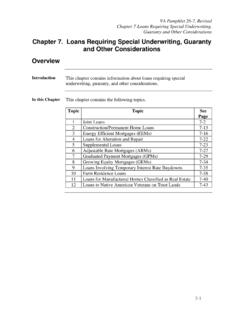
1 Chapter 12 Minimum Property Requirement Overview This Chapter contains the following topics. In this Chapter Topic Topic Name See Page 1 Minimum Property Requirement Procedures 12-32 Marketable Real Estate Entity 12-53 Space Requirements 12-64 Access 12-75 Encroachments 12-96 Drainage and Topography 12-107 Geological or Soil Instability, Subsidence, and Sinkholes 12-118 Special Flood Hazard Area 12-139 Coastal Barrier Resources System 12-1410 Lava Flow Hazard Areas 12-1511 Non-Residential Use 12-1612 Zoning 12-1713 Local Housing/Planning Authority Code Enforcement 12-1814 Utilities 12-1915 Water Supply and Sanitary Facilities 12-2016 Individual Water Supply 12-2217 Individual Sewage Disposal 12-2418 Shared Wells 12-2519 Community Water Supply/Sewage Disposal Requirements 12-2620 Hazards 12-2721 Defective Conditions 12-2822 Mechanical Systems 12-2923 Heating 12-3024 Leased Mechanical Systems and Equipment 12-3125 Alternative Energy
2 Equipment 12-32 Continued on next page VA Pamphlet 26-7, Revised Chapter 12: Minimum Property Requirements 12-21. Minimum Property Requirement Procedures, continueda. MPRs,continuedTopic Topic Name See Page 26 Roof Covering 12-3327 Attics 12-3428 Crawl Space 12-3529 Basements 12-3630 Swimming Pools 12-3731 Burglar Bars 12-3832 Lead-Based Paint 12-3933 Wood Destroying Insects/Fungus/Dry Rot 12-4034 Radon Gas 12-4235 Potential Environmental Problem 12-4336 Stationary Storage Tanks 12-4437 Mineral, Oil and Gas Reservations or Leases 12-4538 High Voltage Electric Transmission Lines 12-4639 High Pressure Gas and Liquid Petroleum Pipelines 12-4740 Properties Near Airports 12-4841 Manufactured Home Classified as Real Estate 12-4942 Modular Homes 12-5043 Energy Conservation and Sustainability 12-5144 Requests for Waiver of MPR Repairs 12-52VA Pamphlet 26-7, Revised Chapter 12: Minimum Property Requirements 12-31.
3 Minimum Property Requirement ProceduresChange Date October 18, 2019 This Chapter has been revised in its has established Minimum Property Requirements (MPRs) to protect the interests of Veterans, lenders, servicers, and VA. Properties must meet these requirements prior to guaranty of the loan by VA. b. Appraisal isNot a HomeInspectionWhile VA-assigned fee appraisers must note any readily apparent repairs that are needed, it is important to distinguish the differences between a real estate appraisal and a home inspection report. The fee appraiser will not perform operational checks of mechanical systems or appliances.
4 The fee appraiser estimates the value of the Property to ensure that it is sufficient for the amount of the proposed loan. c. Safe, Sound,SanitaryMPRs help ensure that the Property is safe, structurally sound, and sanitary. The scope of MPRs also includes issues related to the Property s location and legal considerations. d. AppraisalSubject toRepairs tomeet MPRsThe appraiser will prepare origination appraisals subject to the completion of any MPR repairs that appear to be needed and include the contributory value of the completed repairs in the estimated market value. Liquidation appraisals are prepared as-is (see Chapter 11, Topic 20 of this Handbook).
5 E. RecommendRepairs, NotInspectionsAppraisers must not prepare appraisals subject to inspections. The appraiser must recommend repairs, not inspections, for any conditions that do not appear to meet MPRs. f. CosmeticItemsThe appraiser should not recommend repairs of cosmetic items, items involving minor deferred maintenance or normal wear and tear, or items that are inconsequential in relation to the overall condition of the Property . While minor repairs should not be recommended, the appraiser should consider these items in the overall condition rating when estimating the market value of the Property .
6 Continued on next page VA Pamphlet 26-7, Revised Chapter 12: Minimum Property Requirements 12-41. Minimum Property Requirement Procedures, sheds or other improvments on the site may be included in value if the improvement meets VA s MPRs. If the improvement does not meet MPRs it must be excluded from value. If the improvement presents a health or safety hazard, the appraisal must be completed subject to the removal of the improvement. an origination appraisal is completed, the Notice of Value (NOV) that is issued to the Veteran includes a recommendation that the Veteran may wish to obtain a home inspection (see Chapter 13, Appendix A of this Handbook).
7 About MPRs concerning properties in specific locations are listed by state at j. SAHA dditional MPRs apply to Specially Adapted Housing (SAH) program cases. The Regional Loan Center (RLC) of jurisdiction should be contacted for assistance with SAH questions. VA Pamphlet 26-7, Revised Chapter 12: Minimum Property Requirements 12-52. Marketable Real Estate EntityChange Date October 18, 2019 This Chapter has been revised in its Single RealEstate EntityThe Property must be a single, readily marketable, real estate entity. b. MultipleParcelsMore than one parcel or lot may be included as long as all of the Property is contiguous and legally marketable.
8 VA does not set a limit on the number of acres that the Property may have. If the Property being appraised includes more than one parcel, the appraisal must be prepared subject to placing all of the parcels on one deed. c. Road orWaterwayDividing thePropertyIf a Property is divided by a road or waterway, the appraiser must determine the effect on the utility of the Property to ensure that the Property is a readily marketable, real estate entity. VA Pamphlet 26-7, Revised Chapter 12: Minimum Property Requirements 12-63. Space RequirementsChange Date March 28, 2019 This Chapter has been revised in its SpaceRequirementsEach living unit must have sufficient space for: living, sleeping, cooking and dining, and sanitary Non-StandardConstructionNon-standard house styles which may be unique in a market area, for example, log houses, earth sheltered houses, dome houses, and houses with lower than normal ceiling heights, must meet any local building codes.
9 The appraiser must consider the marketability of the home in the appraisal. VA Pamphlet 26-7, Revised Chapter 12: Minimum Property Requirements 12-7 4. Access Change Date March 28, 2019 This Chapter has been revised in its entirety. a. Street Access Each Property must be provided with a safe and adequate pedestrian or vehicular access from a public or private street with an all-weather surface. b. Private Road Requirements Private roads must be: protected by a permanent easement, and maintained by a homeowners association or joint maintenance agreement. c. Maintenance Agreement Signatures If a maintenance agreement does not exist, every effort should be made to obtain the agreement of all owners of properties on the private road to share the cost of maintaining the road.
10 D. RLC Approval Required if the Veteran is Accepting Additional Responsibility In the absence of an agreement signed by all owners, particularly those of properties located between the subject Property and the public road, an agreement by a Veteran to accept responsibility for a disproportionate share of the road must be reasonable in regards to the distance from the subject Property to the public road. The RLC of jurisdiction must be contacted in order to approve the agreement. VA will not accept an agreement in which the Veteran accepts sole responsibility for maintaining an unreasonable distance of the private road as this could create a burden for the Veteran as well as future Property owners.