Transcription of CHAPTER 14
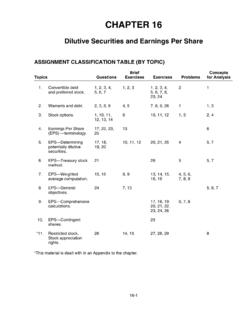
1 14-1 CHAPTER 14 Long-Term LiabilitiesASSIGNMENT CLASSIFICATION TABLE (BY TOPIC)TopicsQuestionsBriefExercisesExerc isesProblems Conceptsfor Analysis1. Long-term liability;classification; , 10, 14,201, 210, 111, 2, 32. Issuance of bonds; typesof , 3, 4, 9,10, 111, 2, 3, 4,5, 6, 73, 4, 5, 6,7, 8, 9, 10,111, 2, 3, 4,5, 6, 7, 101, 3, 63. Premium and discount;amortization , 6, 7,8, 113, 4, 6, 7,8, 104, 5, 6, 7,8, 9, 10,11, 13,14, 151, 2, 3, 4,5, 6, 7, 10,111, 2, 3, 44. Retirement and refundingof , 131112, 13,14, 152, 4, 5, 6,7, 103, 4, 55. Imputation of interest , 15, 16,17, 1812, 13, 14,1516, 17, 188, 96. Disclosures of , 20,21, 22919101, 3, 5*7. Troubled , 24, 25,26, 27, 28,291620, 21, 22,23, 24, 25,2613, 14, 15*8.
2 , 2627, 2812*This material is discussed in the Appendix to the CLASSIFICATION TABLE (BY LEARNING OBJECTIVE)Learning Objectives BriefExercisesExercisesProblems1. Describe the formal proceduresassociated with issuing long-term Identify various types of bond , 23. Describe the accounting valuationfor bonds at date of , 2, 3, 4, 5,6, 7, 83, 4, 5, 6, 7, 8,9, 10, 11, 12,13, 14, 151, 2, 3, 4, 5,6, 7, 104. Apply the methods of bond discountand , 3, 4, 5,6, 7, 8, 103, 4, 5, 6, 7, 8,9, 10, 12, 13,14, 151, 2, 3, 4, 5,6, 7, 10, 115. Describe the accounting for theextinguishment of , 13, 14, 152, 4, 5, 6,7, 106. Explain the accounting for long-termnotes , 13, 14, 1516, 17, 188, 97. Explain the reporting of off-balance sheetfinancing Indicate how to present and analyzelong-term , 10* the accounting for a , 2812* the accounting for , 21, 22,23, 24, 25,2613, 14, 1514-3 ASSIGNMENT CHARACTERISTICS TABLEItemDescriptionLevel ofDifficultyTime(minutes) E14-1 Classification of 20 20 E14-3 Entries for bond 20 E14-4 Entries for bond transactions 20 E14-5 Entries for bond transactions 20 E14-6 Amortization schedule 20 E14-7 Amortization schedule 20 E14-8 Determine proper amounts in account 20 E14-9 Entries and questions for bond 30 E14-10 Entries for bond 20 E14-11 Information related to various bond 30 E14-12 Entry for retirement of bond.
3 Bond issue 20 E14-13 Entries for retirement and issuance of 20 E14-14 Entries for retirement and issuance of 16 E14-15 Entries for retirement and issuance of 15 E14-16 Entries for zero-interest-bearing 20 E14-17 Imputation of 20 E14-18 Imputation of interest with 20 E14-19 Long-term debt 15*E14-20 Settlement of 20*E14-21 Term modification without gain debtor s 30*E14-22 Term modification without gain creditor s 30*E14-23 Term modification with gain debtor s 30*E14-24 Term modification with gain creditor s 30*E14-25 Debtor/creditor entries for settlement of troubled 20*E14-26 Debtor/creditor entries for modification of troubled 25* 25* 25 P14-1 Analysis of amortization schedule and interest 20 P14-2 Issuance and retirement of 30 P14-3 Negative 30 P14-4 Issuance and retirement of bonds; income 20 P14-5 Comprehensive bond 65 P14-6 Issuance of bonds between interest dates, straight-line, 25 P14-7 Entries for life cycle of 25 P14-8 Entries for zero-interest-bearing 25 P14-9 Entries for zero-interest-bearing note; payablein 25 P14-10 Comprehensive problem.
4 Issuance, classification, 25 P14-11 Effective-interest 50*P14-12 Loan impairment 4014-4 ASSIGNMENT CHARACTERISTICS TABLE (Continued)ItemDescriptionLevel ofDifficultyTime(minutes)*P14-13 Debtor/creditor entries for continuation of troubled 25*P14-14 Restructure of note under different 45*P14-15 Debtor/creditor entries for continuation of troubled debtwith new 50 CA14-1 Bond theory: balance sheet presentations, interest rate, 30 CA14-2 Various long-term liability conceptual 15 CA14-3 Bond theory: price, presentation, and 25 CA14-4 Bond theory: amortization and gain or loss 25 CA14-5 Off-balance-sheet 30 CA14-6 Bond issue, ethicsModerate23 3014-5 ANSWERS TO QUESTIONS1. (a) Funds might be obtained through long-term debt from the issuance of bonds, and from thesigning of long-term notes and mortgages.
5 (b) A bond indenture is a contractual agreement (signed by the issuer of bonds) between the bondissuer and the bondholders. The bond indenture contains covenants or restrictions for theprotection of the bondholders.(c) A mortgage is a document which describes the security for a loan, indicates the conditionsunder which the mortgage becomes effective (that is, conditions of default), and describes therights of the mortgagee under default relative to the security. The mortgage accompaniesa formal promissory note and becomes effective only upon default of the If the entire bond matures on a single date, the bonds are referred to as term bonds. Mortgagebonds are secured by real estate.
6 Collateral trust bonds are secured by the securities of othercorporations. Debenture bonds are unsecured. The interest payments for income bonds depend onthe existence of operating income in the issuing company. Callable bonds may be called andretired by the issuer prior to maturity. Registered bonds are issued in the name of the owner andrequire surrender of the certificate and issuance of a new certificate to complete the sale. A beareror coupon bond is not recorded in the name of the owner and may be transferred from oneinvestor to another by mere delivery. Convertible bonds can be converted into other securities ofthe issuing corporation for a specified time after issuance.
7 Commodity-backed bonds (alsocalled asset-linked bonds) are redeemable in measures of a commodity. Deep-discount bonds(also called zero-interest bonds) are sold at a discount which provides the buyer s total interestpayoff at (a) Yield rate the rate of interest actually earned by the bondholders; it is synonymous with theeffective and market rates.(b) Nominal rate the rate set by the party issuing the bonds and expressed as a percentage ofthe par value; it is synonymous with the stated rate.(c) Stated rate synonymous with nominal rate.(d) Market rate synonymous with yield rate and effective rate.(e) Effective rate synonymous with market rate and yield (a) Maturity value the face value of the bonds; the amount which is payable upon maturity.
8 (b) Face value synonymous with par value and maturity value.(c) Market value the amount realizable upon sale.(d) Par value synonymous with maturity and face A discount on bonds payable results when investors demand a rate of interest higher than the ratestated on the bonds. The investors are not satisfied with the nominal interest rate because theycan earn a greater rate on alternative investments of equal risk. They refuse to pay par for thebonds and cannot change the nominal rate. However, by lowering the amount paid for the bonds,investors can alter the effective rate of premium on bonds payable results from the opposite conditions. That is, when investors aresatisfied with a rate of interest lower than the rate stated on the bonds, they are willing to pay morethan the face value of the bonds in order to acquire them, thus reducing their effective rate ofinterest below the stated Discount (premium) on bonds payable should be reported in the balance sheet as a directdeduction from (addition to) the face amount of the bond.
9 Both are liability valuation CHAPTER 14 (Continued)7. Bond discount and bond premium may be amortized on a straight-line basis or on an effective-interest basis. The profession recommends the effective-interest method but permits the straight-line method when the results obtained are not materially different from the effective-interestmethod. The straight-line method results in an even or average allocation of the total interest overthe life of the notes or bonds. The effective-interest method results in an increasing or decreasingamount of interest each period. This is because interest is based on the carrying amount of thebond issuance at the beginning of each period.
10 The straight-line method results in a constantdollar amount of interest and an increasing or decreasing rate of interest over the life of the effective-interest method results in an increasing or decreasing dollar amount of interest anda constant rate of interest over the life of the annual interest expense will decrease each period throughout the life of the bonds. Under theeffective-interest method the interest expense each period is equal to the effective or yield interestrate times the book value of the bonds at the beginning of each interest period. When bonds aresold at a premium, their book value declines to face value over their life; therefore, the interestexpense declines Bond issuance costs according to APB Opinion No.