Transcription of CHAPTER 3
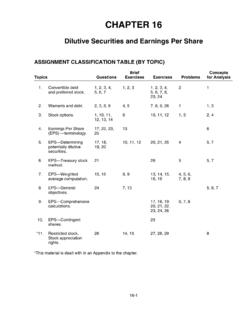
1 3-1 CHAPTER 3 The accounting Information SystemASSIGNMENT CLASSIFICATION TABLE (BY TOPIC)TopicsQuestionsBriefExercisesExerc isesProblems , 2, 3, 51, 21, 2, 3, 4, 191 , 7 , 132, 3, 41, 2, 7 , 14, 16, 173, 4, 5, 6, 7,8, 9, 105, 6, 7, 8,9, 10, 221, 2, 3, 4, 5, 6,7, 8, 9, 11 statements11, 12, 25, 261, 2, 4, 6 , 14, 181, 4, 8, 9, 11 and costof goods , 10, 11, 121112, 14, 15, 16 , 2, 6, 11* vs. Accrual Basis18, 19, 201320, 2110*10. Reversing *11. Worksheet2223, 24, 2511*These topics are dealt with in the Appendix to the CLASSIFICATION TABLE (BY LEARNING OBJECTIVE)Learning basic accounting double-entry steps in accounting transactions in journals, post to ledgeraccounts, and prepare a trial , 2, 3, 4,5, 6, 71, 2, 3, 4, 191, 4, 8, the reasons for preparing , 4, 5, 6,7, 8, 9, 105, 6, 7, 8,9, 10, 222, 3, 4, 5, 6,7, 8, 9, financial statements from the adjustedtrail , 121, 2, 4, 6,7, 8, 9, closing , 14, 181, 4, 8, 9, how to adjust inventory accountsat , 16, 17 * the cash basis of accounting fromthe accrual basis of , 2110* adjusting entries that may be * a 10-column , 24, 2511*These topics are dealt with in the Appendix to the CHARACTERISTICS TABLEItemDescriptionLevel ofDifficultyTime(minutes)
2 E3-1 Transaction analysis service 20 E3-2 Corrected trial 15 E3-3 Corrected trial 20 E3-4 Corrected trial 15 E3-5 Adjusting 15 E3-6 Adjusting 20 E3-7 Analyze adjusted 20 E3-8 Adjusting 15 E3-9 Adjusting 20 E3-10 Adjusting 30 E3-11 Prepare financial 25 E3-12 Prepare financial 25 E3-13 Closing 15 E3-14 Closing 15 E3-15 Missing 15 E3-16 Find missing amounts periodic 25 E3-17 Cost of goods sold periodic 15 E3-18 Closing entries for a 15 E3-19 Transactions of a corporation, including investmentand 15*E3-20 Cash to accrual 20*E3-21 Cash to accrual 15*E3-22 Adjusting and reversing 25* 15*E3-24 Worksheet and balance sheet 25*E3-25 Partial worksheet 15 P3-1 Transactions, financial statements service 35 P3-2 Adjusting entries and financial 40 P3-3 Adjusting 30 P3-4 Financial statements, adjusting and closing 50 P3-5 Adjusting 20 P3-6 Adjusting entries and financial 35 P3-7 Adjusting entries and financial 35*P3-8 Adjusting and 40*P3-9 Adjusting and 35*P3-10 Cash and accrual 40*P3-11 Worksheet, balance sheet, adjusting and closing 503-4 ANSWERS TO are:(a) Payment of an accounts payable.
3 (b) Collection of an accounts receivable from a customer.(c) Transfer of an accounts payable to a note (a), (b), (d) are considered business transactions and are recorded in the accountingrecords because a change in assets, liabilities, or equities has been effected as a result of a transfer ofvalues from one party to another. Transactions (c) and (e) are not business transactions because atransfer of values has not resulted, nor can the event be considered financial in nature and capable ofbeing expressed in terms of Transaction (a): Accounts Receivable (debit), Service Revenue (credit).Transaction (b): Cash (debit), Accounts Receivable (credit).
4 Transaction (c): Office Supplies (debit), Accounts Payable (credit).Transaction (d): Delivery Expense (debit), Cash (credit). and expense accounts are referred to as temporary or nominal accounts because eachperiod they are closed out to Income Summary in the closing process. Their balances are reduced tozero at the end of the accounting period; therefore, the term temporary or nominal is sometimes givento these double-entry system means that for every debit amount there must be a credit amount and vice-versa. At least two accounts are affected. It does not mean that each transaction must be it is not absolutely necessary that a trial balance be taken periodically, it is customary anddesirable.
5 The trial balance accomplishes two principal purposes:(1) It tests the accuracy of the entries in that it proves that debits and credits of an equal amount are inthe ledger.(2) It provides a list of ledger accounts and their balances which may be used in preparing thefinancial statements and in supplying financial data about the (a) Real account; balance sheet.(b) Real account; balance sheet.(c) Merchandise inventory is generally considered a real account appearing on the balance sheet. Ithas the elements of a nominal account when the periodic inventory system is used. It may appearon the income statement when the multiple-step format is used.
6 (d) Real account; balance sheet.(e) Real account; balance sheet.(f) Nominal account; income statement.(g) Nominal account; income statement.(h) Real account; balance December 31, the three days wages due to the employees represent a current liability. The relatedexpense must be recorded in this period to properly reflect the expense (a) In a service company, revenues are service revenues and expenses are operating expenses. In amerchandising company, revenues are sales revenues and expenses consist of cost of goods soldplus operating expenses.(b) The measurement process in a merchandising company consists of comparing the sales price ofthe merchandise inventory to the cost of goods sold and operating CHAPTER 3 (Continued)10.
7 The purpose of the Cost of Goods Sold account is to act as a clearing account for bringing togetherthose items directly affecting cost of goods sold for this period. Example of items that would appear inthis account are: (1) Purchases, (2) Purchase Discounts, (3) Purchase Returns, (4) Purchase Allowances,(5) Transportation-in, (6) Inventory (beginning), and (7) Inventory (ending). The ending balancerepresents the cost of goods The purpose of the Cost of Goods Sold account is to accumulate the costs of issuances frominventory. In a perpetual inventory system , when inventory is sold, Cost of Goods Sold is debited andInventory is credited. At the end of the period, Cost of Goods Sold is closed to Income On the balance sheet, the effect of the error is (1) the equipment account is understated, and (2) theCapital account (proprietorship partnership) or Retained Earnings (Corporation) is understated.
8 Onthe income statement, (1) purchases and cost of goods sold are overstated and (2) net income isunderstated. (Note to instructor: The instructor should also be ready to discuss the effect that theomission of the depreciation charge on the computer might have.)13. (a) No change.(b) Before closing, balances exist in these accounts; after closing, no balances exist.(c) Before closing, balances exist in these accounts; after closing, no balances exist.(d) Before closing, a balance exists in this account exclusive of any dividends or the income or loss forthe period; after closing, the balance is increased or decreased by the amount of net income or netloss, and decreased by dividends declared.
9 (e) No Adjusting entries are prepared prior to the preparation of financial statements in order to bring theaccounts up to date and are necessary (1) to achieve a proper matching of revenues and expenses inmeasuring income and (2) to achieve an accurate presentation of assets, liabilities and stockholders Closing entries are prepared to transfer the balances of nominal accounts to capital (retained earnings)after the adjusting entries have been recorded and the financial statements prepared. Closing entriesare necessary to reduce the balances in nominal accounts to zero in order to prepare the accounts forthe next period s Cost Salvage Value = Depreciable Cost: $3,000 $0 = $3,000.
10 Depreciable Cost Useful Life =Depreciation Expense For One Year $3,000 5 years = $600 per year. The asset was used for6 months (7/1 12/31), therefore 1/2-year of depreciation expense should be reported. Annualdepreciation X 6/12 = amount to be reported on 2007 income statement: $600 X 6/12 = $ 31 Interest ,000 Interest ,000 (To record accrued interest revenue on loan)Accrued expenses result from the same causes as accrued revenues. In fact, an accrued expense onthe books of one company is an accrued revenue to another company.* the cash basis of accounting , revenue is recorded only when cash is received and expensesare recorded only when paid.