Transcription of Chapter 16 Composites - BGU
1 577 Chapter 16 CompositesWith a knowledge of the various types of Composites ,as well as an understanding of the dependence oftheir behaviors on the characteristics, relative amounts,geometry/distribution, and properties of the con-stituent phases, it is possible to design materials withproperty combinations that are better than thosefound in the metal alloys, ceramics, and polymericmaterials. For example, in Design Example , wediscuss how a tubular shaft is designed that meetsspecified stiffness STUDYC omposites?One relatively complex composite structure is the modern ski.
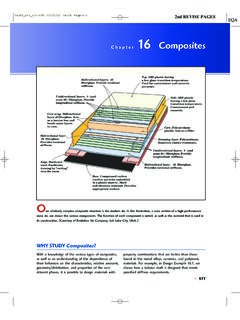
2 In this illustration, a cross section of a high-performancesnow ski, are shown the various components. The function of each component is noted, as well as the material that is used inits construction. (Courtesy of Evolution Ski Company, Salt Lake City, Utah.)Bidirectional layers. 45 fiberglass. Provide Hardenedsteel. Facilitatesturning by cutting into the Polyurethaneplastic. Acts as a layer. chatter layers. 0 (and some 90 ) fiberglass. Provide longitudinal Compressed carbon(carbon particles embeddedin a plastic matrix). Hardand abrasion resistant.
3 Providesappropriate ABS plastic havinga low glass transition for containment and ABS plastichaving a low glasstransition and layers. 0 (andsome 90 ) fiberglass. Providelongitudinal wrap. Bidirectionallayer of fiberglass. Actsas a torsion box andbonds outer layersto layer. 45 layer. 45 torsional 12/31/05 14:08 Page 5772nd REVISE INTRODUCTIONMany of our modern technologies require materials with unusual combinations ofproperties that cannot be met by the conventional metal alloys, ceramics, and polymericmaterials.
4 This is especially true for materials that are needed for aerospace, under-water, and transportation applications. For example, aircraft engineers are increasinglysearching for structural materials that have low densities, are strong, stiff, and abrasionand impact resistant, and are not easily corroded. This is a rather formidable combina-tion of characteristics. Frequently, strong materials are relatively dense; also, increasingthe strength or stiffness generally results in a decrease in impact property combinations and ranges have been, and are yet being, ex-tended by the development of composite materials.
5 Generally speaking, a compositeis considered to be any multiphase material that exhibits a significant proportionof the properties of both constituent phases such that a better combination of prop-erties is realized. According to this principle of combined action,better propertycombinations are fashioned by the judicious combination of two or more distinctmaterials. Property trade-offs are also made for many of sorts have already been discussed; these include multiphasemetal alloys, ceramics, and polymers.
6 For example, pearlitic steels (Section )have a microstructure consisting of alternating layers of ferrite and cementite(Figure ). The ferrite phase is soft and ductile, whereas cementite is hard andvery brittle. The combined mechanical characteristics of the pearlite (reasonablyhigh ductility and strength) are superior to those of either of the constituent are also a number of Composites that occur in nature. For example, woodconsists of strong and flexible cellulose fibers surrounded and held together by astiffer material called lignin.
7 Also, bone is a composite of the strong yet soft pro-tein collagen and the hard, brittle mineral composite, in the present context, is a multiphase material that is artificiallymade,as opposed to one that occurs or forms naturally. In addition, the constituentphases must be chemically dissimilar and separated by a distinct interface. Thus,most metallic alloys and many ceramics do not fit this definition because their mul-tiple phases are formed as a consequence of natural designing composite materials, scientists and engineers have ingeniouslycombined various metals, ceramics, and polymers to produce a new generation ofaLearning ObjectivesAfter careful study of this Chapter you should be able to do the the three main divisions of compositematerials.
8 And cite the distinguishing feature the difference in strengthening mechanismfor large-particle and dispersion-strengthenedparticle-reinforc ed the three different types of fiber-reinforced Composites on the basis of fiber lengthand orientation; comment on the distinctive me- chanical characteristics for each longitudinal modulus and longitudinalstrength for an aligned and continuous fiber-reinforced longitudinal strengths for discontinu-ous and aligned fibrous composite the three common fiber reinforcementsused in polymer-matrix Composites , and, foreach.
9 Cite both desirable characteristics the desirable features of the primary reason for the creation ofceramic-matrix and briefly describe the two subclassifica-tions of structural ofcombined action1496T_c16_577-620 12/31/05 14:08 Page 5782nd REVISE PAGES extraordinary materials. Most Composites have been created to improve combina-tions of mechanical characteristics such as stiffness, toughness, and ambient andhigh-temperature composite materials are composed of just two phases; one is termed thematrix,which is continuous and surrounds the other phase, often called the properties of Composites are a function of the properties of the con-stituent phases, their relative amounts, and the geometry of the dispersed phase.
10 Dispersed phase geometry in this context means the shape of the particles andthe particle size, distribution, and orientation; these characteristics are representedin Figure simple scheme for the classification of composite materials is shown in Fig-ure , which consists of three main divisions: particle-reinforced, fiber-reinforced, Introduction 579 DispersedphaseMatrixphase(c)(b)(a)(d)(e) Figure representations of the various geometrical and spatialcharacteristics of particles of the dispersed phase that may influence the properties ofcomposites: (a) concentration, (b) size, (c) shape, (d) distribution, and (e) orientation.