Transcription of Chapter 19 Angular Momentum
1 Chapter 19 Angular Momentum Introduction .. 1 Angular Momentum about a Point for a Particle .. 2 Angular Momentum for a Point Particle .. 2 Right-Hand-Rule for the Direction of the Angular Momentum .. 3 Example Angular Momentum : Constant Velocity .. 4 Example Angular Momentum and Circular Motion .. 5 Example Angular Momentum About a Point along Central Axis for Circular Motion .. 5 Torque and the Time Derivative of Angular Momentum about a Point for a Particle .. 8 Conservation of Angular Momentum about a Point .. 9 Example Meteor Flyby of Earth .. 10 Angular Impulse and Change in Angular Momentum .. 12 Angular Momentum of a System of Particles .. 13 Example Angular Momentum of Two Particles undergoing Circular Motion .. 14 Example Angular Momentum of a System of Particles about Different Points .. 15 Angular Momentum and Torque for Fixed Axis Rotation.
2 17 Example Circular Ring .. 20 Principle of Conservation of Angular Momentum .. 21 Example Collision Between Pivoted Rod and Object .. 22 External Angular Impulse and Change in Angular Momentum .. 26 Example Angular Impulse on Steel Washer .. 26 19-1 Chapter 19 Angular Momentum The situation, in brief, is that newtonian physics is incapable of predicting conservation of Angular Momentum , but no isolated system has yet been encountered experimentally for which Angular Momentum is not conserved. We conclude that conservation of Angular Momentum is an independent physical law, and until a contradiction is observed, our physical understanding must be guided by it. 1 Dan Kleppner Introduction When we consider a system of objects, we have shown that the external force, acting at the center of mass of the system, is equal to the time derivative of the total Momentum of the system, Fext=d psysdt.
3 ( ) We now introduce the rotational analog of Equation ( ). We will first introduce the concept of Angular Momentum for a point-like particle of mass m with linear Momentum p about a point S, defined by the equation LS= rS p, ( ) where Sr is the vector from the point S to the particle. We will show in this Chapter that the torque about the point S acting on the particle is equal to the rate of change of the Angular Momentum about the point S of the particle, S=d LSdt. ( ) Equation ( ) generalizes to any body undergoing rotation. We shall concern ourselves first with the special case of rigid body undergoing fixed axis rotation about the z-axis with Angular velocity = z k. We divide up the rigid body into N elements labeled by the index i, 1,2,iN=.., the ith element having mass im and position vector ,Sir . The rigid body has a moment of inertia SI about some point S on the fixed axis, (often taken to be the z-axis, but not always) which rotates with Angular velocity about this axis.
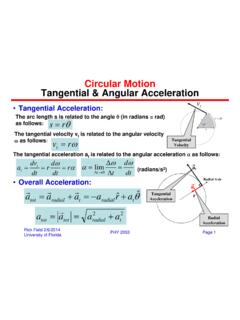
4 The Angular Momentum is then the vector sum of the individual Angular momenta, 1 Kleppner, Daniel, An Introduction to Mechanics (1973), p. 307. 19-2 LS= LS,ii=1i=N = rS,i pii=1i=N ( ) When the rotation axis is the z-axis the z-component of the Angular Momentum , LS,z, about the point S is then given by LS,z=IS z. ( ) We shall show that the z-component of the torque about the point S, S,z, is then the time derivative of the z-component of Angular Momentum about the point S, S,z=dLS,zdt=ISd zdt=IS z. ( ) Angular Momentum about a Point for a Particle Angular Momentum for a Point Particle Consider a point-like particle of mass m moving with a velocity v (Figure ). Figure A point-like particle and its Angular Momentum about S. The linear Momentum of the particle is m=pv.
5 Consider a point S located anywhere in space. Let Sr denote the vector from the point S to the location of the object. Define the Angular Momentum SL about the point S of a point-like particle as the vector product of the vector from the point S to the location of the object with the Momentum of the particle, SS= Lrp . ( ) The derived SI units for Angular Momentum are [kg m2 s 1]=[N m s]=[J s]. There is no special name for this set of units. Because Angular Momentum is defined as a vector, we begin by studying its magnitude and direction. The magnitude of the Angular Momentum about S is given by 19-3 sinSS =Lrp , ( ) where is the angle between the vectors and p , and lies within the range [0] (Figure ). Analogous to the magnitude of torque, there are two ways to determine the magnitude of the Angular Momentum about S. Figure Vector diagram for Angular Momentum .
6 Define the moment arm, r , as the perpendicular distance from the point S to the line defined by the direction of the Momentum . Then r = rSsin . ( ) Hence the magnitude of the Angular Momentum is the product of the moment arm with the magnitude of the Momentum , LS=r p. ( ) Alternatively, define the perpendicular Momentum , p , to be the magnitude of the component of the Momentum perpendicular to the line defined by the direction of the vector rS. Thus sinp =p . ( ) We can think of the magnitude of the Angular Momentum as the product of the distance from S to the particle with the perpendicular Momentum , LS= rSp . ( ) Right-Hand-Rule for the Direction of the Angular Momentum 19-4 We shall define the direction of the Angular Momentum about the point S by a right hand rule. Draw the vectors Sr and p so their tails are touching.
7 Then draw an arc starting from the vector Sr and finishing on the vector p . (There are two such arcs; choose the shorter one.) This arc is either in the clockwise or counterclockwise direction. Curl the fingers of your right hand in the same direction as the arc. Your right thumb points in the direction of the Angular Momentum . Figure The right hand rule. Remember that, as in all vector products, the direction of the Angular Momentum is perpendicular to the plane formed by Sr and p . Example Angular Momentum : Constant Velocity A particle of mass m= moves as shown in Figure with a uniform velocity 11 = + vij . At time t, the particle passes through the point ( , ). Find the direction and the magnitude of the Angular Momentum about the origin (point O) at time t. Figure Example 19-5 Solution: Choose Cartesian coordinates with unit vectors shown in the figure above.
8 The vector from the origin O to the location of the particle is rO= i+ j. The Angular Momentum vector LO of the particle about the origin O is given by: LO= rO p= rO m v=( i+ j) (2kg)( s 1 i+ s 1 j)=0+12kg m2 s 1 k 18kg m2 s 1( k)+ 0= 6kg m2 s 1 k. In the above, the relations ,, = = = =ijkjikiijj0 were used. Example Angular Momentum and Circular Motion A particle of mass m moves in a circle of radius r at an Angular speed about the z-axis in a plane parallel to the x-y plane passing through the origin O (Figure ). Find the magnitude and the direction of the Angular Momentum LO relative to the origin. Figure Example Solution: The velocity of the particle is given by r =v . The vector from the center of the circle (the point O) to the object is given by rO=r r. The Angular Momentum about the center of the circle is the vector product LO= rO p= rO m v=rmv k=rmr k=mr2 k.
9 The magnitude is LO=mr2 , and the direction is in the +k-direction. Example Angular Momentum About a Point along Central Axis for Circular Motion A particle of mass m moves in a circle of radius r at an Angular speed about the z- axis in a plane parallel to but a distance h above the x-y plane (Figure ). (a) Find the 19-6 magnitude and the direction of the Angular Momentum LO relative to the origin O. (b) Find the z-component of LO. Figure Example Solution: We begin by making a geometric argument. Suppose the particle has coordinates (,,)xyh. The Angular Momentum about the origin O is defined as LO= rO m v. ( ) The vectors rO and v are perpendicular to each other so the Angular Momentum is perpendicular to the plane formed by those two vectors. The speed of the particle is vr =. Suppose the vector rO forms an angle with the z-axis.
10 Then LO forms an angle 90 with respect to the z-axis or an angle with respect to the x-y plane as shown in Figure Figure Direction of LO Figure Direction of LO sweeps out a cone The magnitude of LO is 19-7 LO= rOm v=m(h2+(x2+y2))1/2r . ( ) The magnitude of LO is constant, but its direction is changing as the particle moves in a circular orbit about the z-axis, sweeping out a cone as shown in Figure We draw the vector LO at the origin because it is defined at that point. We shall now explicitly calculate the vector product. Determining the vector product using polar coordinates is the easiest way to calculate LO= rO m v. We begin by writing the two vectors that appear in Eq. ( ) in polar coordinates. We start with the vector from the origin to the location of the moving object, rO=x i+y j+h k=r r+h k where 221/2()rxy=+.