Transcription of Chapter 2 Electrochemical Sensors
1 27 Chapter 2 Electrochemical SensorsChapter 2 ElectrochemicalSensorsThe oldest Electrochemical Sensors date back tothe 1950s and were used for oxygen recently, as the Occupational Safety andHealth Administration (OSHA) began requiring themonitoring of toxic and combustible gases in confinedspace applications, new and better electrochemicalsensors have been the mid-1980s, miniaturized electrochemicalsensors became available for detection of many dif-ferent toxic gases in PEL ranges, with the Sensors ex-hibiting good sensitivity and selectivity.
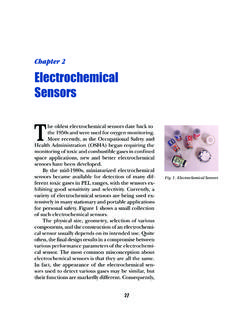
2 Currently, avariety of Electrochemical Sensors are being used ex-tensively in many stationary and portable applicationsfor personal safety. Figure 1 shows a small collectionof such Electrochemical physical size, geometry, selection of variouscomponents, and the construction of an electrochemi-cal sensor usually depends on its intended use. Quiteoften, the final design results in a compromise betweenvarious performance parameters of the electrochemi-cal sensor . The most common misconception aboutelectrochemical Sensors is that they are all the fact, the appearance of the Electrochemical sen-sors used to detect various gases may be similar, buttheir functions are markedly different.
3 Consequently,Fig. 1. Electrochemical Sensors28 Hazardous Gas Monitorsone can expect varying performance from each ofthese Sensors , in terms of sensitivity, selectivity, re-sponse time, and operating example, a low concentration gas sensor withvery high sensitivity uses a coarse-porosity hydrophobicmembrane and less restricted capillary to allow moregas molecules to pass through to produce enough sig-nal for better sensitivity. However, this design also al-lows more of the electrolyte s water molecules to es-cape out to the environment. In other words, an elec-trochemical sensor with high sensitivity would have arelatively short operating life due to evaporation ofmoisture through the porous , the electrolyte composition and the sens-ing electrode material is selected based on the chemi-cal reactivity of the target gas.
4 By careful selection ofthe electrolyte and/or the sensing electrode, one canachieve the selectivity towards the target gas, but thesensitivity may be summary, different Electrochemical Sensors mayappear very similar, but are constructed with differ-ent materials including such critical elements as sens-ing electrodes, electrolyte composition, and porosityof hydrophobic barriers. Additionally, some electro-chemical Sensors use external electrical energy tomake them reactive to the target gas. All componentsof the Sensors play a crucial role in determining theoverall characteristics of the of OperationElectrochemical Sensors operate by reacting withthe gas of interest and producing an elec-trical signal proportional to the gas concen-tration.
5 A typical Electrochemical sensor con-sists of a sensing electrode (or working elec-trode), and a counter electrode separated by athin layer of electrolyte, Figure that comes in contact with the sensorAnodeCathodeElectrolyte+ Micro AmmeterGas MoleculesFig. 2 Basic SensorHydrophobicMembraneCapillaryDiffus ionBarrierSensing ElectrodeReference ElectrodeCounter ElectrodeElectrolyteFig. 3 Typical Electrochemical sensor Setup29 Chapter 2 Electrochemical Sensorsfirst passes through a small capillary-type opening andthen diffuses through a hydrophobic barrier, and even-tually reaches the electrode surface.
6 This approach isadopted to allow the proper amount of gas to react atthe sensing electrode to produce a sufficient electri-cal signal while preventing the electrolyte from leak-ing out of the sensor , Figure gas that diffuses through the barrier reacts atthe surface of the sensing electrode involving either anoxidation or reduction mechanism. These reactions arecatalyzed by the electrode materials specifically devel-oped for the gas of a resistor connected across the electrodes, acurrent proportional to the gas concentration flows be-tween the anode and the cathode.
7 The current can bemeasured to determine the gas concentration. Becausea current is generated in the process, the electrochemi-cal sensor is often described as an amperometric gas sensoror a micro fuel of a Reference Electrode. For a sen-sor requiring an external driving voltage, it is impor-tant to have a stable and constant potential at the sens-ing electrode. In reality, the sensing electrode potentialdoes not remain constant due to the continuous elec-trochemical reaction taking place on the surface of theelectrode. It causes deterioration of the performanceof the sensor over extended periods of time.
8 To improvethe performance of the sensor , a reference electrode reference electrode is placed within the elec-trolyte in close proximity to the sensing electrode. Afixed stable constant potential is applied to the sens-ing electrode. The reference electrode maintains thevalue of this fixed voltage at the sensing electrode. Nocurrent flows to or from the reference electrode. Thegas molecules react at the sensing electrode and thecurrent flow between the sensing and the counter elec-trode is measured and is typically related directly toHydrophobicMembraneWater and GasGasElectrolyteFig.
9 4 Hydrophobic Membrane:prevents liquid electrolyte fromleaking Gas Monitorsthe gas concentration. The value of the voltage appliedto the sensing electrode makes the sensor specific to thetarget micro fuel cell-type Electrochemical Sensors do notrequire an external driving voltage. For example, an elec-trochemical sensor specific to oxygen has an anode, ei-ther Pb or Cd, that supplies electrons for the reduction ofoxygen at the cathode. During the oxidation of the an-ode, the electrons are released which then travel via anexternal circuit to the cathode where oxygen moleculesconsume the electrons as follows:In acidic electrolyteOxidation at the anode:2Pb + 2H2O 2 PbO + 4H+ + 4e-Reduction at the cathode:O2 + 4H+ + 4e- 2H2 OIn basic electrolyteOxidation at the anode:2Pb + 4OH- 2 PbO + 2H2O + 4e-Reduction at the cathode:O2 + 2H2O + 4e- 4OH-The overall reaction in both cases is.
10 2Pb + O2 types of Sensors do not require a reference ComponentsAn Electrochemical sensor consists of the following ma-jor components:A. Gas Permeable Membrane (also called hydrophobicmembrane): This is used to cover the sensor s sens-ing (catalyst) electrode and, in some instances, tocontrol the amount of gas molecules reaching theelectrode surface. Such barriers are typically madeof thin, low-porosity Teflon membranes. Such sen-sors are called membrane clad Sensors . Alternatively,the sensing electrode is covered with a high-poros-ity Teflon and the amount of gas molecules reach-ing the electrode surface is controlled by a capil-31 Chapter 2 Electrochemical Sensorslary.