Example: bachelor of science
Chapter 2 Motion in One Dimension
The average speed of the particle is absolute value of the average velocity and is given by s = Distance travelled ∆t (2.2) In general, the value of the average velocity for a moving particle depends on the initial and final times for which we have found the displacements. 2.1.3 Instantaneous Velocity and Speed
Tags:
Information
Domain:
Source:
Link to this page:
Documents from same domain

Chapter 7 Linear Momentum and Collisions
www2.tntech.eduThe value of the average force depends on the time interval chosen. 7.1.3 Conservation of Linear Momentum Linear momentum is a useful quantity for cases where we have a few particles (objects) ... again moving freely. For such an event, the two particles have well-defined momenta p1i and p2i before the
Chapter 6 Work, Kinetic Energy and Potential Energy
www2.tntech.eduThe potential energy U(r) also has units of joules in the SI system. When our physics problems involve forces for which we can have a potential energy function, we usually think about the change in potential energy of the objects rather than the work done by these forces. However for non–conservative forces, we must directly calculate
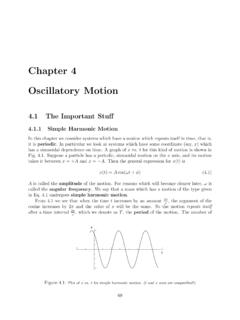
Chapter 4 Oscillatory Motion
www2.tntech.edu72 CHAPTER 4. OSCILLATORY MOTION m m (a) (b) (c) x Figure 4.3: (a) Unstretched vertical spring of force constant k (assumed massless). (b) Mass attached to spring is at equilibrium when the spring has been extended by a distance mg/k.

Worked Examples from Introductory Physics (Algebra–Based ...
www2.tntech.edu• A summary of the material in the first semester of the non–calculus physics course as I teach it at Tennessee Tech. • A set of example problems typical of those given in non–calculus physics courses solved and explained as well as I know how. It is not intended as a substitute for any textbook suggested by a professor...at least not yet!

Chapter 1 Units and Vectors: Tools for Physics
www2.tntech.eduIf two vectors are perpendicular then their scalar product is zero. The vector product (or cross product) of vectors a and b is a vector c whose mag-nitude is given by c = absinφ (1.9) where φ is the smallest angle between a and b. The direction of c is perpendicular to the

Chapter 3 Static Equilibrium
www2.tntech.eduChapter 3 Static Equilibrium 3.1 The Important Stuff In this chapter we study a special case of the dynamics of rigid objects covered in the last two chapters. It is the (very important!) special case where the center of mass of the object has no motion and the object is not rotating. 3.1.1 Conditions for Equilibrium of a Rigid Object

Chapter 1 Electric Charge; Coulomb’s Law
www2.tntech.eduChapter 1 Electric Charge; Coulomb’s Law 1.1 The Important Stuff 1.1.1 Introduction During the second semester of your introductory year of physics you will study two special types of forces which occur in nature as a result of the fact that the constituents of matter have electric charge; these forces are the electric force and the magnetic ...

Chapter 2 Electric Fields
www2.tntech.edu20 CHAPTER 2. ELECTRIC FIELDS mg F elec = qE E q = 24 mC Figure 2.2: Forces acting on the charged mass in Example 1. 1. An object having a net charge of 24µC is placed in a uniform electric field of 610 N C directed vertically. What is the mass of this object if it “floats” in the field? [Ser4 23-16] The forces acting on the mass are ...

Chapter 4 Forces I
www2.tntech.eduChapter 4 Forces I 4.1 The Important Stuff 4.1.1 Newton’s First Law With Newton’s Laws we begin the study of how motion occurs in the real world. The study of the causes of motion is called dynamics, or mechanics. The relation between force and acceleration was given by Isaac Newton in his three laws of motion, which form the

Chapter 1 Rotation of an Object About a Fixed Axis
www2.tntech.eduRotation of an Object About a Fixed Axis ... 1.1.2 Angular Displacement As a rotating object moves through an angle θ from the starting position, a mass point on the object at radius r will move a distance s; s length of arc of a circle of radius r, subtended by the angle θ.
Related documents

PHYSICS (861) - CISCE
cisce.orgspeed and velocity, average speed and average velocity, uniform velocity, instantaneous speed and instantaneous velocity, acceleration, instantaneous acceleration, s-t, v-t and a-t graphs for uniform acceleration and ons drawn conclusi from these graphs; kinematic equations of motion for objects in uniformly accelerated

Exam 1 Review Questions PHY 2425 - Exam 1
www.austincc.eduSection: 2–1 Topic: Displacement, Velocity, and Speed Type: Conceptual 12 If an object is moving at uniform speed in a straight line, its instantaneous velocity halfway through any time interval is A) greater than its average velocity. D) half of its average velocity. B) less than its average velocity.

Physics Intro & Kinematics - Department of Physics
www.phys.ufl.eduSpeed vs. Velocity • During your 8 mi. trip, which took 15 min., your speedometer displays your instantaneous speed, which varies throughout the trip. • Your average speed is 32 mi/hr. • Your average velocity is 32 mi/hr in a SE direction. • At any point in time, your velocity vector points tangent to your path. • The faster you go ...
K to 12 BASIC EDUCATION CURRICULUM SENIOR HIGH …
www.deped.gov.phspeed, average velocity, instantaneous velocity, average acceleration, and instantaneous acceleration in 2- and 3- dimensions 2. Projectile motion 3. Circular motion 4. Relative motion 2. Extend the definition of position, velocity, and acceleration to 2D and 3D using vector representation STEM_GP12KIN-Ic-21 3. Deduce the consequences of the

Practice Honors Physics Test: Newtons Laws - Weebly
asphysicsmontessori.weebly.comWhat is the car’s average acceleration? a. 0.33 m/s 2 b. 3.33 m/s 2 c. 3 m/s 2 d. 9 m/s 2 ____ 4. In the absence of air resistance, objects fall at constant a. speed. b. velocity. c. acceleration. d. distances each successive second. e. all of the above ____ 5. A ball is thrown straight up. At the top of its path its instantaneous speed is a ...
Chapter 3 Motion in Two and Three Dimensions
www2.tntech.eduThe instantaneous velocity v of a particle is always tangent to the path of the particle. 3.1.3 Acceleration If a particle’s velocity changes by ∆v in a time period ∆t, the average acceleration a for that period is a = ∆v ∆t = ∆vx ∆t i+ ∆vy ∆t j+ ∆vz ∆t k (3.10)