Transcription of Chapter 27 – Magnetic Field and Magnetic Forces
1 Chapter 27 Magnetic Field and Magnetic Forces - Magnetism- Magnetic Field - Magnetic Field Lines and Magnetic Flux- Motion of charged particles in a Magnetic Field - Applications of Motion of charged particles - Magnetic Force on a Current-Carrying Conductor- Force and Torque on a Current Loop1) A moving charge or collection of moving charges ( electric current) produces a Magnetic Field . (Chap. 28).2) A second current or charge responds to the Magnetic Field andexperiences a Magnetic force. (Chap. 27).1. MagnetismPermanent magnets: exert Forces on each other as well as on unmagnetizedFe pieces. - The needle of a compass is a piece of magnetized Fe. - If a bar-shaped permanent magnet is free to rotate, one end points north (north pole of magnet).- An object that contains Fe is not by itself magnetized, it can be attracted by either the north or south pole of permanent A bar magnet sets up a Magnetic Field in the space around it and a second body responds to that Field .
2 A compass needle tends to align with the Magnetic Field at the needle s Magnetism- Magnets exert Forces on each other just like charges. You can draw Magnetic Field lines just like you drew electric Field Magnetic north and south pole s behavior is not unlike electric magnets, like poles repel and opposite poles A permanent magnet will attract a metal like iron with either the north or south poles about our planet- We observed monopoles in electricity. A (+) or (-) alone was stable, and Field lines could be drawn around Magnets cannot exist as monopoles. If you break a bar magnet between N and S poles, you get two smaller magnets, each with its own N and S declination / Magnetic variation:the Earth s Magnetic axis is not parallel to its geographic axis (axis of rotation) a compass reading deviates from geographic inclination:the Magnetic Field is not horizontal at most of earth s surface, its angle up or down.
3 The Magnetic Field is vertical at Magnetic Poles versus electric Charge-In 1820, Oerstedran experiments with conducting wires run near a sensitive compass. The orientation of the wire and the direction of the flow both moved the compass / Faraday / Henry moving a magnet near a conducting loop can induce a The Magnetic Forces between two bodies are due to the interaction between moving electrons in the Inside a magnetized body(permanent magnet) there is a coordinated motion of certain atomic electrons. Not true for unmagnetized Magnetic FieldElectric Field :1) A distribution of electric charge at rest creates an electric Field E in the surrounding ) The electric Field exerts a force FE= q E on any other charges in presence of that Field :1) A moving charge or current creates a Magnetic Field in the surrounding space (in addition to E).
4 2) The Magnetic Field exerts a force Fmon any other moving charge or current present in that Field . - The Magnetic Field is a vector Field vector quantity associated with each point in space. sinBvqBvqFm== BvqFm =- Fmis always perpendicular to B and v. 2. Magnetic FieldInteraction of Magnetic force and charge- The moving charge interacts with the fixed magnet. The force between them is at a maximum when the velocity of the charge is perpendicular to the Magnetic Hand RulePositive chargemoving in Magnetic Field direction of force follows right hand ruleNegative charge F directioncontrary to right hand rule. =vBqFUnits:1 Tesla = 1 N s / C m = 1 N/A m1 Gauss = 10-4 TRight Hand RuleIf charged particle moves in region where both, E and B are present:)(BvEqF +=Measuring Magnetic Fields with Test Charges- In general, if a Magnetic Field (B) is present, the electron beam is deflected.
5 However this is not true if the beam is // to B ( = 0, F=0 no deflection).Ex:electron beam in a cathode X-ray deflection F = 0 v // BDeflection F 0 F v, BElectron q< 0 F has contrary direction to righthand rule- Magnetic Field lines may be traced from N toward S (analogous to the electric Field lines).- At each point they are tangent to Magnetic Field The more densely packed the Field lines, the stronger the Field at a Field lines never Magnetic Field Lines and Magnetic Flux- The Field lines point in the same direction as a compass (from N toward S).- Magnetic Field lines are not lines of force . - Magnetic Field lines have no ends they continue through the interior of the Flux and Gauss s Law for Magnetism = == AdBdABdABB cos- Magnetic flux is a scalar If B is uniform: cosBAABB== 0= = AdBB Units: 1 Weber (1 Wb = 1 T m2 = 1 N m / A)- Difference with respect to electric flux the total Magnetic flux througha closed surface is always zero.
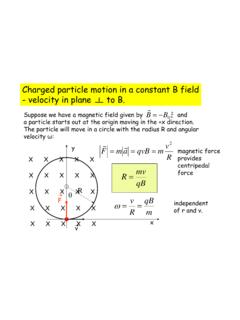
6 This is because there is no isolatedmagnetic charge ( monopole ) that can be enclosed by the Gaussian surface. - The Magnetic Field is equal to the flux per unit area across an area at right angles to the Magnetic Field = Magnetic flux density. =dAdBB4. Motion of charged particles in a Magnetic FieldBqmvR=BvqFm =- Magnetic force perpendicular to v it cannot change themagnitude of the velocity, only its direction. - F does not have a component parallel to particle s motion cannot do Motion of a charged particle under the action of a Magnetic Field alone is always motion with constant speed. - Magnitudes of F and v are constant (v perp. B) uniformcircular =Radius of circular orbitin Magnetic Field : + particle counter-clockwise particle clockwise charged particle will move in a plane perpendicular to the Magnetic If v is not perpendicular to B v//(parallel to B) constant because F//= 0 particle moves in a helix.
7 (R same as before, with v = v ).Cyclotron frequency: f = /2 Angular speed: = v/R mBqmvBqv== 5. Applications of Motion of charged ParticlesVelocity selectorSource of charged particles - particles of a specific speed can be selected from the beam using an arrangement of E and B Fm( Magnetic ) for + charge towards right (q v B).- FE ( electric ) for + charge to left (q E).- Fnet= 0 if Fm= FE -qE + q v B = 0 v = E/B- Only particles with speed E/B can pass through without being deflected by the s e/mExperiment E = K + U =0 m v2= U = e V222 VBEme=meVBEv2==e/m does not depend on the cathode material or residual gas on tube particles in the beam (electrons) are a common constituent of all Spectrometer- Using the same concept as Thompson, Bainbridge was able to construct a device that would only allow one mass in flight to reach the detector.
8 - Velocity selector filters particles with v = E/B. After this, in the region of B particles with m2 > m1travel with radius (R2 > R1).'BqmvR=6. Magnetic Force on a Current-Carrying Conductor- Total force: BvqFdm =))((BqvnAlFdm=BqvFdm=Force on one chargen = number of charges per unit volumeA l= volume IlBlBJAlBAnqvFdm===))(())()(((B wire)In general: sinIlBIlBF== Magnetic force on a straight wire segment:BlIF = Magnetic force on an infinitesimal wire section:BlIdFd =- Current is not a vector. The direction of the current flow is given by dl, not I. dl is tangent to the =7. Force and Torque on a Current Loop- The net force on a current loop in a uniform Magnetic Field is zero. Right wire of length a F = I a B (B l)Left wire of length b F = I b B sin (90 - ) (B forms 90 - angle with l)F = I b B cos - Net torque 0 (general).Fnet= F F + F - F = 0 == = =rFFrFrFr sin 00sin'= = FrF sin)2/(bFF= sin)2/(200''FbFFFF total++=+++= sin)sin)((IBAbIBatotal==Torque is zero, = 0 is angle between a vector perpendicular to loop and BTorque on a current loopA = a b sinIBAtotal= sinBtotal=AI = Magnetic dipole moment:B = Magnetic torque:Potential Energy for a Magnetic Dipole:dqp = electric dipole moment:Ep = electric torque:Potential Energy for an electric Dipole: cosBBU = = EpU =Direction: perpendicular to plane of loop (direction of loop s vector area right hand rule) Magnetic Torque: Loops and CoilsIf these loops all carry equal current I in same clockwise sense, F and torque on the sidesof two adjacent loops cancel, and only forcesand torques around boundary 0.
9 Solenoid sinNIBA=N = number of turns is angle between axis of solenoid and BMax. torque: solenoid axis B. Torque rotates solenoid to position where its axis is parallel to Dipole in a Non-Uniform Magnetic Field - Net force on a current loop in a non-uniform Field is not =Radial force components cancel each Other Fnetto polarity of magnet changes Fnetto Dipole and How Magnets WorkA solenoid and a magnet orients themselveswith axis parallel to : spinning ball of charge circulation of charge around spin axissimilar to current loop electron has net Magnetic In Fe atom, large number of electron Magnetic moments align to each other non-zero atomic Magnetic In unmagnetized Fe piece no overall alignment of of atoms total = Iron bar magnet Magnetic moments of manyatoms are parallel total A bar magnet tends to align to B, so that linefrom S to N is in direction of South and North poles represent tail and head of magnet s dipole moment.
10 How can a magnet attract an unmagnetized Fe object?1) Atomic Magnetic moments of Fe try to align to B of bar magnet Fe acquires net Magnetic dipole moment // ) Non-Uniform B attracts Magnetic Magnetic dipole produced on nail is equivalent to current loop (I direction right hand rule) net Magnetic force on nail isattractive(a) or (b) unmagnetized Fe objectis attracted to either pole of