Transcription of Chapter 3: Biological Molecules - WOU
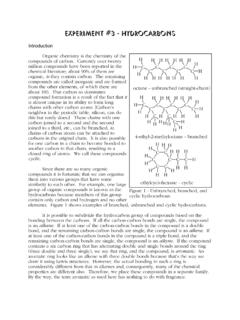
1 Chapter 3: Biological MoleculesChapter 3: Biological MoleculesNearly all Biological Molecules can be grouped into one of four general categories (Table ):CategoryGeneral Function1) Carbohydrates Energy source Structural material 2) Lipids Energy storage Structural material 3) Proteins Structural material Catalyze cell processes 4) Nucleic Acids Store genetic material Transfer genetic material Chapter 3: Biological MoleculesWhy is Carbon so Important in Biological Molecules ? Answer: Carbon is versatile Can form many covalent bonds resulting in Molecules with complex structures (chains, rings, branching)CCCC Organic: Molecules with a carbon skeleton Inorganic: Molecules without a carbon skeleton Functional Groups: Determine characteristics of Molecules Chapter 3: Biological MoleculesFunctional Groups (Table )A) Methyl GroupB) Hydroxyl GroupC) Carboxyl Group Non-polar (hydrophobic) Lipids Polar (hydrophilic) Carbohydrates Acidic (H+dissociates) Fatty acids / amino acidsD) Amino Group Basic (H+bonds) Amino acids / Nucleic acidsChapter 3: Biological MoleculesHow are Organic Molecules Synthesized?
2 Answer: They are synthesized by a modular approach Sub-units are added one to another Single sub-unit = monomer( one part ) Long chains of monomers = polymer( many parts ) Biological Molecules subtract or add water as they are joined together or broken apartChapter 3: Biological MoleculesDehydration Synthesis: To form by removing water Hydrolysis: To break apart with water Chapter 3: Biological MoleculesWhat Are Carbohydrates? Molecules composed of carbon, hydrogen, andoxygen (1:2:1) Composed of water-soluble sugar Molecules : Monosaccharide= Single sugar ( ) Disaccharide= Two sugars ( ) Polysaccharide= Many sugars ( glycogen) Important as:1) Energy source for most organisms2) Structural support (plants / insects) Chapter 3: Biological MoleculesCarbohydrates -Monosaccharides: Backbone of 3 -7 carbons = (CH2O)n Fold up into rings in solution:( glucose)Monosaccharide Types:2) 5-C Backbone (C5H10O5) Ribose/ Deoxyribose1) 6-C Backbone (C6H12O6) Glucose(most common) Fructose(corn sugar) Galactose(milk sugar)RNADNAC hapter 3: Biological MoleculesCarbohydrates -Disaccharides.
3 Two sugar Molecules linked (dehydration synthesis):(Figure ) Short-term energy storageDisaccharide Types:1) Sucrose= Glucose + Fructose2) Lactose= Glucose + Galactose3) Maltose= Glucose + GlucoseChapter 3: Biological MoleculesCarbohydrates -Polysaccharides: Multiple sugar Molecules linked together1) Long term energy storage:A) Starch(1000 -500,000 glucose Molecules ) Found in roots and seeds (plants)(Figure ) Chapter 3: Biological MoleculesCarbohydrates -Polysaccharides: Multiple sugar Molecules linked together1) Long term energy storage:A) Starch (1000 -500,000 glucose Molecules ) Found in roots and seeds (plants)B) Glycogen(1000 -100,000 glucose Molecules -many branches) Found in skeletal muscle and liver (animals) Chapter 3: Biological MoleculesCarbohydrates -Polysaccharides: Multiple sugar Molecules linked together2) Structural Material:A) Cellulose(Plants-composes cell wall) Not digestible by most animals (fiber in diet)Starch(Digestible)Cellulose(Indiges tible)Carbohydrates -Polysaccharides: Multiple sugar Molecules linked together2) Structural Material:A) Cellulose (Plants -composes cell wall) Not digestible by most animals (fiber in diet) Chapter 3.
4 Biological MoleculesB) Chitin (Exoskeleton-insects / crabs / spiders) Nitrogen functional groups attached to glucose sub-units( ) Chapter 3: Biological MoleculesWhat Are Lipids? Molecules composed almost entirely of carbon and hydrogen with non-polar carbon-carbon bonds (Hydrophobic)Types of Lipids:1) Oils & Fats: Composed of carbon, hydrogen, and oxygenForm Chains:Function: Energy Storage3 fatty acid sub-units (CH2w/ COOH)& GlycerolFats / Oils = Calories / gramChapter 3: Biological MoleculesFat & Oil Formation: Dehydration synthesis of 3 fatty acids and a glycerolChapter 3: Biological MoleculesWhy are fats solid at room temperature and oils liquid at room temperature?
5 Answer: Variation in Fatty Acid StructureSaturated Fatty Acids:Unsaturated Fatty Acids: Double bonds present in C chains Not saturated with hydrogen Form kinked chains Carbon chains have single bonds Saturated with hydrogen Form straight chainsChapter 3: Biological MoleculesWhat Are Lipids? Molecules composed almost entirely of carbon and hydrogen with non-polar carbon-carbon bonds (Hydrophobic)Types of Lipids:1) Oils & Fats2) Waxes: Similar in structure of saturated fats (solid at room temp.)Functions:1) Form waterproofouter covering2) StructuralmaterialChapter 3: Biological MoleculesWhat Are Lipids? Molecules composed almost entirely of carbon and hydrogen with non-polar carbon-carbon bonds (Hydrophobic)(Figure )Types of Lipids:1) Oils & Fats2) Waxes:3) Phospholipids: Similar in structure to fats / oils except 1 of 3 fatty acidsreplaced by phosphate group Found in plasma membrane of cellsChapter 3: Biological MoleculesWhat Are Lipids?
6 Molecules composed almost entirely of carbon and hydrogen with non-polar carbon-carbon bonds (Hydrophobic)CholesterolTypes of Lipids:1) Oils & Fats2) Waxes:3) Phospholipids:4) Steroids: 4 rings of carbon with functional groups attachedHormonesChapter 3: Biological MoleculesWhat Are Proteins? Molecules composed of 1 or more chains of amino acidsAmino Acids: A central carbon with four bonds:3) A hydrogen1) An amine group (-NH2)2) A carboxyl group (COOH)4) A variable group (R) Chapter 3: Biological MoleculesAmino Acids: 20 unique amino acids Amino acid characteristics depend on variable (R) groupsHydrophilicHydrophobicDisulfide Bonds Amino acids attached via dehydration synthesis:(Figure ) Chapter 3: Biological MoleculesProtein Structure Dictates Protein Function!
7 Levels of Protein Structure:3)TertiaryDisulfide bondsbetween AAsHydrophilic / phobicinteractionsbetween AAsHelixPleated Sheet2)SecondaryHydrogen bondsbetween AAs1)PrimarySequence ofamino acids4)QuaternaryHydrogen bondsbetween peptidechains (2 or more)(Hemoglobin) Chapter 3: Biological MoleculesFunctions of Proteins (Table ):3) Energy Storage( albumin)2) Structure( keratin)1) Catalyze Chemical Reactions ( amylase)4) Transport( hemoglobin)6) Hormones( insulin)5) Movement( muscle fibers)7) Poisons( venom) Chapter 3: Biological MoleculesThe Story Behind 3: Biological MoleculesWhat Are Nucleic Acids? Molecules composed of nucleotides:1) 5-carbon sugar2) Phosphate group3)Nitrogen-containing base (Variable) Chapter 3: Biological MoleculesNucleic Acid Types(based on sugar in nucleotide):1)Deoxyribonucleic Acid(DNA) Sequence of nucleotides housingthe genetic code for an organism 2)Ribonucleic Acid(RNA) A copy of the genetic code whichdirects the synthesis of proteins Chapter 3: Biological MoleculesOther Functions of Nucleotides:Cyclic NucleotidescAMPC oenzymesATPN ucleotides with ExtraPhosphate Groups Intracellularmessengers Energy transfer Molecules Assist enzymeactio